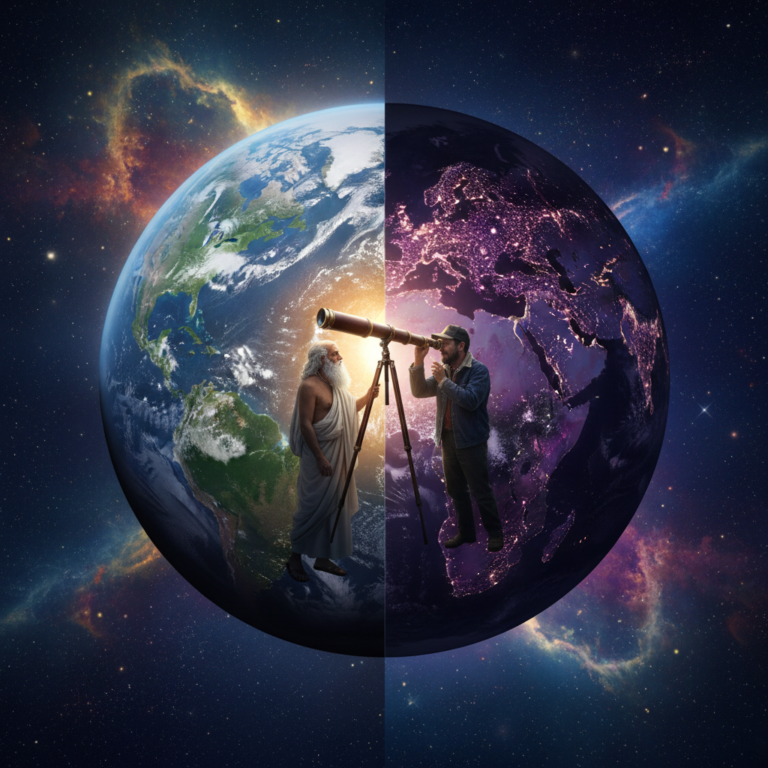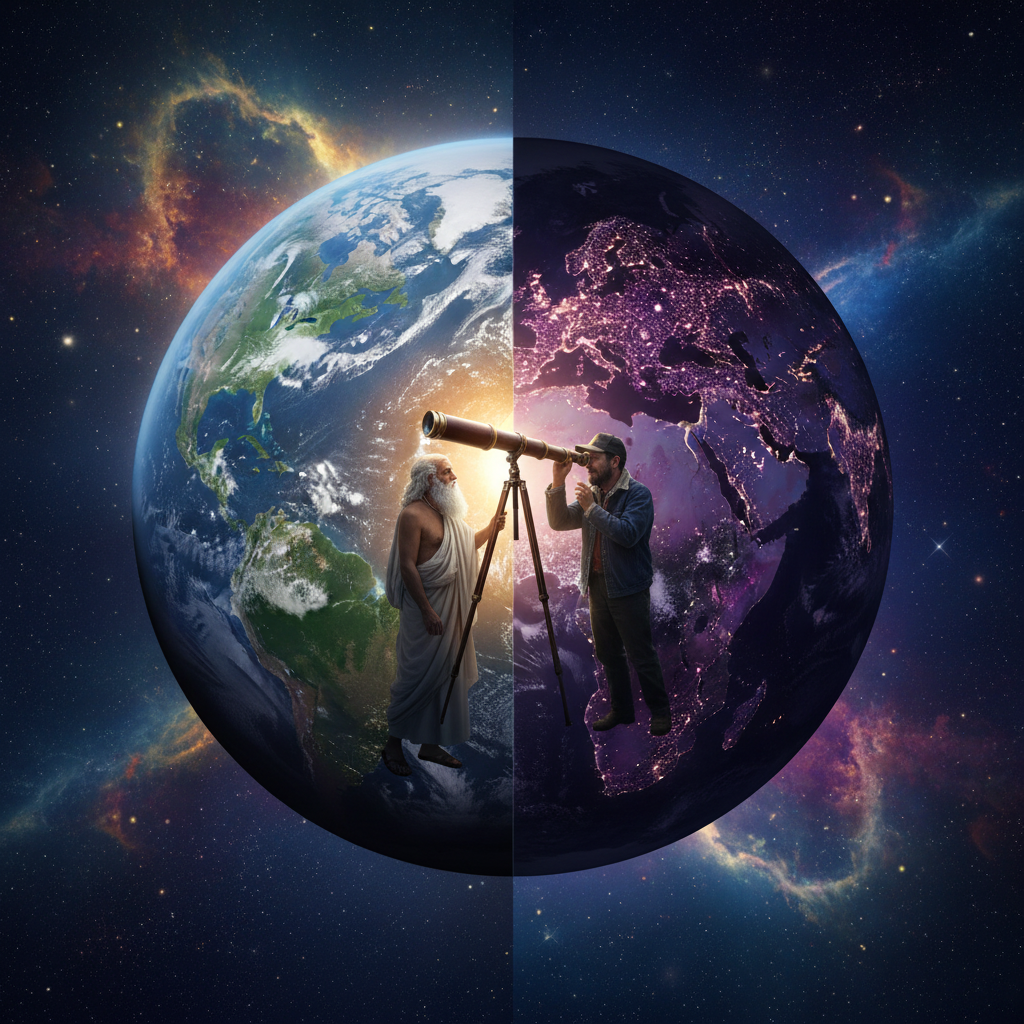
It features the double-exposure of the lush Earth-like planet and its darkened "Mirror Earth" counterpart, with Philolaus and Bethurum peering through the telescope into the "invisible" world.
Is there a “Mirror Earth” hiding in plain sight? For centuries, humanity has been haunted by the idea of an Antichthon—a Anti-Earth that shares our orbit but remains forever invisible. From the Pythagorean “Central Fire” theory to Truman Bethurum’s 1952 claims of meeting the Lady Captain of Planet Clarion, the legend suggests we are not the only residents of our orbital path. While modern astronomers use gravity and satellites to scan every inch of our solar system, the rumors of a “Planet X,” a “Dark Twin,” or a hidden world behind the Moon continue to leak from the world of underground whistleblowers. Are these worlds physical planets, interdimensional echoes, or a “Cosmic Mirror” meant to show us who we really are?
The “Anti-Earth” Phenomenon
The concept of a “Anti-Earth” or a hidden planet behind the Sun is one of the oldest mysteries in astronomy, evolving from the 5th-century BCE philosophy of Antichthon to modern-day sci-fi and exopolitical theories like Planet Clarion. However, NASA data and the laws of celestial mechanics provide a definitive answer to whether such a world could truly exist.
The NASA STEREO Proof
The strongest physical evidence against a hidden planet comes from NASA’s STEREO (Solar Terrestrial Relations Observatory) mission. Launched in 2006, these twin spacecraft—one “ahead” of Earth and one “behind”—were designed to provide a 3D view of the Sun.
As the two probes drifted away from Earth to reach opposite sides of the Sun, they gained a clear, unobstructed view of the L3 Lagrange point—the specific spot where a “Counter-Earth” would theoretically hide.
-
The Result: STEREO’s coronagraphs (specialized cameras that block out the Sun’s glare) found absolutely nothing.
-
Sensitivity: NASA confirmed that these instruments were sensitive enough to detect any object larger than 100 kilometers (62 miles) in diameter. A planet the size of Earth (12,742 km) would have been impossible to miss.
The Stability Problem: L3 Lagrange Point
Even without direct visual confirmation, the laws of physics make a hidden Earth-twin impossible over long periods. In a three-body system (Sun, Earth, and a third object), there are five equilibrium points called Lagrange Points.
-
L3 is located exactly on the opposite side of the Sun from Earth.
-
The Verdict: NASA identifies L3 as an unstable point. Unlike the stable L4 and L5 points (where “Trojan” asteroids cluster), L3 is like balancing a marble on the tip of a needle.
Because of the gravitational pull from other planets—specifically Venus, which passes within 0.3 AU of that spot every 20 months—any object at L3 would be tugged out of its “hidden” position within a few centuries and pulled into a visible orbit.
Gravitational “Fingerprints”
Planets don’t just exist; they exert weight on their neighbors. Astronomers track the orbits of planets and man-made probes with extreme precision.
-
Perturbations: If an Earth-sized mass existed at L3, its gravity would noticeably alter the orbits of Mars and Venus.
-
Navigation: NASA’s deep-space missions to the inner planets (like the Parker Solar Probe or BepiColombo) rely on complex navigational calculations. If a hidden planet were present, its gravitational “fingerprint” would have caused these probes to miss their targets entirely. No such missing mass has ever been detected.
The Search for “Real” Hidden Planets
While there is no planet behind the Sun, NASA is still hunting for hidden worlds in the outer solar system.
-
Planet Nine: Researchers at Caltech, using NASA-funded data from the WISE (Wide-field Infrared Survey Explorer) mission, have found evidence of a massive “Planet Nine” lurking far beyond Neptune.
-
Difference in Location: Unlike Clarion or Antichthon, Planet Nine is thought to be in a massive, eccentric orbit thousands of times further from the Sun than Earth, explaining why it hasn’t been visually “caught” yet.
| Name | Source | Location | Description |
| Antichthon | Philolaus (Ancient Greece) | Opposite Earth (behind “Central Fire”) | A 5th-century BC mirror planet to balance the cosmos. |
| Clarion | Truman Bethurum (1952) | Behind the Moon | A Utopian world with no war or taxes; home to Aura Rhanes. |
| Nibiru | Zecharia Sitchin / Nancy Lieder | Highly elliptical orbit | A “12th Planet” that returns every 3,600 years. |
| Planet Nine | Batygin & Brown (Caltech) | Far beyond Neptune | A theoretical Neptune-sized world detected via gravity. |
| Vulcan | 19th Century Astronomers | Between Mercury and the Sun | A “ghost planet” once used to explain Mercury’s orbit. |
This post traces the evolution of the “Anti-Earth” theory across history. We begin with the Pythagorean Counter-Earth (Antichthon), a 5th-century BC hypothesis designed to explain lunar eclipses. We then fast-forward to the 1950s contactee era, focusing on Planet Clarion, which Bethurum claimed was always obscured by the Moon—a claim that baffled scientists but captivated thousands.
The article also tackles the more ominous “Hidden Planets” of modern lore, including Nibiru (The 12th Planet) and the scientific search for Planet Nine. We analyze why a planet couldn’t actually “hide” at the L3 Lagrange point (the far side of the Sun) without being detected by gravitational perturbations or deep-space probes like NASA’s STEREO. Finally, we explore the Hollow Earth and Hollow Moon theories as “internal” hidden worlds, questioning if the “others” aren’t coming from across the galaxy, but from right under our feet.