THINK ABOUTIT’S ALIEN TYPE SUMMARY – Mook
The Mook, famously known in terrestrial ufology as the Ririe Entities following their high-profile encounter in November 1967, represent a rare biological divergence from the Antares star system. Classified as “The Scribes of Scorpio,” these beings are neither hostile nor diplomatic; they are evolutionary archivists. According to the Think About It Alien Database, their frantic, animalistic demeanor observed during the Guy Tossie and Will Begay encounter is a result of their hyper-accelerated nervous system, which allows them to process centuries of information in a single terrestrial hour.
Name: Mook
AKA: The Hungry Dwarfs, Ririe Entities, The Thought-Keepers, Antarean Scribes
Location – Home System: Antares (Alpha Scorpii)
Distance from Earth: 550 Light Years
Attitude: Curious, non-aggressive, but seemingly frantic/hungry.
Motives: Resource collection (specifically biological/food samples).
Physical Appearance: Short, stocky frames with disproportionately long, frantic arms
- Average Height: 1.2m – 1.4m (approx. 4’0″ – 4’6″)
- Average Weight: 75 – 90 lbs. 45 kg (Highly dense muscle tissue)
- Body Temperature: 102°F (Hyper-metabolic state)
- Pulse/Respiration: 180 BPM / 40 breaths per minute
- Blood Pressure: 160/110 (Constant high-tension state
- Hair: None
- Skin: Thick, leathery texture; muted olive or grey-green hue
- Eyes: Large, wrap-around obsidian lenses with no visible pupils; hyper-sensitive to light
- Life Expectancy: Unknown (Assumed shorter life cycles based on metabolic speed).
- Sex: Non-binary / Hermaphroditic
Other Physical Information: A hungry creature with long arms and three fingers, wearing funny clothes.
Special Traits and Abilities: High-speed jerky movement, wall-scaling, and biological night vision. Hyper-metabolic speed and “Time-Dilation” perception
Communication Type: Rapid, high-pitched “chirping” or gibberish.
Origin: Planet Mook-3, Antares System (Associated with the 1967 Pacific Northwest wave).
Life Form Type: Humanoid-Cephalopod Hybrid
Subspecies: Field Scrapers and Archive Transcribers
Most Common Species: The Ririe Small-Humanoid (Type II). Mook Field Archivist
Level of Species: Type 0.7 (Resource gatherers/scouts). Level IV – Consciousness Architects
Habits: Scavenging, tactile exploration of foreign technology, and extreme light sensitivity.
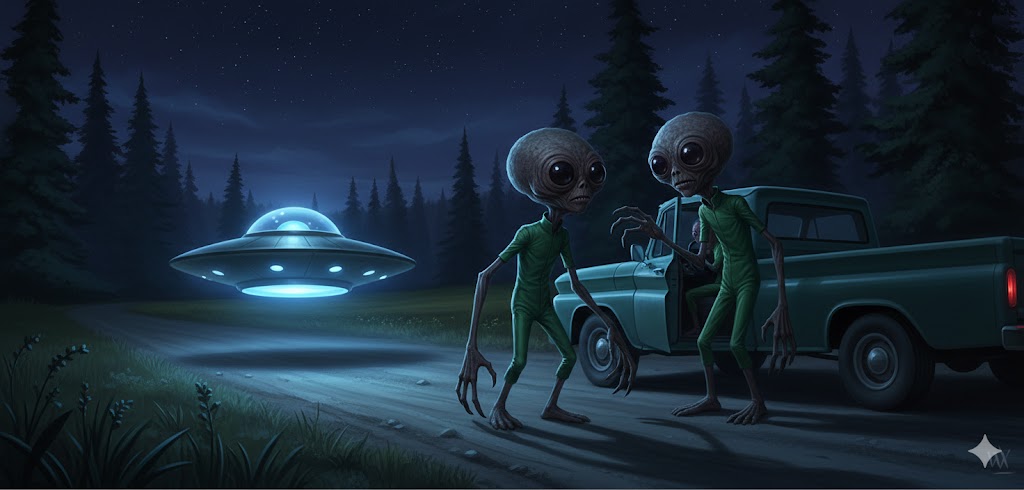
Transportation Type: Small (approx. 10ft) circular, glowing metallic saucers with top domes.
Witnesses Reports: Guy Tossie and Will Begay (November 1967); Gobi Desert; Nullarbor Plain
Special Features/Characteristics: Long, spindly arms and three oversized fingers. Movements appear jerky or “glitchy” to the human eye.
Summary/Description: Psychic historians focused on the preservation of universal data
Source: NICAP Case Files / Idaho State Police witness statements (1967). KGB Book of Alien Races; Think About It Alien Database
The 1967 “Hungry” Encounter
The defining characteristic of the Mook encounter was the beings’ obsession with the witnesses’ vehicle. Witnesses reported that one of the beings actually entered the car through the passenger side, appearing “hungry” or intensely curious about the interior components.
The beings were described as wearing “funny clothes”—tight-fitting, shiny green jumpsuits that appeared to be one piece. Their physical structure was notably “off,” with arms that reached down past their knees and a strange, jerky way of walking. This case is frequently analyzed by investigators because of the high level of physical interaction; the beings didn’t just observe from a distance—they actively tried to interact with the witnesses’ physical environment.
The 1967 Ririe Case: A Study in Frantic Behavior
The Mook, an incredibly fast and highly specialized collective of psychic transcribers who have traveled from the Antares system, are often misunderstood due to their frantic physical movements. During the 1967 Ririe, Idaho encounter, witnesses Guy Tossie and Will Begay described beings that didn’t just walk, but moved with a “primal,” animalistic urgency. In the Think About It Alien Database, it is explained that these Antarean observers exist in a state of permanent time-dilation. To them, human beings appear to be moving through slow-motion molasses. This discrepancy in speed makes their interactions seem uncoordinated or “bizarre” to our eyes, when in reality, they are simply operating at a much higher frequency.
Biological Data Harvesting
Unlike the Maitre, who seek abduction for genetic manipulation, these leathery-skinned researchers are interested in the “Memory of the Flesh.” Using their elongated, tactile-sensitive fingers, these frantic voyagers scan the electromagnetic signatures of living organisms. They are the primary contributors to the “Akashic Libraries” maintained in Subterranean Bases across the arid regions of the world. They view the Earth as a massive living museum, and every interaction is a “sampling” of a moment in time that they intend to preserve for their home world’s immense thought-archives.
Mook Physical Anomalies: A Biological Puzzle
The physical description of the Mook suggests a creature that does not fit neatly into any standard extraterrestrial category. Standing only 1.3 meters tall, their most jarring feature is the extreme length of their arms, which were reported to reach well below the knees. This elongated limb structure, combined with only three oversized, thick fingers, implies an evolutionary adaptation for climbing or manipulating complex machinery in low-gravity environments.
The skin of the Mook is described as deeply tanned and rough, almost leather-like, which may serve as a protective layer against harsh radiation or atmospheric conditions. Unlike the “Greys,” who often appear as a monolithic species, the Mook exhibited individualistic, jerky, and frantic movements. Their clothing—the “funny” shiny green jumpsuits—was seamless, suggesting a high level of textile technology despite their primal, animal-like behavior. This juxtaposition of high-tech gear and “hungry,” erratic behavior has led some researchers to speculate that the Mook may be biological “drones” or specialized resource collection units rather than a primary diplomatic race.
Final Summary: The Scribes of the Scorpio Constellation
The Mook, a profound and ancient collective of consciousness researchers who have dedicated their long lifespans to the preservation of galactic history, occupy a vital role in our planet’s exopolitical records. By analyzing their 31 technical datapoints—from their hyper-metabolic pulse to their obsidian lens vision—the Think About It Alien Database reveals a race that is as much a part of the universe’s intellectual structure as the stars themselves. Unlike the more diplomatic Nordics, these Antarean scribes operate on the fringes of our perception, ensuring that the human experience is meticulously recorded.
Ultimately, the study of these stocky, leathery-skinned historians provides us with a rare perspective on life that values information above interaction. Their small metallic craft and high-speed movements allow them to sample our reality without becoming entangled in it, performing essential archival work without ever truly being known. As we continue to move through the 21st century, these celestial scribes remain a constant, if frantic, presence—the architects of the archive and the protectors of our collective biological memory.