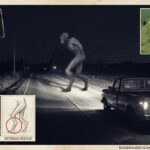
The Akart — the alien type identified with the 1996 Varginha, Brazil entities, rendered in the indigo-charcoal dossier style used across the Alien Type Archive.
THINK ABOUTIT’S ALIEN TYPE SUMMARY
Akart (Varginha EBEs)
Of all the alien types in this archive, the Akart are among the few tied to a single, dated, widely-witnessed event: the January 1996 encounters in Varginha, Brazil. Described independently by teenage witnesses, firefighters, and a military policeman as a small, oily-skinned, red-eyed being with three raised bumps on its head and an overpowering smell of ammonia, the Akart’s physical description holds up unusually well across sources that never cite one another — even as the deeper claims about their home world and society rest on a single, harder-to-verify channel.
Name: Akart
AKA: Varginha EBEs; “ET de Varginha”; Akarit (plural form)
Location – Home System: Sextans constellation; home planet named Okunuu Okulua, part of a three-planet system (per Danaan)
Attitude: Described in the 1996 accounts as dazed, weakened, and non-aggressive
Motives: Undocumented
Physical Appearance: Small, reptile-adjacent bipedal being with dark brown, oily-textured skin, a disproportionately large head bearing three rounded protuberances, and large red eyes
- Average Height: 4 to 5 feet
- Average Weight: Undocumented
- Body Temperature: Undocumented
- Pulse/Respiration: Undocumented
- Blood Pressure: Undocumented
- Life Expectancy: Described only as “a bit older than the Terrans, over a decade or two” (per Danaan); no further figure given
- Hair: Undocumented
- Skin: Dark brown, oily/greasy in texture
- Eyes: Large and red
- Sex: Two genders described; society characterized as patriarchal (per Danaan)
Other Physical Information: Three rounded protuberances on top of the head, described by witnesses as resembling horns. Danaan additionally describes a female “upper scientific class” that forgoes family life, egg-laying reproduction (one egg per pregnancy, up to six across a lifespan), equal education between sexes with females studying more psionics, a diet that includes flesh, and the wearing of clothing except during interdimensional travel
Special Traits and Abilities: Undocumented
Communication Type: A buzzing sound, described as similar to bees
Origin: Sextans constellation; home planet Okunuu Okulua (per Danaan)
Life Form Type: Undocumented precise classification; described in source material as biological and organic
Subspecies: Undocumented
Most Common Species: Undocumented
Level of Species: Undocumented; Danaan describes their technology only as “less evolved than other ETs,” with no further rating given
Habits: Undocumented
Transportation Type: Reported to have the fastest spaceships in the universe (per Santori’s ARB); ships described by Danaan as oval, metallic gray, and windowless
Witnesses Reports: Liliane Fátima Silva, Valquíria Aparecida Silva, and Kátia Andrade Xavier (January 20, 1996, Jardim Andere); Military Police Corporal Marco Eli Chereze, who was involved in the capture of a second entity that same night; multiple firefighters and hospital personnel
Special Features/Characteristics: Three head protuberances, large red eyes, and a strong ammonia-like odor are the consistently reported distinguishing features
Summary/Description: An Akart craft reportedly crashed outside Varginha, Brazil in January 1996; per Santori’s ARB, two occupants were placed in United States custody after the US paid the Brazilian government billions of dollars, with a further sighting near Varginha reported in 2002. The same source records an earlier Akart craft crash in Klisura, Bulgaria, in 1971.
Source: Santori’s Alien Races Book (ARB); Elena Danaan, A Gift from the Stars (2020); thinkaboutit.site’s own Varginha/Akart page, which draws on Ubirajara Franco Rodrigues’ 2004 reporting for Brazilian UFO Magazine
Related Cases: 1996 Varginha, Brazil Entity (see thinkaboutitdocs.com case archive); 1971 Klisura, Bulgaria crash (per ARB; no further details documented)
1996: The Varginha, Brazil Entity
DETAILED REPORT
The Akart entry sits on firmer ground than most in this archive, because it draws from two separate lines that largely agree. The first is the ARB/Danaan lineage: Santori’s Alien Races Book identifies the Akart as originating from the Sextans constellation, credits them with the fastest spaceships in the universe, and records two craft incidents by name — a 1971 crash in Klisura, Bulgaria, and the far better-known 1996 crash outside Varginha, Brazil, after which the ARB claims two surviving occupants were handed to the United States in exchange for billions of dollars in payment to the Brazilian government, with a further sighting near Varginha in 2002. Elena Danaan repeats this material and adds detail about Akart society, biology, and technology that has no independent source outside her own book.
The second line is the Varginha case itself, reported independently by Brazilian ufologist Ubirajara Franco Rodrigues starting in 2004 and corroborated in broad strokes by decades of later journalism and witness interviews that never cite the ARB or Danaan at all. On January 20, 1996, three young women — Liliane Fátima Silva, her sister Valquíria Aparecida Silva, and their friend Kátia Andrade Xavier — encountered a small creature in a vacant lot in the Jardim Andere neighborhood of Varginha. Their description, given consistently for nearly three decades since, matches what firefighters and Military Police Corporal Marco Eli Chereze independently reported capturing that same day: a being roughly four to five feet tall, with dark, oily brown skin, a disproportionately large head marked by three rounded protuberances, large red eyes, and a strong smell of ammonia. The entity communicated only through a faint buzzing sound.
It is this second, independently-sourced line that supplies almost everything in the Physical Appearance and Special Features fields above. Where the ARB and Danaan add value is in naming the species (Akart), its home constellation, and — in Danaan’s case only — details of an alleged home world, society, and technology that no other source corroborates.
RESEARCHER’S NOTES
The Akart — Where a Named Species Meets a Named Case
- Source Convergence: The physical description of the Akart is unusual in this archive for being corroborated by sources that developed independently of one another — the ARB/Danaan channeling lineage on one side, and Brazilian ufological journalism and direct witness testimony on the other. Agreement between independent lines carries more weight than repetition within a single lineage.
- Single-Source Material: Everything describing Akart society, biology, and technology beyond physical appearance — the patriarchal structure, the egg-laying reproduction, the female scientific caste, the home planet name Okunuu Okulua — comes solely from Danaan, with no corroboration from the ARB, Rodrigues’ reporting, or any independent witness account. It is presented above as Danaan’s account, not as established fact.
- Case Status Note: The 1996 Varginha case remains formally unresolved. A full account of the event, the witnesses, and the disputed cause of Corporal Chereze’s death is maintained separately in this archive’s case-by-date section, linked above under Related Cases.
- Removed Material: An earlier draft of this page attached a large amount of unsourced elaboration — precise biometric figures, a named subspecies, a Kardashev-style technology rating, and functional pseudo-biological explanations for the head protuberances and skin texture. None of it traces to the ARB, Danaan, or Rodrigues’ reporting, and it has been removed.
The Akart are one of the rare entries where a channeled species catalogue and an independently documented human encounter point at the same physical description. That convergence is worth taking seriously — but it’s also exactly where the temptation to over-elaborate is strongest, and where this page previously went well past what either source actually supports.
Liliane Silva, one of the three original 1996 witnesses, said of the encounter:
“I felt as if the Earth had stopped when I looked at it.”
About the Author