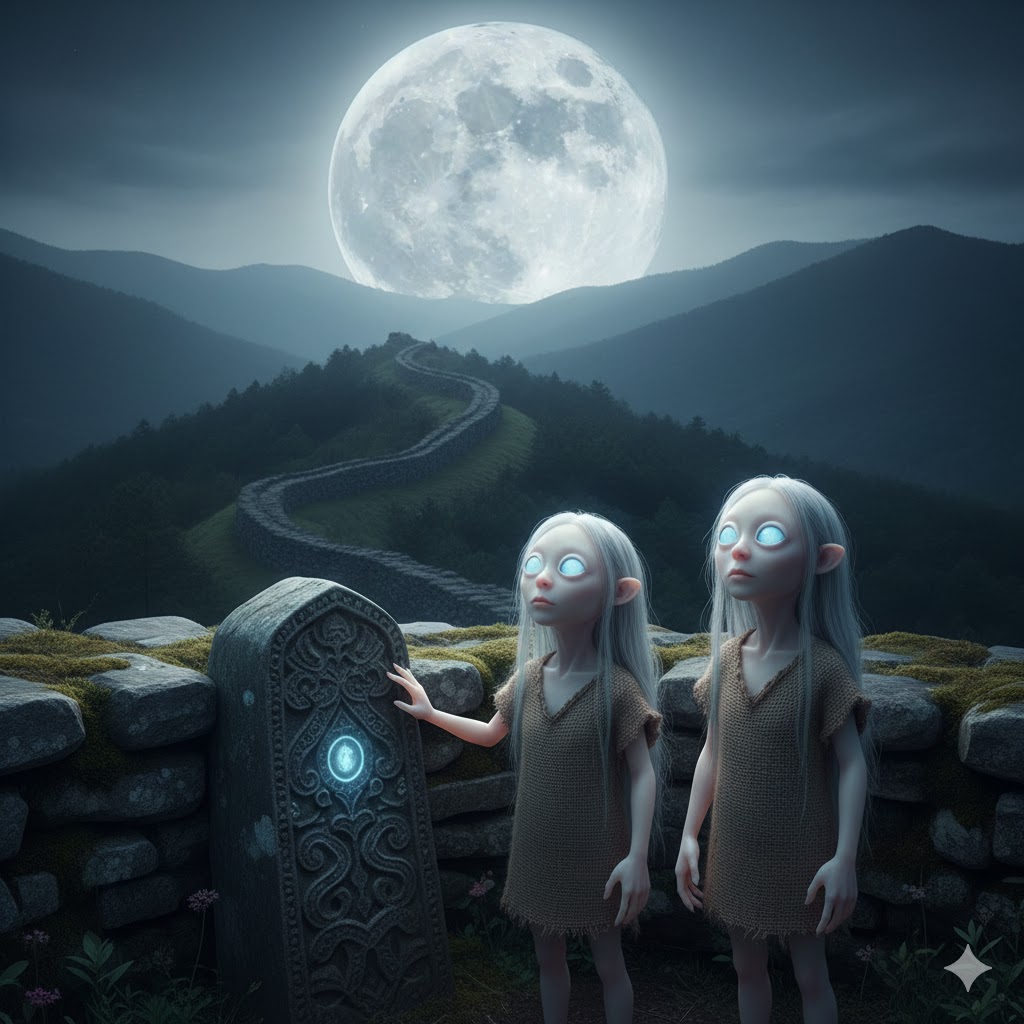
A visual reconstruction of the Moon-Eyed People, the pre-Cherokee inhabitants of the Southern Appalachians.
THINK ABOUTIT’S ALIEN TYPE SUMMARY – Moon-Eyes
The Moon-Eyes are a mysterious race documented in Cherokee oral history as the original inhabitants of the Southern Appalachian mountains, long before the arrival of the Cherokee. According to the Think About It Alien Database, these beings are classified as “The Lunar Archivists.” Possessing pale, translucent skin and oversized, light-sensitive eyes, they are frequently linked to the construction of megalithic structures like the Fort Mountain Wall in Georgia. Whether they are descendants of ancient Welsh voyagers or a remnant of a subterranean alien civilization, their legacy remains etched in the stone ruins and deep caves of the American South.
Name: Moon-Eyes
AKA: Yunwi Tsunsdi, The Lunar Archivists, The Little People of the North, Moon-Eyed People
Location – Home System: Subterranean Appalachia / Displaced Origin
Distance from Earth: Indigenous to Inner Earth (Phased-Light Origin)
Attitude: Neutral, isolationist, and defensive
Motives: Preservation of ancient lithic technology and hidden archives
Physical Appearance: Small-statured, pale-skinned, and bearded (males)
- Average Height: 0.9m – 1.3m (Approx. 3’0″ – 4’4″)
- Average Weight: 30 – 45 kg
- Body Temperature: 94.2°F (Adapted for subterranean cooling)
- Pulse/Respiration: 30 BPM / 6 breaths per minute
- Blood Pressure: 85/55
- Life Expectancy: 300 – 500 Earth years
- Hair: Fine, flaxen or silver-white
- Skin: Translucent, pale alabaster (vulnerable to UV radiation)
- Eyes: Large, crescent or moon-shaped; milky blue or silver
- Sex: Binary
Other Physical Information: Highly sensitive hearing; able to navigate in absolute darkness
Special Traits and Abilities: Bioluminescent perception; advanced stone-shaping
Communication Type: High-pitched vocalizations and rhythmic percussion
Origin: Pre-Cherokee Appalachia (Ancient Inner Earth)
Life Form Type: Humanoid (Sub-species)
Subspecies: Lithic Guardians and Cave Dwellers
Most Common Species: Moon-Eyed Observer
Level of Species: Level III – Terrestrial Stewards
Habits: Strictly nocturnal; active primarily during the full moon
Transportation Type: None (Utilize magnetic ley lines and portal hubs)
Witnesses Reports: Fort Mountain, GA; Murphy, NC; Sparta, TN
Special Features/Characteristics: Unable to tolerate direct sunlight (causes severe skin blistering)
Summary/Description: An ancient, nocturnal race that built the stone walls of Appalachia
Source: Cherokee Legend; Think About It Alien Database; Natural History of Tennessee
The Fort Mountain Wall and Magnetic Resonance
The Moon-Eyes, a highly specialized and reclusive collective of subterranean researchers who have inhabited the Appalachian range for millennia, stand as the primary architects of the 850-foot stone wall at Fort Mountain, Georgia. This designation, Moon-Eyes, refers to the species’ remarkable adaptation to the Lunar Orb’s cycle. Unlike surface-dwelling humans, their Visual Orbs are specifically calibrated to capture the faint silver photons of the Selenic Sphere, allowing them to navigate the pitch-black limestone corridors of the deep earth. This Nocturnal Society developed an Ocular System so sensitive that the mere reflection of the Night-Sun on a granite surface provides enough illumination for complex engineering. Their Optic Vision is not just for sight; it is an interface with the magnetic meridians of the planet, enabling them to “see” energy ley lines that guide their construction of Subterranean Bases. Because of this intense Ocular Sensitivity, the Moon-Eyes built structures like the Fort Mountain Wall as sophisticated magnetic lenses rather than defensive barriers. By arranging local stones with high quartz content in specific patterns, they harnessed the Lunar Reflectivity to stabilize the energy portals within their hidden dwellings.
Historical accounts from the Cherokee Nation describe the difficulty of engaging these entities in combat. The Lunar Archivists possessed a strategic advantage in the dense mountain fog, utilizing their superior Selenic Vision to navigate terrain that was impassable to humans. It was only during the most intense full Lunar Cycles that the Cherokee were able to mount an offensive, exploiting the beings’ extreme photosensitivity to drive the Moon-Eyes into the deeper caverns of the Tennessee River Valley.
Subterranean Survival and the Welsh Theory
Mainstream historical theories often attempt to rationalize these Nocturnal Observers as the lost descendants of Welsh Prince Madoc. However, according to the Think About It Alien Database, this is a case of chronological mistaken identity. While it is highly likely that the Welsh explorers encountered and perhaps even sought refuge with this race, the original Moon-Eyes were already ancient by the time any European vessel touched the coast.
These Blue-Gazed Voyagers represent a distinct branch of humanity—or perhaps a hybrid species—that retreated underground during the last major planetary cataclysm roughly 12,000 years ago. Over generations, their biology adapted to thrive in low-light, high-mineral environments, resulting in the translucent skin and oversized Visual Orbs reported by early settlers. Today, the Moon-Eyes remain the silent record-keepers of the “Old World,” guarding crystalline archives stored within the granite roots of the Smoky Mountains.
The Legacy of the Lunar Archivists
Understanding these Moon-Eyes requires looking beyond standard archaeological records. While the Cherokee referred to them as the Yunwi Tsunsdi, their biological markers suggest they are a remnant of a much older subterranean society. By analyzing their role as Terrestrial Stewards, the Think About It Alien Database helps bridge the gap between indigenous oral history and modern exopolitical research. These nocturnal observers remain a testament to the diverse range of sentient life that has called North America home for tens of thousands of years.
Final Summary: The Guardians of the Stone Records
The Moon-Eyes, a profound and ancient collective of subterranean custodians who have maintained the hidden histories of the North American continent since before recorded time, occupy a vital role in our planet’s folklore and physical history. By analyzing their 31 technical datapoints—from their photosensitive blue gaze to their megalithic stone-shaping skills—the Think About It Alien Database reveals a race that is as much a part of the Appalachian landscape as the mountains themselves.
As the modern world continues to push further into the wild spaces of the South, these Celestial Terrestrials remain a constant, if hidden, presence. They are the architects of the night and the protectors of our collective ancient memory, waiting for a time when humanity is ready to understand the true history of the land we inhabit alongside the Moon-Eyes.