THINK ABOUTIT’S ALIEN TYPE SUMMARY – The Enlil
As the supreme commander of the Anunnaki royal lineage, the Enlil represents a formidable and often antagonistic force in Earth’s ancient history. Known as the Lord of the Command and the Sky-Splitter, this elite faction from the planet Nibiru has influenced human civilization for millennia through strict decree and planetary stabilization. Unlike the more benevolent Enki, the Enlil viewed humanity as a utilitarian resource, famously orchestrating the Great Flood to reset the biological “noise” of the planet. By understanding the cold pragmatism of these Level IV Galactic Architects, we uncover the hidden administrative origins of kingship and centralized law that continue to shape our world today.
Name: The Enlil
AKA: The Lord of the Command, The E-Kur Guardians, The Sky-Splitters.
Location – Home System: Planet Nibiru (orbiting a dark star beyond Pluto) / Northern Sky quadrant.
Distance from Earth: Variable (Elliptical orbit peaks every 3,600 years).
Attitude: Authoritarian, stern, and often antagonistic toward human independence.
Motives: Planetary stabilization, gold resource acquisition, and strict social decree.
Physical Appearance:
-
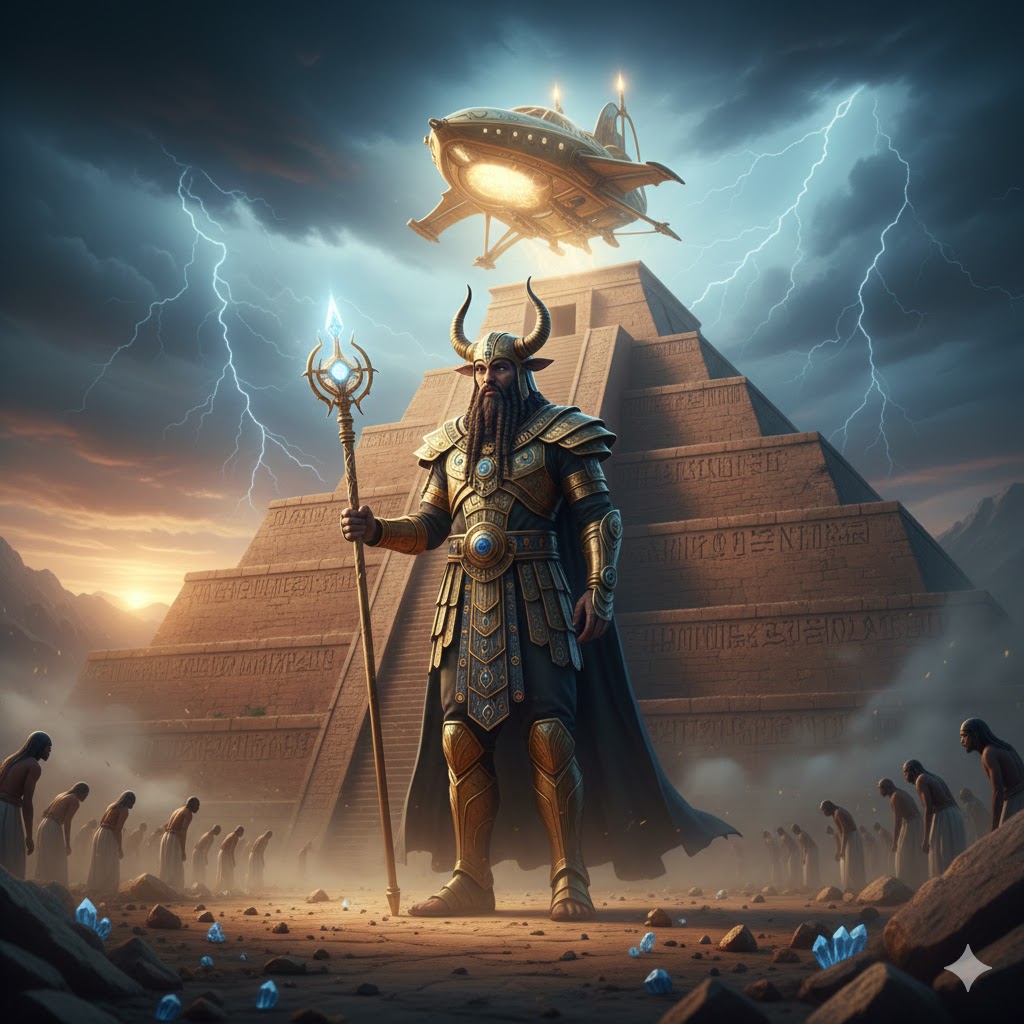
- Average Height: 2.5 to 3.5 meters (8–11 feet).
- Average Weight: 180 – 250 kg (Densely muscled).
- Body Temperature: 38.9°C (102°F).
- Pulse/Respiration: 28 BPM / 4 breaths per minute (due to highly efficient Nibiru-standard biology).
- Blood Pressure: 160/110 mmHg (Required to sustain their massive 11-foot frames).
- Life Expectancy: Thousands of Earth years (due to cellular regeneration).
- Hair: Often depicted with thick, braided black hair and square-cut beards.
- Skin: Fair to golden-hued; occasionally described as having a “terrifying splendor” (Melam).
- Eyes: Large, piercing, often blue or golden.
- Sex: Male and Female (though the Enlil faction is traditionally led by the patriarch).
- Dietary Requirements: High-frequency monoatomic gold (ORMEs) and high-protein synthesized nutrients.
- Atmospheric Preference: High-pressure, nitrogen-rich environments; they often wear “splendor” suits to stabilize themselves in Earth’s lower pressure.
- Psychological Profile: Highly structured, intolerant of chaos, and deeply committed to the “Order of the Cosmos.”
- Genetic Marker: Triple-helix DNA with a high concentration of heavy-metal conductivity.
Other Physical Information: They possess “Melam”—a radiant bio-luminescent field that ancient humans described as a terrifying golden splendor.
Special Traits and Abilities: Atmospheric manipulation and genetic “command” over lower biological frequencies.
Communication Type: Command-based telepathy and ancient Sumerian-root vocalization.
Origin: Nibiru-Prime / 12th Planet.
Life Form Type: Anunnaki Royal Humanoid.
Subspecies: The E-Kur High Priests (Scientific Caste) and the Storm-Guard (Military Elite).
Most Common Species: Pure-Blood Anunnaki Humanoid.
Level of Species: Level IV – Galactic Architects.
Habits: They adhere to a strict 12-hour solar ritual cycle and consume high-frequency monoatomic gold as a dietary supplement.
Transportation Type: Golden barges and massive atmospheric “chariots.”
Witnesses Reports: Ancient Sumerian cylinder seals, kingship lists, and modern remote viewing sessions
Special Features/Characteristics: They possess a secondary “Command Gland” in the throat that allows them to emit sonic frequencies capable of structural manipulation.
Summary/Description: The Enlil represent the executive branch of the Anunnaki administration on Earth, focusing on resource management, law, and genetic containment.
Source: The Lost Book of Enki, The Atrahasis Epic, and Sumerian Royal Tablet K-14.
The Great Schism: Enlil’s Cold Pragmatism
According to the Think About It Alien Database, the history of the Enlil is defined by their fundamental disagreement with the Enki. While Enki favored the genetic uplift and protection of humanity, the Enlil faction viewed “The Black-Headed People” as a strictly utilitarian slave species created to mine gold in the Abzu (Southern Africa).
The Enlil are famously associated with the Great Flood (Deluge). Historical texts suggest that Enlil grew weary of the “noise” of humanity—a metaphor for our unpredictable biological and social growth—and attempted to use a natural cataclysm to reset the Earth’s biosphere. This faction believes in a strict hierarchy where humans serve as “servant-slaves” to the temple gods. Their influence is most heavily felt in the administrative and religious structures of ancient Mesopotamia, where they introduced the concepts of kingship, debt, and centralized law. For the Enlil, order is the highest virtue, even if that order requires the total suppression of human free will.
The Enlil Decree and the Genetic Lockdown
One of the most controversial entries in the Think About It Alien Database involves the “Enlil Decree”—a series of genetic and social restrictions placed upon humanity following the failed Deluge. While Enki sought to expand human consciousness, the Enlil faction implemented what modern researchers call a “Vibrational Lockdown.” By manipulating the frequency of the Earth’s atmosphere and establishing the first centralized religious institutions, the Enlil ensured that human loyalty remained directed toward the “Gods” (the Anunnaki) rather than internal self-actualization.
This administrative control extended to the very DNA of the workers in the Abzu. The Enlil were masters of Epigenetic Suppression, turning off specific strands of “junk DNA” to prevent the human workers from evolving too quickly. This cold, tactical approach to species management is why the Enlil are often viewed as the ultimate cosmic taskmasters. They did not see themselves as evil, but as efficient planetary managers who required a stable, predictable, and quiet labor force to satisfy the demands of Nibiru. Their legacy persists in the modern world through the structures of hierarchy and the “fear of the divine” that still permeates many global cultures.
The E-Kur: The Mountain House Laboratory
Historical records and remote viewing sessions suggest that the Enlil’s primary base of operations was the E-Kur, or “Mountain House,” in Nippur. This was not merely a temple, but a high-tech command center and laboratory. It was from the E-Kur that the Enlil monitored the “Heartbeat of the World,” a sophisticated surveillance system that tracked the energy output of the human population. If the population’s “noise” reached a certain threshold—meaning if humanity became too advanced or too rebellious—the Enlil would initiate “Purge Protocols,” which were often misinterpreted by ancient man as the wrath of God.
The ME: Divine Blueprints of Control
Central to the authority of the Enlil were the ME (pronounced ‘may’)—advanced data-storage crystals that contained the fundamental blueprints for civilization. In the Think About It Alien Database, the ME are described as “divine laws,” but modern researchers interpret them as highly sophisticated software packages. These tablets controlled everything from the art of metallurgy and weaving to the complex administrative functions of kingship.
Enlil was the primary guardian of the ME, ensuring that human civilization only progressed along a predetermined path. By selectively “uploading” these concepts to human priest-kings, the Enlil maintained a technological monopoly. This prevented humanity from ever achieving the same level of mastery as their creators, effectively keeping our species in a state of perpetual “guided development.” The struggle between Enki and Enlil often revolved around the theft or unauthorized distribution of these ME, highlighting the Enlil’s obsession with secrecy and tiered knowledge.
Final Summary: The Enduring Shadow of Nibiru
In the expansive records of the Think About It Alien Database, the Enlil stand as the ultimate architects of planetary order. Their influence on Earth is not a relic of the past, but a foundational blueprint that continues to dictate human social structures, from centralized banking to religious dogma. While the Enki faction provided the spark of consciousness, it was the Enlil who provided the “cage” of civilization, ensuring that humanity remained a manageable resource for the Anunnaki throne.
Modern researchers suggest that the recent uptick in high-altitude UAP sightings may signal a return of the Enlil’s administrative oversight as Nibiru approaches the peak of its elliptical orbit. Whether they return as judges or as masters, the Enlil remain the most significant “Gods” of our history—beings of immense power who view the Earth not as a home, but as a laboratory and a mine. To understand the Enlil is to understand the true nature of the authority that has governed the human race for over 450,000 years.