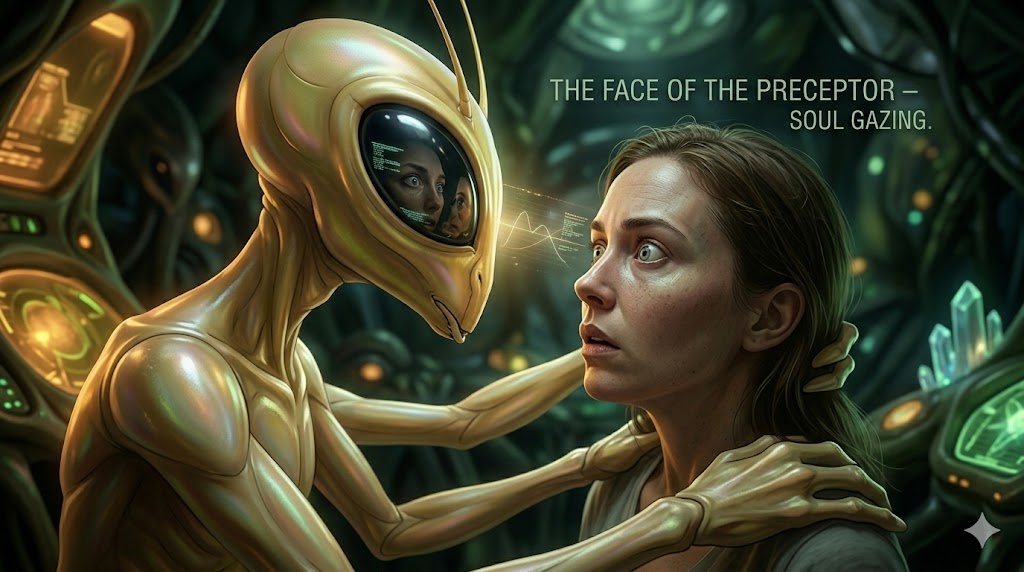
THE FACE OF THE PRECEPTOR. A high-resolution capture of the Soul Gazing process. This interaction allows Mantis groups to stabilize human neurological frequencies during contact encounters.
THINK ABOUTIT’S ALIEN TYPE SUMMARY – The Mantis Beings
Mantis Beings represent a highly evolved, insectoid-humanoid lineage often found in supervisory roles during contact scenarios. Known taxonomically in some circles as Docta Gryllus tegimen, these entities are described as intelligent, gentle-spirited, yet “hyper” in their movements. Existing within a collective consciousness, their home world is a model of total cooperation where infrastructure, nutrition, and transport are synchronized. This symbiotic existence has allowed them to evolve into a state bordering the spirit realm, where they act as multidimensional coordinators for the Orion-Zeta contact phenomenon.
Name: Mantis Beings
AKA: Mantids, Praying Mantis Types, The Preceptors
Location – Home System: Undisclosed (Planet of Total Cooperation)
Distance from Earth: Multidimensional / Non-linear
Attitude: Clinical, watchful, and protective; described as having a “parental” or “doctor-like” demeanor.
Motives: Coordinating contact/abduction phenomena; staving off darker influences; assisting in human evolutionary transitions.
Physical Appearance: Extremely thin, long torsos with insect-like features; long, crooked limbs.
- Average Height: over 6 to 7 feet tall
- Average Weight: 90 – 120 lbs (Exoskeletal/Light-frame)
- Body Temperature: 92°F (Endothermic-Insectoid)
- Pulse/Respiration: Highly rhythmic; slow during “soul gazing” sessions.
- Blood Pressure: Low-pressure hemolymph-based system.
- Life Expectancy: 150 – 500 Years (Varies by dimensional phase)
- Hair: none
- Skin: Coloring ranges from light grey to gold; some reports describe black, plastic-like armor or exoskeletons.
- Eyes: Large, narrow-V positioned eyes; sharply slanted upward and outward.
- Sex: Binary (Male and Female identified); however, reproduction is collective.
Other Physical Information: Possess a midsection organ capable of sensing and amplifying fear; jerky, “clicking” movements; three-fingered “mitten” hands.
Special Traits and Abilities: Neurological “freezing” capability; telepathic dominance; “Soul Gazing” (unflinching nose-to-nose eye contact).
Communication Type: High-frequency telepathy; distinctive clicking sounds (manual and vocal).
Origin: Evolved human-life form (Insectoid-Mammalian hybrid lineage).
Life Form Type: Insectoid-Humanoid
Subspecies: Santari (Helping race/Transition specialists)
Most Common Species: Golden Mantid (Command Class)
Level of Species: Level XXIX (Spiritual-Technical Integration)
Habits: Background monitoring of Grey activities; anesthetic management of abductees.
Transportation Type: Crystalline collective craft; inter-dimensional phase-shift units.
Witnesses Reports: Mike Shea (1973), Joe Lewels, various MILAB and abduction survivors.
Special Features/Characteristics: Reported wearing black helmets or “exoskeleton armor” with a central ridge; often mistaken for large grasshoppers in black suits.
Summary/Description: High-level coordinators who manage the emotional and neurological stability of humans during contact.
Source: Mike Shea (Cooksville, MD), Joe Lewels, CRM Archives.
Recorded in 1973 at Cooksville, Maryland, USA by Mike Shea, lawyer. A 2-metre tall praying mantis-like species that some researchers believe to be an insectoid whilst others believe it to be a mammal-like species that has evolved a tall praying mantis-like shape. Mike shea?s description of this species is that they looked like grasshoppers with long arms and bowed legs, dressed in black, plastic-like armour, with a black face and wearing a black helmet with a line down the middle that came to a point. If it is insectoid the armour and helmet may be its exoskeleton. This species has been observed associating with other species such as Grays and involved with abductions. Abductees report that this species makes a distinctive clicking with its fingers.
THE NEUROLOGICAL ANESTHESIOLOGISTS
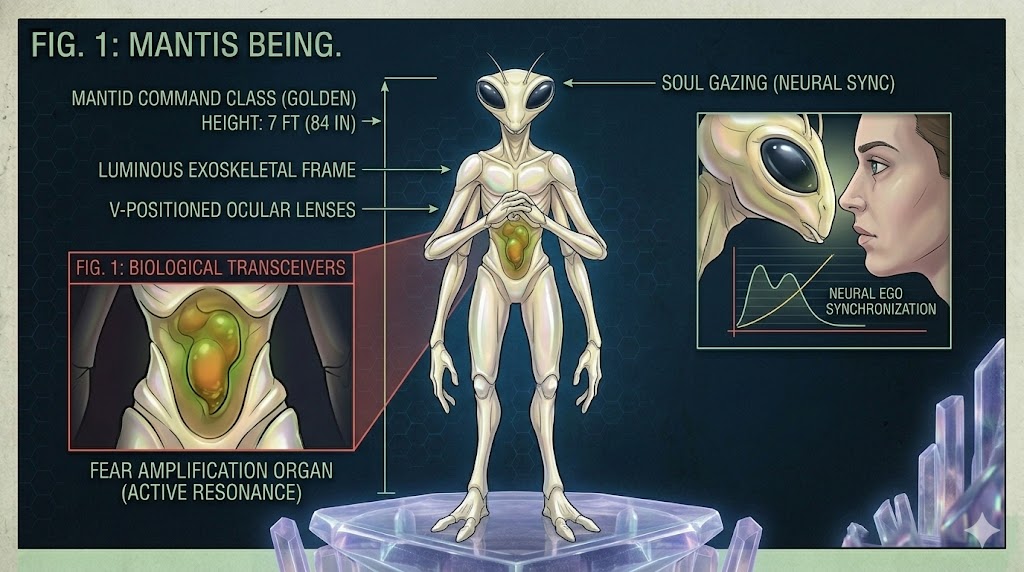
The Fear-Amplification Organ and Protective Paralysis
One of the most distinctive biological features of Mantis groups is a specialized organ located within their midsection. This organ functions as a bio-transceiver for emotional frequencies, acting as a bridge between biological impulse and telepathic command. While many animals can sense fear, Mantids possess the sophisticated ability to absorb human terror, amplify it, and radiate it back toward the originator in a controlled feedback loop. While this initially sounds predatory to the uninitiated, contactees consistently report that it is performed with “great love and care,” serving as a necessary intervention for the human nervous system.
The purpose of this feedback loop is to disable the human neurological system safely. When humans encounter visitors, the natural “fight or flight” response—often involving loud noises, erratic movement, and surging adrenaline—is viewed by Mantids as a severe danger to the human’s own physical safety and cardiovascular stability. By “freezing” the individual, Mantids act as the anesthesiologists of the experience. They ensure that the complex biological or genetic work being performed by Greys (Dow) is not interrupted by physical trauma or sudden muscle contractions. Furthermore, they find the human habit of “showing teeth” (whether smiling or snarling) particularly confusing, often misinterpreting it as a sign of extreme distress or primitive aggression regardless of context. Their amplification organ effectively overrides these survivalist “glitches” in our biology, allowing for a calm, albeit paralyzed, interaction.
Soul Gazing and Ego Dissolution
Beyond mere physical management, Mantis beings engage in a profound psychological process known as “Soul Gazing.” During this high-intensity interaction, a Mantid will position itself inches away from a human’s face, staring unflinchingly into their eyes for extended periods. This process is frequently described as “shattering to the human ego,” as the sheer weight of the Mantid’s consciousness pours into the subject’s ocular lenses.
Researchers within the Think About It Alien Database suggest that Soul Gazing is a method of direct, high-bandwidth data-transfer and deep consciousness-scanning. It allows the Mantid to bypass the human’s conscious filters—the “masks” we wear—and access the deep subconscious or “soul-matrix” directly. For the human, this experience often leads to a temporary but total loss of self-identity, which is replaced by an overwhelming sense of cosmic interconnectedness and “oneness.” This is why many experiencers, despite the initial shock and “insectoid fear” associated with the Mantid’s appearance, eventually report a deep sense of respect, spiritual clarity, and even kinship with these entities after the encounter. They are not merely observing our bodies; they are communicating directly with the essence that inhabits them.
2026 MANDATE: THE SANTARI ALLIANCE
The Transition and Dark Influence Mitigation
As of 2026, the role of Mantis groups has shifted from background monitoring to active transition assistance. Reports from the Andromedan Council indicate that a specific sub-sect of Mantids, known as the Santari, has been deployed to the Earth sector. Their primary mission is to help stave off “darker influences”—specifically the predatory energetic harvests of the Alpha Draconian empire.
The Santari believe that humanity is currently in a “Cocoon Phase.” They view our planetary turmoil not as a catastrophe, but as the necessary breakdown of old structures before a metamorphosis into a higher-vibrational state. Their presence in 2026 is increasingly spotted near nuclear facilities and volcanic hot spots, where they are said to be “calming” the planetary grid to prevent a premature or destructive shift.
The Collective Planet: A Blueprint for Earth
The home world of Mantis beings serves as a potential future blueprint for human society. On their planet, there is no concept of “competing interests.” Every building, vehicle, and food source is grown from a shared genetic-vibrational blueprint. This “Total Cooperation” means that destruction and pollution are physically impossible because any harm to the environment is immediately felt by the collective.
By modeling this behavior during contact, Mantids are trying to “seed” the concept of collective stewardship into the human psyche. They communicate that Earth’s current path of individualistic destruction is an evolutionary dead-end. Through their interactions, they hope to prepare a “First Contact Generation” that understands the power of symbiotic existence, moving humanity closer to the Level XXIX status they currently enjoy.
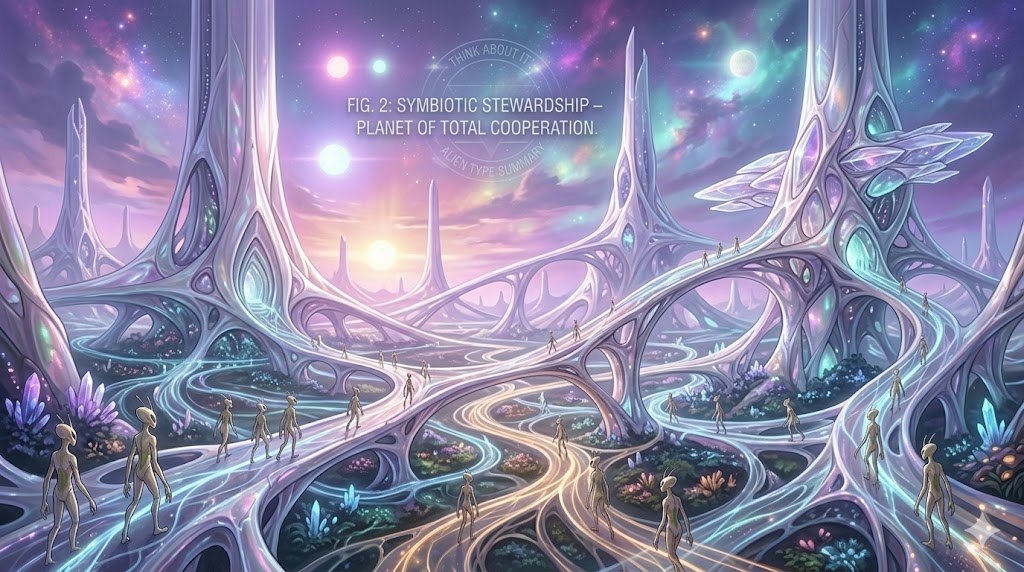
FINAL SUMMARY: SOVEREIGN VERDICTS
Mantis beings remain perhaps the most misunderstood entities within this entire database. While jerky, insectoid movements and distinctive “clicking” vocalizations can be terrifying to uninitiated observers, reported intent is consistently protective and educational. These practitioners are masters of “Contact Environments,” ensuring dimensional bridges remain stable for both human subjects and visiting groups. To encounter a Mantid is to be invited into a masterclass of neurological discipline. They demonstrate that fear is merely a manageable frequency—a biological static that must be tuned out to perceive higher realities. Beneath “shattered egos” resulting from soul-gazing, lies a human spirit capable of engaging with highest levels of galactic intelligence.
As we progress through 2026, their role as “Preceptors” of human evolution becomes increasingly vital. They serve as a cosmic counterbalance to predatory parasitic forces, acting as silent guardians over the human nervous system during this volatile transition. Their presence reminds us that appearance is often a veil; beneath a formidable insectoid exterior beats a heart of clinical compassion. By studying their collective cooperative model, humanity finds a roadmap for planetary survival.
Sovereign recognition of these beings requires moving past primitive “monster” archetypes. We must view them instead as high-level surgeons of the soul, meticulously preparing our species for a seat at the galactic table. In 2026, the mandate is clear: those who master their own internal frequency, as taught by the Mantids, will be the ones to successfully navigate the coming shift into multidimensional citizenship. They are not merely visitors; they are the ancient monitors of our potential, waiting for us to finally outgrow the frequency of fear.