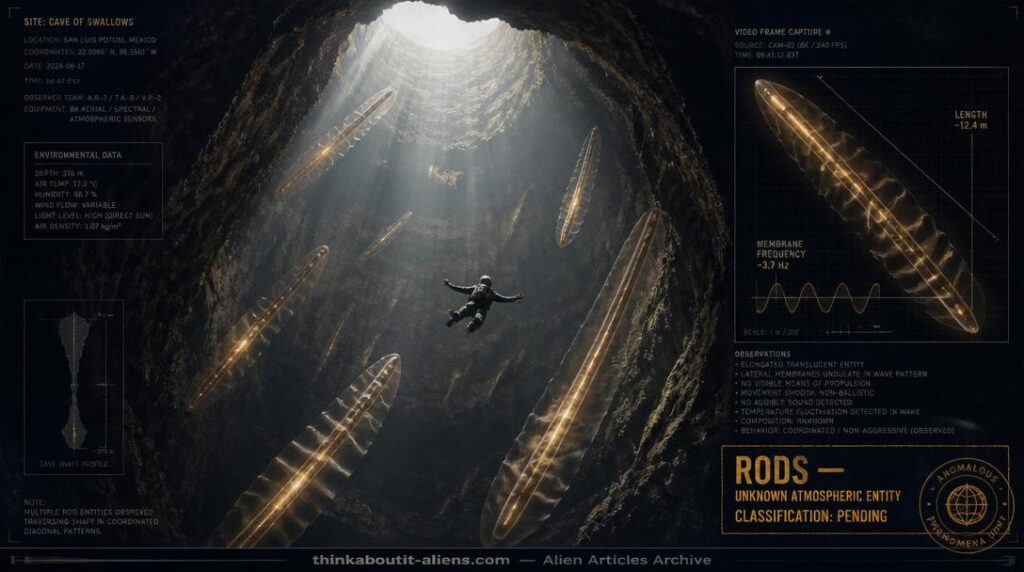
The Rods phenomenon — translucent high-speed entities diving through the Cave of Swallows alongside skydivers, as documented by Jose Escamilla.
In the mid-1990s, independent filmmaker Jose Escamilla was reviewing video footage shot near Roswell, New Mexico when he noticed something that shouldn’t have been there: elongated, translucent, high-speed entities streaking through the frame at velocities no known insect or bird could match, propelled by undulating membrane-like appendages along their bodies. He called them “Rods” — and when News 9 Oklahoma picked up the story for a televised investigation, the phenomenon went from fringe curiosity to mainstream debate. This article presents the News 9 segment alongside Escamilla’s original research, documenting Rod captures on video from locations around the world including the famous Cave of Swallows footage (Golondrinas, Mexico) where Rods appear to dive alongside base-jumping skydivers at impossible speeds through a 1,200-foot vertical shaft.
The Rod phenomenon occupies a contested space between cryptozoology, atmospheric biology, and camera artifact debunking. Skeptics argue that Rods are motion-blur artifacts created by insects or birds crossing close to the camera lens at speeds the shutter cannot freeze — a position supported by controlled experiments. Proponents counter that the consistent morphology across thousands of independent video captures (elongated cylindrical body, lateral membrane oscillation, apparent intelligent maneuvering), the absence of any known organism matching the profile, and the failure of motion-blur models to account for Rods captured on high-speed film suggest something genuinely unknown. Classified under Unknown Type Aliens on the Think About It taxonomy, Rods — also called “Skyfish” in Japanese research — represent one of the few anomalous entity categories supported primarily by video evidence rather than witness testimony. Whether biological, atmospheric, interdimensional, or artifactual, they remain unexplained.
News 9 Investigates The Phenomenon Of RODS With Jose Escamilla?!
November 30, 2014 – UNITED STATES – “We think it’s a living entity of some kind. It does have behavior of being alive,” said Escamilla. “They’re very evasive, they’re super fast.”
Escamilla calls this entity a ROD, measuring one to six feet long with a cylinder body and multiple sets of wings.
“We don’t know what they’re doing here. We don’t know how long they’ve been here,” he said. “We have rock carvings that appears to show RODS on carve drawings from 50,000 years ago.”
Skeptics, however, don’t buy into the ROD theory. Skeptics like Mark Zimmerman, an assistant Professor of Photography at the University of Central Oklahoma in Edmond.
“I hate to call myself a skeptic, but I’m probably labelled as that because I just think there’s some sort of scientific answer for things like this,” said Zimmerman. “I think it’s interesting and makes for a good topic of discussion.”
In fact, he discussed the phenomenon in class recently after one of his students, Erick Perry, captured what appears to be a ROD in a photograph taken for a class assignment.
“It was actually somebody in class who pointed it out,” said Perry.
As part of the assignment, Perry took the same photograph at a cemetery during different times of the day. In the night photograph, a white object appeared in the upper right-handed corner.
 |
| Escamilla calls this entity a ROD, measuring one to six feet long with a cylinder body and multiple sets of wings. |
“People in class joked around about it, like UFOs, but most likely, it was probably like a bug or a plane or something,” he said. “The fact that it was in a cemetery made it a little more creepy.”
Zimmerman agrees the object is more than likely not out of this world.
“You can capture planes as they’re going across the sky, satellites, things that you typically wouldn’t see other than like a dot typically when you look up,” he said. “Whereas with the longer shutter, when it’s open, things will move and light will reflect off of it.”
Wanting to prove his point, Zimmerman shot a series of photographs at different exposure times around a porch light, capturing what appears to be objects similar to Rods, but actually turned out to be moths. Like other camera experts, Zimmerman says cameras are capable of producing artifacts, something in the picture that wasn’t actually there.
Escamilla viewed Perry’s photograph from class and says the mysterious object is not a ROD, but perhaps an airplane. However, he says that doesn’t disprove his ROD theory.
“Each object has its own certain footprint, it’s certain pattern of flight, you can tell what an insect looks like, you can tell what a bird looks like, a dragonfly and a ROD is a ROD,” he said.
Escamilla says RODS can be seen anywhere but their hotbeds are in Washington DC, New Orleans, Canada, Mexico, Texas, Arizona and California the U.S. He says they’ve also been captured in Scotland, Russia, Japan, China, Germany and the UK.
WATCH: News 9 investigates the phenomenon of RODS.
Escamilla has seen RODS in photographs and video of space and even underwater. He even spied a ROD in video taken from SkyNews9 during tornado coverage in 1999.
“Those RODS are huge. That one white ROD that comes out of the top of the cloud, that cloud front was 10 miles away from the helicopter and it comes out in three frames. That thing must have been a 100 feet in length,” said Escamilla.
So what do you believe? Do rods exist among us, these strange living things that appear and disappear in the blink of an eye, caught at just the right moment in time?
“I think everyone always has some sort of conspiracy on anything. I mean, it could be Bigfoot,” said Zimmerman.
“This phenomenon is real and for those of you who don’t believe in it, that’s your prerogative. You can believe what you want, or disbelieve, but the fact is, these things are here,” said Escamilla. “They are doing something here. We don’t know what they do but they are doing it.”
Escamilla says technology has improved the documentation of RODS, where he’s now able to capture them using infrared filters and in high-speed footage. – News9.
Executive Summary:
Rods — The Escamilla Discovery, News 9 Investigation, and the Motion Blur Debate
Jose Escamilla’s discovery of “Rods” — elongated, high-speed, translucent entities captured on video — generated a News 9 Oklahoma television investigation and a global wave of independent video captures. The entities appear as cylindrical bodies ranging from inches to several feet in length, propelled by rapidly oscillating lateral membranes, moving at speeds estimated between 150 and 1,000+ mph. Key footage includes captures near Roswell, New Mexico and the Cave of Swallows (Golondrinas, Mexico), where Rods were recorded diving alongside skydivers through a 1,200-foot shaft. The phenomenon is alternatively explained as motion-blur artifacts from insects (skeptic position) or an unknown atmospheric or interdimensional life form (proponent position).
The debate remains unresolved. Controlled motion-blur experiments replicate some Rod-like artifacts but fail to account for captures on high-speed film or the consistent morphological profile across independent global captures. The Japanese research community’s “Skyfish” designation reflects independent documentation of the same phenomenon. Classified under Unknown Type Aliens pending further evidence.
“They’re not insects, they’re not birds, and they’re not camera artifacts — they’re something we haven’t identified yet, and they’re everywhere.”
— Jose Escamilla
About the Author