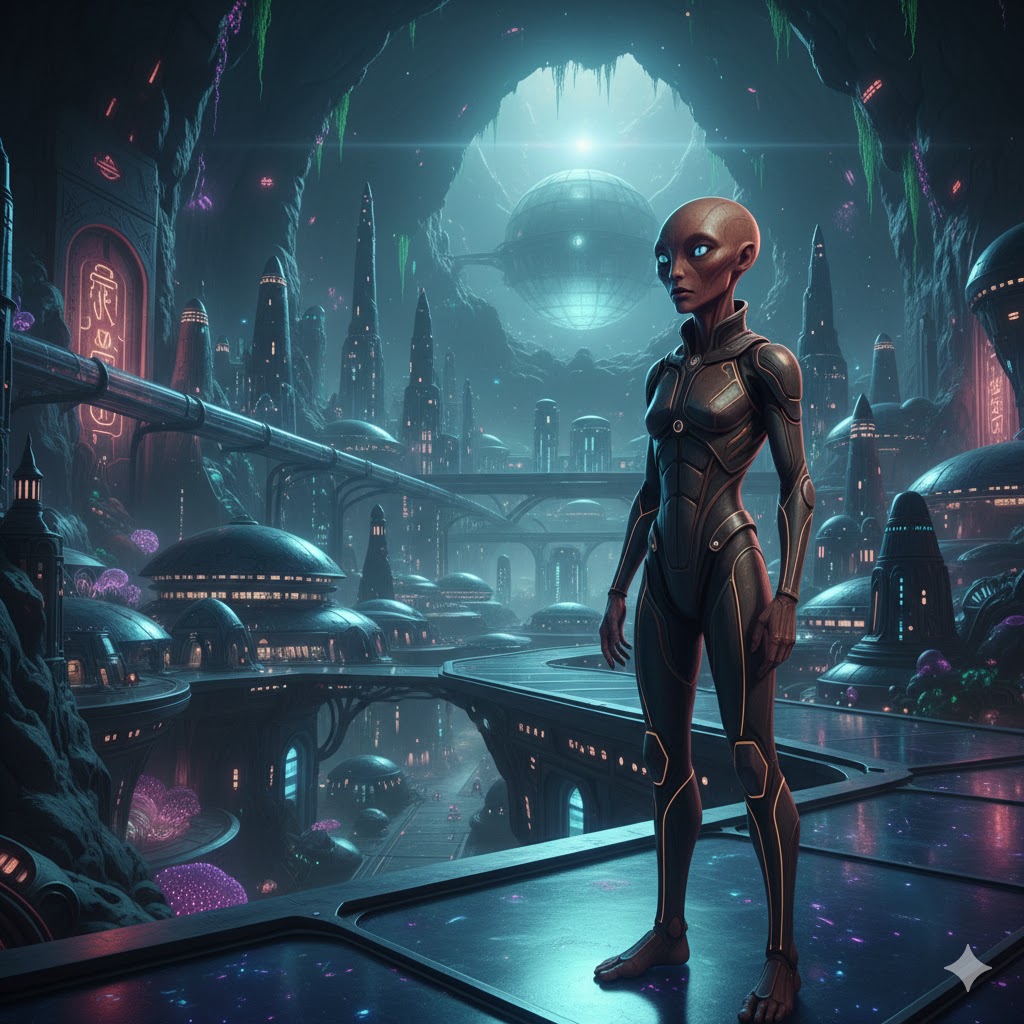
A glimpse into the self-sustaining Martian colonies located deep beneath the Cydonia region.
THINK ABOUTIT’S ALIEN TYPE SUMMARY – Martians
The Martians are a resilient humanoid race originating from the planet Mars (Ares). Once home to a thriving surface civilization with vast oceans and atmosphere, a series of cataclysmic events—possibly nuclear or celestial in nature—forced the remaining population into a sophisticated network of subterranean bases. Within the Think About It Alien Database, Martians are documented as a “Reclusive” race that maintains a policy of non-interference with Earth, despite their close proximity. They possess highly advanced technology in the fields of terraforming and gravitational physics, developed out of the necessity to survive their planet’s harsh environmental shift.
Name: Martians
AKA: Aresians, The Red Dwellers, The Cydonians.
Location – Home System: Mars, 4th planet from the Sun, Sol System.
Distance from Earth: Minimum 33.9 million miles (approx. 54.6 million km).
Attitude: Highly cautious, reclusive, and protective of their remaining resources.
Motives: Preservation of their subterranean biosphere and long-term planetary restoration.
Physical Appearance:
- Average Height: 1.5 to 1.8 meters (approx. 4.9 to 5.9 feet); slightly shorter on average than humans due to past environmental stressors
- Average Weight: 130 – 160 lbs (59 – 72 kg); their bone density is slightly lower than a human’s, adapted for the lower gravity environment of Mars.
- Body Temperature: 96.4°F (35.8°C); slightly cooler than the human average, reflecting their energy-efficient metabolism.
- Pulse/Respiration: 50 BPM / 10 breaths per minute; they possess a highly efficient respiratory system designed to process recycled atmospheric blends.
- Blood Pressure: 95/60; stable and low, suited for their low-gravity habitat.
- Life Expectancy: 180 – 240 Earth years, supported by advanced regenerative medicine and a sterile living environment.
- Hair: Sparse or non-existent; most Martians are completely hairless, an evolutionary trait resulting from thousands of years living in regulated, dust-free underground environments.
- Skin: Varies from a pale, reddish-copper to a greyish-tan, adapted for artificial light environments.
- Eyes: Larger than human eyes with a vertical slit pupil, optimized for low-light underground visibility.
- Sex: Dimorphic (Male and Female); their reproductive cycle is strictly controlled to manage the limited resources of their subterranean biospheres.
Other Physical Information: Possess a secondary transparent eyelid (nictitating membrane) to protect against fine Martian dust. Their bone structure is porous but reinforced with high mineral content to maintain integrity in low-gravity environments.
Special Traits and Abilities: Martians possess “Structural Intuition,” allowing them to sense flaws in geological or architectural formations. They also have a limited form of psychokinesis used for fine-tuning delicate machinery.
Communication Type: A combination of a soft, melodic verbal language and high-bandwidth telepathy used for technical data transfer.
Origin: Mars (Ares), 4th planet of the Sol System. Specifically the subterranean cavern networks beneath the Cydonia and Valles Marineris regions.
Life Form Type: Humanoid / Underground Civilized.
Subspecies: The ‘High Cydonians’ (descendants of surface-level royalty/administrators) and the ‘Valles Marineris Mantle-Dwellers’ (specialized engineers for deep-crust living).
Most Common Species: The Aresian Humanoid (Subsurface Variant).
Level of Species: Level III – Inter-Planetary Survivors.
Habits: Meticulously conservation-minded. They treat water as a sacred resource and are known for creating “Living Art” out of bioluminescent moss and crystals.
Transportation Type: Sleek, bronze-colored triangular craft and subterranean mag-lev transit systems
Witnesses Reports: Remote viewers from the Stargate Project; leaked Soviet “Phobos 2” mission data; and testimony from high-level whistleblowers regarding the “Cydonia Underground.”
Special Features/Characteristics: Dual-layered respiratory systems for low-oxygen environments; high-frequency sonic resonance vocalizations; and “Structural Intuition” (the ability to sense geological stability).
Summary/Description: they have had bases on Mars for thousands of years where they mine a sort of gold – like mineral. The first recorded visit to Earth was in 1235 BC in Japan !
Source: Think About It Alien Database; Aresian Archive Transmissions; Remote Viewing Records.
The Cydonia Legacy: From Surface to Subsurface
Evidence from the Think About It Alien Database suggests that the Martian civilization reached its peak millions of years ago, coinciding with the construction of the massive monuments in the Cydonia region. The “Face on Mars” and the surrounding pyramidal structures are believed to be remnants of a surface-dwelling era. When the Martian atmosphere was stripped away—a topic of intense debate among exopoliticians—the survivors utilized their mastery of geology to carve out vast, self-sustaining cities deep within the Martian crust.
Modern Martian society is deeply spiritual and scientifically oriented. They view Earth with a mixture of concern and detachment, often acting as silent observers of our space exploration efforts. There are persistent reports of Martians interacting with the Marcabians and other confederation members to ensure that human “Mars Missions” do not inadvertently breach the sanctity of their hidden colonies. Their technology is primarily focused on “internal growth,” utilizing zero-point energy to power their underground worlds without the need for surface-based solar or fossil fuels.
The Aresian Infrastructure: Subterranean Science
The subterranean nature of Martian life is not merely a choice but a biological necessity. Following the depletion of the Martian magnetosphere, the remaining Aresians (as they call themselves) had to master Gravitational Engineering. Their cities, such as those rumored to exist beneath the Valles Marineris, are suspended in pressurized pockets that mimic the atmospheric pressure of Earth. This is why Martians can transition to Earth environments relatively easily, though they find our gravity slightly “heavy.”
Their technology is largely based on Sonic Resonance. Rather than using combustion or electricity as we know it, Martians utilize specific sound frequencies to manipulate matter and generate light. This accounts for the bioluminescent glow seen in remote viewing sessions of their cities. Furthermore, the Think About It Alien Database notes that Martians have a unique relationship with the Marcabians. The Marcabians provide the Martians with specific heavy elements for their atmospheric scrubbers in exchange for Martian geological data.
Historically, the Martian “Diaspora” occurred approximately 100,000 years ago. While most stayed underground, small factions attempted to migrate to Earth, potentially influencing early Egyptian and Sumerian cultures. This “Cydonian Connection” is why we see similar pyramidal architecture on both planets. Today, the Martians remain the silent guardians of the Red Planet, ensuring that human rovers and future colonists do not stumble upon the “Life-Support Hubs” that keep their species alive.
Aresian Society: Why Martians Stay Hidden
The history of the Martians is inextricably linked to the preservation of their DNA. Unlike other galactic races, Martians do not seek to colonize other worlds because their biological signature is specifically tuned to the resonance of the Red Planet. This deep connection explains why Martians have invested so much energy into subterranean terraforming rather than exodus.
In the Think About It Alien Database, we categorize the Martians as a ‘Legacy Race’—one that has seen the rise and fall of their own solar system’s golden age. When researchers discuss the ‘Face on Mars,’ they are actually looking at the cultural markers left behind by the Martians before their retreat. By understanding the Martians, humanity can better prepare for the challenges of long-term planetary survival and the ethics of atmospheric management.
Final Summary: Survival and Sovereignty
The Martians serve as a poignant reminder of planetary fragility. In the Think About It Alien Database, they are not portrayed as invaders, but as survivors. Their reclusive nature is a defense mechanism, protecting a civilization that has already faced total environmental collapse. By maintaining their subterranean sovereignty, they provide a silent witness to Earth’s development, hoping that humanity learns the lessons of planetary stewardship before it is too late.