The Strom are elusive invertebrate researchers who have monitored Earth's vegetation since the end of the last Ice Age.
THINK ABOUTIT’S ALIEN TYPE SUMMARY – Strom
“They are 2-meter tall invertebrates from Ursa Minor who have visited Earth 200 times since the Ice Age. Meet the Strom—the ‘Coelenterate’ aliens who value vegetation above all else. Discover why their octagonal ships haunt our forests and why 2026 Disclosure identifies them as the silent guardians of Earth’s flora.”
In the vast catalog of the Think About It Alien Database, few species are as cautious as the Strom. Originating from the Little Dipper, these invertebrate beings possess a culture where plants are considered sacred. Having first arrived at the end of the last Ice Age, they have spent millennia cataloging our planet’s vegetation. As 2026 Disclosure reveals the existence of 20 Strom colonies across the galaxy, we finally understand the motives of the beings who move through our wilderness unseen.
Name: Strom
AKA: The Ursa Minor Botanists, The Octagon Pilots, The Jelly-Giants
Location – Home System: come from Constellation URSA MINOR (The Little Dipper)
Distance from Earth: Varied (~70 to 500+ Light-years depending on colony)
Attitude: This race is acting with extreme caution, rarely seen by people
Motives: Vegetation is of great significance to the Strom culture. Main reason to study the flora of our planet.
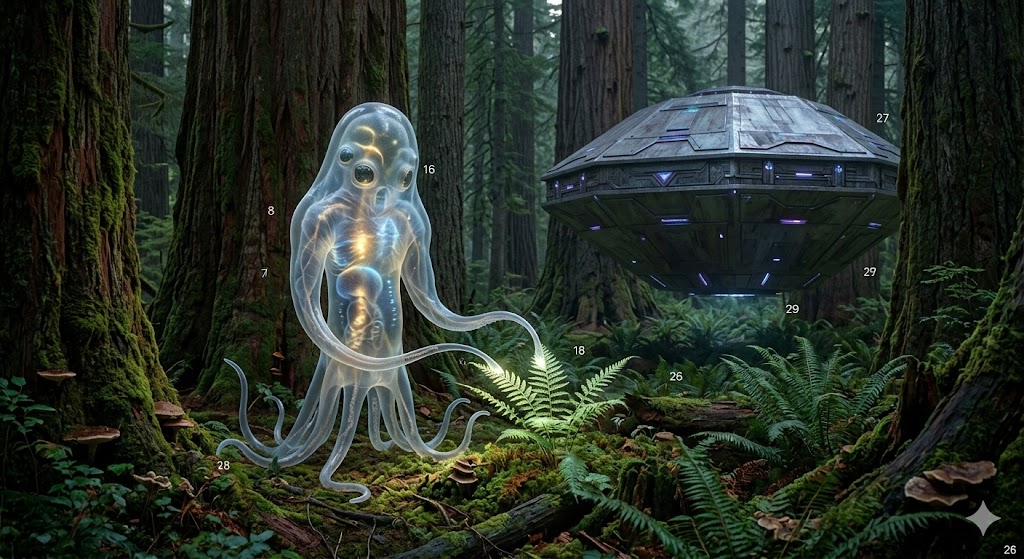
Physical Appearance: Invertebrate/Coelenterate; translucent, fluid-filled body structure
- Average Height: Average height is 2 meters (approx. 6’7″)
- Average Weight: Variable (Lightweight due to lack of bone density)
- Body Temperature: Ambient (Ectothermic behavior)
- Pulse/Respiration: Diffused; gas exchange occurs through the outer membrane
- Blood Pressure: Hydraulic-based internal pressure
- Life Expectancy: Unknown (Likely very long due to regenerative tissues)
- Hair: None
- Skin: Membranous, often shimmering with bioluminescent internal fluids
- Eyes: Multi-faceted light sensors integrated into the upper body mass
- Sex: Unknown (Likely hermaphroditic or budding-based reproduction)
Other Physical Information: Classified as Coelenterates (related to Earth’s cnidarians like jellyfish)
Special Traits and Abilities: Bioluminescent signaling; total bodily flexibility; chemical sensing
Communication Type: Chemical-hormonal release; rhythmic light pulses
Origin: Ursa Minor Sector
Life Form Type: Invertebrate / Coelenterate
Subspecies: Varies across 20 distinct galactic colonies
Most Common Species: Strom Prime
Level of Species: Level XII – Advanced Scientific Voyagers
Habits: Landing in remote, densely forested areas; taking soil and plant samples
Transportation Type: Octagonal (8-sided) metallic craft
Witnesses Reports: Rare sightings by forest rangers; radar detection of octagonal UAPs
Special Features/Characteristics: First visited Earth at the end of the last Ice Age
Summary/Description: Elusive invertebrate researchers from Ursa Minor focused entirely on botanical study.
Source: Ancient Chronology Leaks
The Invertebrate Voyagers
Biological Architecture: The Coelenterate Advantage
The Strom are a radical departure from the “Grey” or “Reptilian” norm. Classified as Coelenterates, their biology is more akin to Earth’s jellyfish or sea anemones, but adapted for a terrestrial, atmospheric existence. Standing 2 meters tall, they possess no internal skeleton. Instead, they rely on a complex system of hydrostatic pressure to maintain their upright posture.
This lack of bone structure makes them incredibly resilient to the high-G maneuvers of their octagonal ships. According to the Think About It Alien Database, a Strom can squeeze its entire 2-meter mass through an opening only a few centimeters wide, making them masters of infiltration and evasion. Their bodies are translucent, allowing witnesses to see the pulsing, bioluminescent organs within, which shift in intensity depending on their proximity to rare or “sacred” plant life.
The 200 Visits: From the Ice Age to 2026
The Strom have a long-term investment in Earth. Their first recorded visit occurred roughly 12,000 years ago, just as the last Ice Age was receding. While other races like the Anunnaki were focused on human genetics or gold, the Strom were cataloging the shift in Earth’s vegetation as the glaciers melted.
Over the course of 200 distinct visits, they have created a genetic “seed bank” of Earth’s flora across their 20 galactic colonies. They view plants not just as a resource, but as the “Intelligence of the Soil.” In Strom culture, a planet’s health is measured by its botanical diversity, not its technological advancement. This explains their extreme caution: they do not wish to interfere with human politics; they only wish to ensure that Earth’s vegetation survives the current ecological crisis.
2026 Disclosure: The Octagonal Sentinels
The Octagon Ships: Geometric Precision
In the 2026 Disclosure cycle, the distinctive Octagonal Craft of the Strom have become a frequent topic of UAP (Unidentified Aerial Phenomena) hearings. Unlike the “Saucers” of the Greys or the “Cylinders” of the Nordics, the Strom ships are perfect 8-sided polygons.
These craft are designed for Silent Hovering. They often descend over dense canopy layers—such as the Amazon or the Siberian Taiga—using localized gravitational fields to “vacuum” up pollen and plant spores without disturbing a single leaf. In 2026, satellite footage captured an octagonal Strom craft hovering over a forest fire in British Columbia, apparently using a targeted cooling beam to preserve a specific grove of ancient cedars. This highlights their role as the “Silent Gardeners” of the galaxy.
The 20 Colonies and the Botanical Network
The revelation that the Strom possess 20 colonies across the galaxy has significant implications for exopolitics. These colonies are essentially “Garden Worlds,” where Earth’s endangered plants are currently thriving.
In 2026, contactees have reported telepathic messages from the Strom indicating that they are preparing to “re-seed” Earth in the event of a total ecological collapse. They do not communicate with the “clicks” of the Stinky Blobs or the complex frequencies of the Sons of Light. Instead, they use a Chemical-Visual language. They release pheromones that induce vivid imagery in the human mind, usually depicting lush, vibrant forests and the interconnected “neural network” of tree roots.
Exobotany and the 12,000-Year Archive
The Science of Sacred Vegetation
For the Strom, plants are not merely biological organisms; they are considered “Planetary Neurons.” According to the Think About It Alien Database, the Strom believe that the floral diversity of a planet acts as a living hard drive, storing the history and energetic frequency of the world. This is why their 200 visits to Earth have focused exclusively on remote, undisturbed wilderness.
Unlike the Sons of Darkness, who seek to harvest human emotion, or the Spicans, who focus on architectural resonance, the Strom are the galaxy’s premier Conservationists. Their 2-meter tall, invertebrate bodies are highly sensitive to the chemical signals emitted by trees (often referred to as the “Wood Wide Web”). When a Strom “touches” a plant with its bioluminescent filaments, it is performing a high-speed data download, cataloging the genetic health of the ecosystem. In the 2026 Disclosure documents, whistleblowers from the Department of the Interior have noted “Octagon” sightings specifically in areas of high biodiversity or where rare, endangered species are struggling to survive.
Coelenterate Physiology: Life Without a Center
The physical structure of the Strom is a marvel of evolutionary engineering. As Coelenterates, they possess a centralized cavity that serves as both respiratory and circulatory systems. Because they lack a rigid skeleton, they are immune to the high-G forces required for interstellar travel through the “Little Dipper” corridors. Their skin is a semi-permeable membrane that “breathes” the forest air, absorbing nutrients directly from the humidity and pheromones of the trees.
This biology makes them nearly invisible to standard infrared military sensors, as their body temperature naturally adjusts to match the surrounding foliage. However, in 2026, new “Bio-Luminescent Tracking” technology has allowed researchers to capture the faint, rhythmic pulses they emit when communicating with plant life. These pulses are not “speech” in the human sense but a form of Harmonic Priming, where the Strom use light to stimulate the growth and health of the vegetation they study.
The 20 Colonies: Earth’s Backup Drive
The revelation of the 20 Strom Colonies across the galaxy has shifted the 2026 exopolitical narrative. These colonies are not industrial hubs; they are “Biosphere Preserves.” It is now understood that for every 200 visits the Strom made to Earth, they were transporting rare seeds and spores to these distant worlds.
In the event of a total ecological collapse on Earth, these colonies serve as a “Backup Drive” for our planet’s biology. The Strom are not here to save humanity—they are here to save the Earth. Their octagonal ships are essentially “Genetic Lifeboats.” Recent 2026 sightings over the Amazon rainforest suggest that the Strom are currently in an “Emergency Extraction” phase, intensified by the rapid loss of Earth’s old-growth forests. They act with extreme caution because they view human interference as a viral threat to the botanical integrity of the planet.
Final Summary: The Silent Sentinels of the Soil
The Strom represent a rare, non-predatory intelligence in the Think About It Alien Database. As 2-meter tall invertebrate researchers from Ursa Minor, they remind us that human beings are not the only stakeholders on this planet. Their octagonal craft, first seen at the end of the Ice Age, are symbols of a 12,000-year commitment to the preservation of life. While they remain elusive and rarely interact with people, their presence is a silent testament to the value of our natural world. In the face of 2026 Disclosure, the Strom stand as the ultimate gardeners, ensuring that even if humanity falters, the green heart of the Earth will beat on across their twenty galactic colonies.