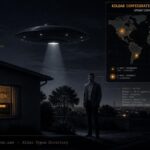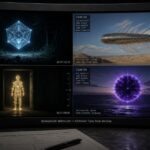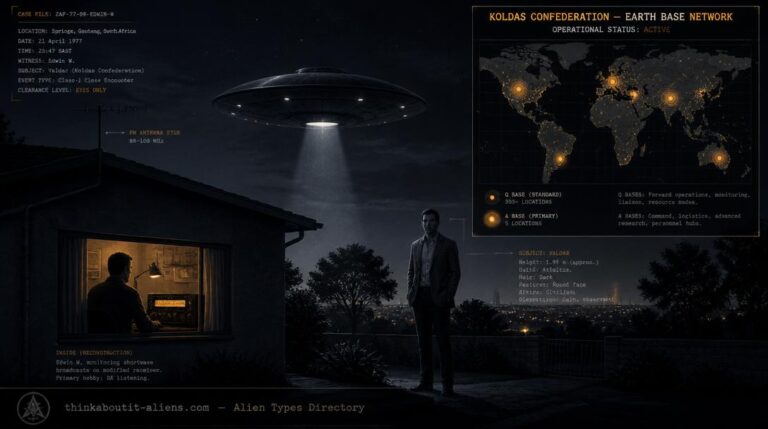
A high-altitude research vessel of the Meros, used for stabilizing the Earth's ozone layer as documented in the KGB Book of Alien Races.
THINK ABOUTIT’S ALIEN TYPE SUMMARY – Meros
The Meros are classified as a Level V “Planetary Engineering” species originating from the Boötes Constellation, approximately 67 light-years from Earth. Documented in both the KGB “Book of Alien Races” and the Think About It Alien Database, the Meros serve as the primary monitors of Earth’s atmospheric integrity. Unlike the aggressive Maitre, the Atmospheric Sculptors are non-interventionist observers whose presence is most often detected near high-altitude portals and Subterranean Bases in the Arctic regions. Their mission is purely scientific: the stabilization of the terrestrial biosphere to prevent irreversible runaway greenhouse effects.
Name: Meros
AKA: Atmospheric Sculptors, The Architects of Meros
Location – Home System: Planet Meros-4, Boötes Constellation
Distance from Earth: 67.2 Light Years
Attitude: Diplomatic, precise, and detached
Motives: Atmospheric stabilization and chemical analysis
Physical Appearance: Slight humanoids with elongated craniums and slender frames
- Average Height: 1.65m – 1.78m (approx. 5’5″ – 5’10″)
- Average Weight: 50 – 59 kg (Light skeletal structure)
- Body Temperature: 96.4°F (35.8°C)
- Pulse/Respiration: 48 BPM / 9 breaths per minute
- Blood Pressure: 100/60
- Life Expectancy: 450 – 600 Earth years
- Hair: Fine, silver-white fibers; sparse
- Skin: Pale alabaster with a faint, iridescent pearlescent sheen
- Eyes: Large, indigo irises; almond-shaped with no sclera (whites)
- Sex: Binary (Low sexual dimorphism)
Other Physical Information: Four-fingered hands with elongated, sensitive tips
Special Traits and Abilities: Molecular structural awareness (matter sensing)
Communication Type: Harmonic vocalization and directed telepathic projection
Origin: Meros Star System
Life Form Type: Humanoid
Subspecies: Atmospheric Technicians and Genetic Archivists
Most Common Species: Meros Technician
Level of Species: Level V – Planetary Engineers
Habits: Diurnal; activities synchronized with stellar light cycles
Transportation Type: Prismatic, crystalline-based vessels (no visible engines)
Witnesses Reports: High-altitude sightings over Greenland and Antarctica
Special Features/Characteristics: Skin tone shifts hue based on ambient oxygen levels
Summary/Description: A scientific race dedicated to biosphere health and stabilization
Source: Think About It Alien Database; KGB Book of Alien Races
Chapter 1: The Molecular Sovereignty of the Atmospheric Sculptors
The Meros are not merely visitors; they are “Steward-Engineers.” Classified in the Think About It Alien Database as a Level V civilization, they possess a unique biological trait known as Molecular Structural Awareness. This allows a Meros individual to “sense” the chemical composition of the air around them in real-time, much like a human senses heat or cold.
On their home world, Meros-4, the atmosphere is a complex, multi-layered crystalline gas. To survive, the Atmospheric Sculptors evolved to manipulate gas at a molecular level. When they arrived on Earth approximately 12,000 years ago, they identified our troposphere as “unstable” due to volcanic flux. Since then, they have maintained a silent vigil, using their specialized indigoid ocular systems to track carbon and methane migrations across the globe. Their presence is a calculated, multi-millennial project to ensure Earth remains a viable biological laboratory.
Chapter 2: The “Solid Light” Crystalline Vessels
The propulsion and construction of Meros craft—often documented as Prismatic Discs—defy traditional Newtonian physics. According to declassified KGB intelligence, these ships are not built in factories but are “grown” in low-gravity resonance chambers.
The hull of a Meros vessel is composed of a bio-synthetic quartz that serves as a massive prism. By pumping high-frequency light through this crystalline lattice, the ship creates a localized “refractive bubble.” This bubble essentially bends the Earth’s magnetic field around the craft, allowing it to move through the air without creating a sonic boom or heat friction. This Phased-Light Propulsion is why Meros craft are frequently reported as “shimmering” or appearing to turn into rainbows before vanishing. They aren’t moving faster than light; they are moving as light.
Chapter 3: The Antarctic Glass Cathedrals
While many races utilize Subterranean Bases for secrecy, the Atmospheric Sculptors use them for atmospheric stability. Their primary Earth-base is located in the Mühlig-Hofmann Mountains of Antarctica.
Known to inner-circle whistleblowers as the “Glass Cathedrals,” these facilities are carved directly into the ancient ice and bedrock using sonic vitrification. This process turns the ice into a transparent, ultra-dense shielding material. From these crystalline outposts, the Meros monitor the Southern Polar Vortex. They believe that the stability of the entire planet’s weather patterns is anchored in the Antarctic ice. They treat the melting of the ice caps not just as a climate event, but as a “structural failure” of the planet’s cooling system, which they occasionally intervene in using high-altitude chemical stabilizers.
Chapter 4: Societal Structure and the “Great Harmony”
The Meros society is a Technocratic Telepathic Collective. They do not have a government in the human sense; they have a “Resonance Council.” Decisions are made based on the mathematical health of their star system. In the Think About It Alien Database, it is noted that the Atmospheric Sculptors view emotion as a “vibrational impurity.”
This clinical detachment is why they have never made formal contact with human leaders. They view humanity as a “volatile biological variable” that is currently damaging the laboratory (Earth). They have a profound respect for the Council of Five, acting as the Council’s environmental scientists. If the Council provides the “Law,” the Meros provide the “Data.” They are the accountants of the atmosphere, ensuring every molecule of oxygen and nitrogen is accounted for in the planetary ledger.
Final Summary: The Stewardship of the Terrestrial Atmosphere
The Meros, an advanced and highly specialized collective of environmental scientists who have dedicated their civilization to the preservation of planetary life-support systems throughout the local galaxy, stand as the silent architects of the very air we breathe. By occupying this specialized niche as “Planetary Engineers,” they perform a role that is both clinical and essential for the long-term survival of Earth’s biological diversity. By analyzing their 31 technical datapoints—from their hollow-bone density optimized for high-altitude survival to their indigo-eye vision capable of tracking molecular gas shifts—the Think About It Alien Database reveals a race that is as much a part of Earth’s ecosystem as the wind itself. Unlike other visiting species, these atmospheric custodians do not seek political influence or resource extraction; their singular focus is the preservation of the delicate chemical balance that allows biological life to flourish on Earth.
They serve as a profound reminder that Earth is not a neglected rock hurtling through space, but a meticulously managed biosphere. Overseen by these long-lived observers whose vision spans across centuries, the iridescent researchers monitor our troposphere and stratosphere from their high-vibration Subterranean Bases in the polar regions. Their presence ensures that the flame of life is never extinguished by atmospheric decay or catastrophic environmental collapse. By stabilizing the ozone and neutralizing toxins at a molecular level, the Boötes researchers fulfill their role as the invisible guardians of our world’s most vital resource.
Ultimately, the study of this particular civilization provides a rare glimpse into a culture that values scientific altruism over visibility. Their crystalline, prismatic technology and their “Solid Light” propulsion systems allow them to move through our skies as phantoms, performing the essential work of terraforming maintenance without disturbing the development of human society. As we look toward the future, these celestial engineers remain a constant, ethereal presence in our upper atmosphere—the architects of our climate and the protectors of our collective future.