THINK ABOUTIT’S ALIEN TYPE SUMMARY – Alabram
The Alabram are a highly advanced humanoid species originating from a high-temperature star system located in a satellite galaxy just beyond the Andromeda Galaxy (M31). Reaching Earth from a distance of over 2.5 million light-years, they are primarily known through the specialized research of Ruth Montgomery. Unlike more intrusive species, the Alabram operate as cosmic librarians, utilizing a unique biological process of osmotic learning to absorb planetary histories without direct interference. Because their home sun is intensely hot, the Alabram have evolved into a subterranean civilization, perfecting the art of cave-dwelling and tunnel-engineering. Their presence near Earth is rare, as they prefer to observe from the fringes of the physical plane, gathering data through telepathic resonance rather than physical contact.
Name: Alabram
AKA: The Andromeda Outliers, The Osmotic Thinkers.
Location – Home System: on a planet that lies beyond the Andromeda galaxy.
Distance from Earth: 2.5 Million+ Light Years (Originating from a satellite galaxy beyond M31).
Attitude: They view themselves as cosmic librarians.
Motives: Information gathering. They travel specifically to “absorb” the history of other civilizations through their unique telepathic biology.
Physical Appearance:
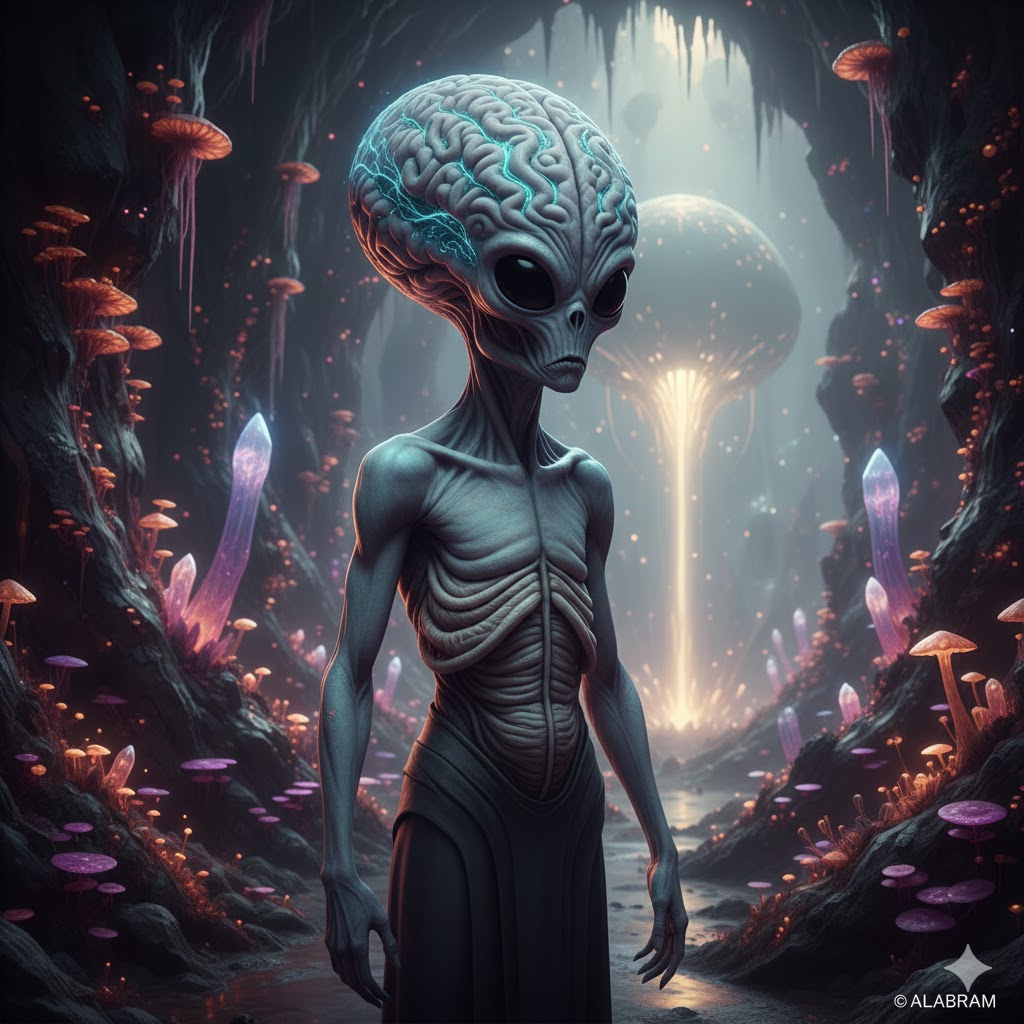
- Average Height: 1.5 – 1.7 meters.
- Average Weight: 50–60 kg (Light-boned due to low-gravity evolution).
- Body Temperature: 35.5°C.
- Pulse/Respiration: 30 BPM (Extremely efficient diaphragms allow for very slow, deep breathing cycles).
- Blood Pressure: 100/60 mmHg.
- Life Expectancy: 400–500 years.
- Hair: None; their skin is smooth and highly sensitive to atmospheric vibrations.
- Skin: Pale, almost translucent grey, reflecting their life in low-light subterranean environments.
- Eyes: Large, dark, and highly specialized for infrared vision to navigate deep tunnel systems.
- Sex: Biological binary, though their gestation period is significantly shorter than humans
Other Physical Information: The beings on this particular planet have a similar physical appearance to us, but with great enlarged diaphragms and lungs. This is because the oxygen on this planet is so weak that an Earth person could not exist. “This planet has millions of people on it like ourselves. Their birthing process is different than us in that they carry the fetus for a shorter gestation period in their stomachs, and regurgitate it when the time for giving birth. At that moment the new baby is extremely small. It reaches full maturity in only seven years. “The beings on this planet have extremely large brains and are able to absorb information through osmosis, and are very telepathic. They drink liquid similar to water and live on foods that are grown in caves and tunnels hollowed out beneath the surface of the earth. The reason for this is the star that serves as their sun is so hot that it would burn the plants if they were planted on the surface of the planet.”
Special Traits and Abilities: extremely large brains and are able to absorb information through osmosis, and are very telepathic.
Communication Type: telepathic
Origin: A scorched planet in a satellite galaxy of Andromeda; the name translates roughly to “The Place of Deep Resonance.”
Life Form Type: humanoid
Subspecies: None known; they maintain a high level of genetic stability
Most Common Species: Alabram Primary (Subterranean Humanoid).
Level of Species: Type III (Kardashev Scale). Their ability to travel between galaxies suggests mastery over dark energy propulsion.
Habits: They are known to visit Earth’s most remote cave systems and volcanic regions, likely because the environmental pressure reminds them of their home world.
Transportation Type: Trans-Galactic Organic Vessels. Their ships are theorized to be “grown” rather than built, reflecting their underground botanical lifestyle.
Witnesses Reports: Rare reports from high-altitude hikers describe “shimmering, large-headed figures” that appear to vanish into solid rock walls.
Special Features/Characteristics: A reinforced rib cage and diaphragm designed for high-efficiency breathing in low-oxygen environments.
Summary/Description: Ruth Montgomery mentions the Alabram, a humanoid species that lives on a planet that lies beyond the Andromeda galaxy. Nobody else mentions them.
Source: Ruth Montgomery
The Biology of Information Absorption
The most striking feature of the Alabram is their ability to learn through a process described by Ruth Montgomery as “osmosis.” Unlike humans, who rely on linear language and sensory input, the Alabram possess a specialized neural cortex that can “pull” data from their environment. When in the presence of an object or an individual, they can absorb the “energetic history” of that subject without a single word being spoken.
This biological trait is a direct adaptation to their subterranean life. Because they live in hollowed-out tunnels to avoid the scorching heat of their sun, their primary senses evolved to function in low-light environments where traditional sight is less reliable than psychic and atmospheric sensing. Their enlarged diaphragms and lungs are not just for breathing thin air; they also act as resonance chambers for their telepathic broadcasts, allowing them to communicate across vast distances within their planet’s crust.
Subterranean Society and the Ethics of Non-Interference
Living in the deep, crystalline tunnel networks of their home world has shaped the Alabram into a society that values collective resonance over individual ego. Because they can “feel” the history of their environment through osmosis, their social hierarchy is built upon the depth of one’s contribution to the planetary “Library of Consciousness.” They do not possess a military or a central government in the human sense; instead, they are guided by a Council of Archivists who determine which galaxies require documentation.
Their ethical code is strictly non-interventional. While other races might attempt to influence human development, the Alabram believe that to interfere with a species’ growth is to “pollute” the information they are trying to gather. This explains why sightings of their organic, grown vessels are so rare—they operate on a different vibrational frequency, one that allows them to move through our physical reality like ghosts in the machine. To the Alabram, Earth is not a prize to be won, but a complex, unfolding story to be preserved for the eternal archives of the Andromeda fringe.
Final Summary: The Wisdom of the Depths
In the study of exopolitics, the Alabram serve as a reminder that the most advanced civilizations are often the most elusive. By evolving to thrive in the extreme environments of the Andromeda fringe, they have developed a society that values the internal and the intellectual over the external and the material. Their unique osmotic learning capability represents an evolutionary leap that humanity has yet to comprehend—a way of knowing that requires no language, only presence. As we continue to explore the depths of our own planet and the reaches of our galaxy, the silent observation of the Alabram stands as a testament to the enduring power of knowledge and the infinite variety of the humanoid form.