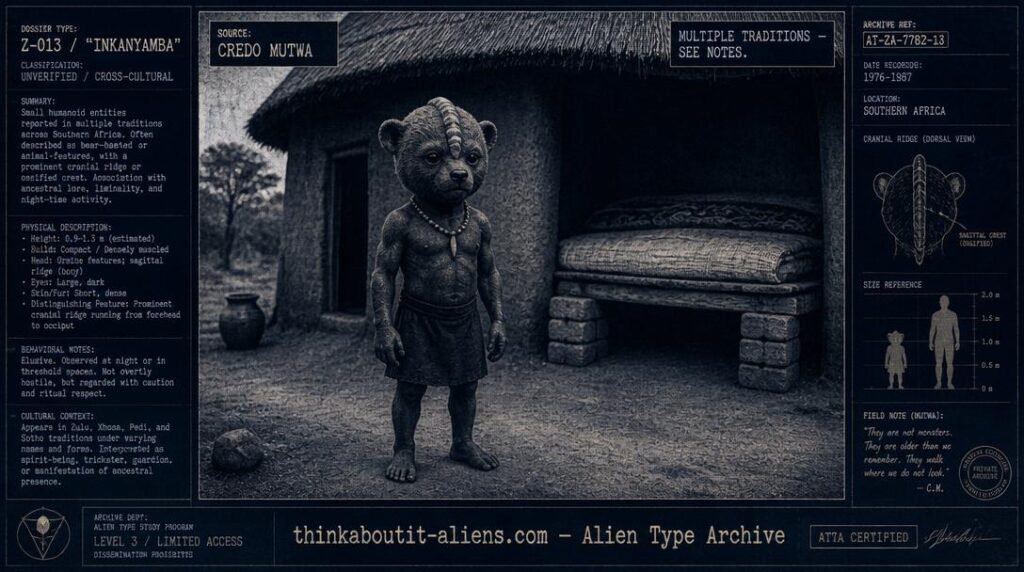
A dossier-style rendering of the Tokoloshe matching Credo Mutwa's own precise physical description, including the protective bed-raising practice he describes.
THINK ABOUTIT’S ALIEN TYPE SUMMARY
TOKOLOSHE
In his own words, recorded in a published interview: “It looks like a very nasty looking teddy-bear in appearance, in that its head is like that of a teddy-bear, but it has got a thick, sharp, bony ridge on top of its head… and with this ridge it can knock down an ox by butting it with its head.” That is Zulu sangoma Vusamazulu Credo Mutwa’s own description of the Tokoloshe, and it is precise enough to quote directly rather than paraphrase into something vaguer. It is also one specific tradition among several: other documented Southern African accounts of the Tokoloshe describe something quite different — withered, grey, long-fingered — and this entry keeps that distinction rather than presenting Mutwa’s account as the single “genuine” version.
Name: Tokoloshe
AKA: Tikoloshe, per Mutwa’s own usage. “The Bony-Ridge Entities” and “The Teddy-Bear Stalkers” are descriptive labels used in this entry but are not documented traditional names.
Location – Home System: Undisclosed. Mutwa describes the Tokoloshe as extraterrestrial in origin without specifying a home planet or system.
Distance from Earth: Undocumented
Attitude: This varies more than a single “malicious” label suggests. Mutwa’s own account includes both threat (the bony-ridge headbutt capable of felling an ox, and the practice of raising beds on bricks as protection) and a more benign detail often omitted from summaries: he states the Tokoloshe “likes to play with children, and has been seen hundreds of times by school children” across South Africa. Other, non-Mutwa folkloric traditions describe a more uniformly malicious, mischievous, or violent entity.
Motives: Undocumented in specific terms beyond the behaviors described above
Physical Appearance: Per Mutwa’s own description: a “nasty looking teddy-bear” appearance, with a head shaped like a teddy bear’s
- Average Height: Undocumented with a specific figure by Mutwa; other, non-Mutwa folkloric descriptions describe a small, dwarf-like stature
- Average Weight: Undocumented
- Body Temperature: Undocumented
- Pulse/Respiration: Undocumented
- Blood Pressure: Undocumented
- Life Expectancy: Undocumented
- Hair: Not specifically described by Mutwa in the source reviewed; other folkloric accounts describe a furry or hairy appearance
- Skin: Undocumented by Mutwa; other, non-Mutwa accounts describe withered or grey skin
- Eyes: Undocumented by Mutwa
- Sex: Undocumented
Other Physical Information: Per Mutwa’s own words: “It has got a thick, sharp, bony ridge on top of its head… The ridge goes from above its forehead to the back of its head.” Mutwa also states plainly that Tokoloshes “have a hole in their head,” without further explanation of its function.
Special Traits and Abilities: Per Mutwa, immense physical strength — specifically, the ability to knock down an ox by head-butting it with the bony cranial ridge
Communication Type: Undocumented by Mutwa in the source reviewed
Origin: Extraterrestrial, per Mutwa’s own stated view, though he gives no specific planet or system of origin
Life Form Type: Described by Mutwa as a physical, biological entity rather than a spirit; no further taxonomic classification is given
Subspecies: Undocumented. “High-Ridge Stalkers” and “Shadow-Dwellers” do not appear in Mutwa’s account and have been removed.
Most Common Species: Undocumented; a “Tokoloshe-Enforcer Type A” designation does not appear in the source
Level of Species: Undocumented (no numbered or graded classification appears in Mutwa’s account)
Habits: Per Mutwa, associated with the widespread South African practice of raising beds roughly three feet off the ground on stacked bricks as a protective measure. He also states the Tokoloshe “likes to play with children” and has reportedly been seen by South African schoolchildren “hundreds of times” in recent years — a detail that complicates a purely predatory characterization.
Transportation Type: Undocumented
Witnesses Reports: Widespread reports across South Africa, per Mutwa, including numerous schoolchildren; Credo Mutwa himself, a Zulu Sanusi (high shaman), is the named source for the specific “teddy-bear” description used throughout this entry. Mutwa separately notes a similarity between the Tokoloshe and a Pacific Island entity called “Tiki,” suggesting the names may share a common root.
Special Features/Characteristics: A hole located in the head, per Mutwa’s own account, without a stated function or explanation
Summary/Description: A widely feared figure across South African tradition, described in one specific, named, first-person account (Zulu sangoma Credo Mutwa) as a physical, extraterrestrial “teddy-bear”-headed being with a sharp bony cranial ridge capable of felling an ox — an entity that inspires precautions like elevated beds, yet which Mutwa also describes as fond of playing with children. Other, separate folkloric traditions describe a differently-appearing being under the same name.
Source: Credo Mutwa, as recorded in published interview transcripts (including material republished by Exopolitics South Africa and related outlets); broader South African and Zulu oral folklore, which in other tellings describes a differently-appearing entity under the same name
Related Cases: A reported similarity, per Mutwa, to “Tiki” traditions in the Pacific Islands; the broader Chitauri/Mantindane cosmology described elsewhere by Mutwa, though he does not explicitly place the Tokoloshe within that specific hierarchy in the source reviewed for this correction
DETAILED REPORT
The physical description at the center of this entry is a close, checkable quotation from Credo Mutwa himself, recorded in an interview and republished by several independent secondary sources with identical wording: a “nasty looking teddy-bear” head bearing a thick, sharp bony ridge running from the forehead to the back of the skull, strong enough to knock down an ox with a single headbutt, and a hole in the head whose purpose Mutwa does not explain. Mutwa states plainly that this is a physical, extraterrestrial entity, not a spirit or myth — a claim that is his own interpretation, offered as such, rather than an independently verified fact.
Two details from Mutwa’s own account were missing from earlier versions of this page and are worth restoring. First, he describes the Tokoloshe as enjoying play with children and states it has been seen “hundreds of times” by South African schoolchildren — a detail that sits uneasily alongside a purely predatory framing and deserves to be represented alongside the more threatening details. Second, Mutwa draws an explicit cross-cultural comparison, noting that a similar creature is reported in the Pacific Islands under the name “Tiki,” which he suggests may share linguistic roots with “Tikiloshe” or “Tokoloshe.”
It is also worth being clear that Mutwa’s account is not the only documented description of the Tokoloshe. Other South African and broader Southern African folkloric traditions describe a differently-appearing being under the same name — variously withered, grey-skinned, long-fingered, sometimes described as created through a specific ritual involving a sangoma and a heated implement. This entry treats Mutwa’s account as one specific, named, first-person source, not as the single correct version superseding all others.
RESEARCHER’S NOTES
A Precisely Quotable Source, and What Got Invented to Explain Its Gaps
- Source Chain Assessment: The core physical description in this entry is an exact, verifiable quotation from Credo Mutwa, consistently reproduced across multiple independent secondary sources. That level of precision is unusual in this archive and deserves to be preserved exactly rather than paraphrased into vaguer, less checkable language.
- Fabricated Biometric and Classification Panel: Precise height, weight, body temperature, blood pressure, and life expectancy figures; a “Technical Tier III” rating; and named subspecies (“High-Ridge Stalkers,” “Shadow-Dwellers,” “Tokoloshe-Enforcer Type A”) do not appear in Mutwa’s account and have been marked Undocumented or removed.
- Fabricated Mechanism for a Genuine Detail: Mutwa states plainly that the Tokoloshe has a hole in its head, but does not explain its purpose. The previous version of this page filled that gap with an elaborate invented mechanism — a “Multidimensional Sensory Port” harvesting “bio-photonic emissions” and “Loosh.” This entry preserves the genuine, unexplained detail and removes the invented explanation built on top of it.
- Genuine Detail Restored: Mutwa’s own statements that the Tokoloshe enjoys playing with children and has been seen by schoolchildren “hundreds of times,” and his cross-cultural comparison to the Pacific “Tiki” tradition, are both part of his actual recorded account and were missing from the previous version of this page.
- Single-Tradition Framing Corrected: The previous version presented Mutwa’s specific “teddy-bear” description as the one “genuine” Tokoloshe, dismissing other documented folkloric accounts. This entry instead treats Mutwa’s account as one specific, valuable, named source among several distinct traditions describing a being under the same name.
What holds up here is genuinely strong by this archive’s standards: a specific, named, precisely quotable source describing a being with concrete, checkable physical detail. It does not need an invented rating system or a fabricated energy-harvesting mechanism to be worth documenting carefully — it needs exactly what Mutwa actually said, including the parts, like children playing with it, that complicate a simpler story.
“It looks like a very nasty looking teddy-bear in appearance… it has got a thick, sharp, bony ridge on top of its head.”
— Credo Mutwa, describing the Tokoloshe.
About the Author