THINK ABOUTIT’S ALIEN TYPE SUMMARY – Chupacabra
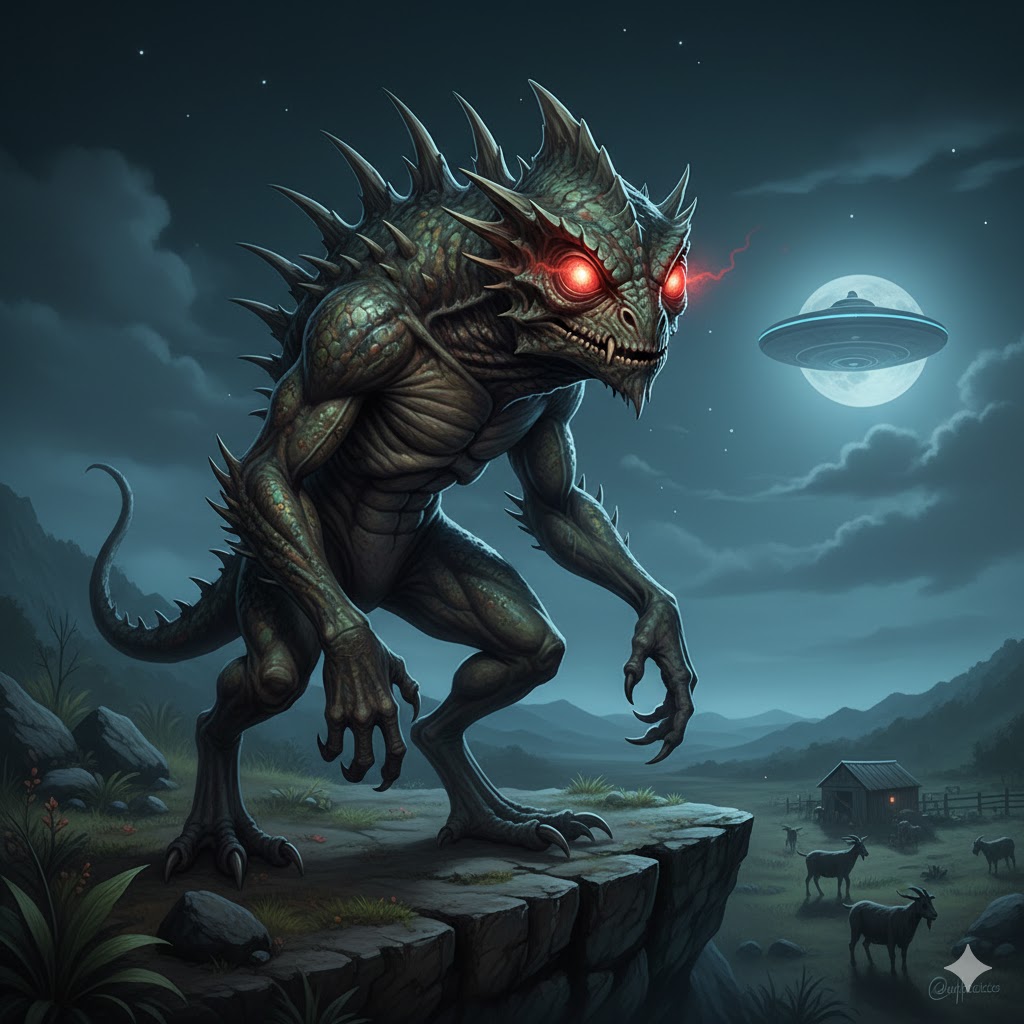
The Chupacabra, famously known as the “Goat-Sucker,” is a unique entity that blurs the lines between cryptozoology and ufology. First rising to global prominence during the 1995 Puerto Rican wave, the creature is described as a bipedal, reptilian-humanoid hybrid with glowing red eyes and a row of quills running down its spine. Unlike standard terrestrial predators, the Chupacabra exhibits sophisticated biological traits, including chameleon-like skin that shifts color for near-perfect camouflage and the ability to leap great distances. Most significantly, it is frequently sighted in the vicinity of UFO activity, leading many researchers to believe it is a bio-engineered “genetic construct” or a pet-like scouting entity belonging to the Greys or other extraterrestrial factions.
Name: Chupacabra
AKA: Goat-Sucker, El Chupacabra, Puerto Rican Gargoyle.
Location – Home System: Unknown; frequently associated with localized “vortex” areas in Puerto Rico and Mexico.
Distance from Earth: N/A (Suspected Interdimensional or Bio-Engineered).
Attitude: Predatory and aggressive; exhibits high-speed evasion tactics.
Motives: Biological resource gathering (blood/plasma) from livestock.
Physical Appearance:
- Average Height: 3 to 5 feet.
- Average Weight: 110 lbs.
- Body Temperature: Variable (due to chameleon-like skin shifting).
- Pulse/Respiration: 140 BPM / 45 breaths per minute (indicating a high-stress, predatory metabolism).
- Blood Pressure: 210/140 (Required for explosive leaping ability and rapid muscle response).
- Hair: strong coarse hair all over its body, observers claim the hair is black
- Skin: it has the remarkable ability to change colors at will, almost like a chameleon. In the dark, it will change to black or a deep brown color — in a sunlit area surrounded by vegetation, it changes to green, green-grey, light brown or beige.
- Eyes: Two elongated red eyes
- Life Expectancy: Unknown; suspected to be a short-lived “expendable” biological unit.
Other Physical Information: Its head is oval in shape and has an elongated jaw. Two elongated red eyes have been reported, together with small holes in the nostril area, a small slit-like mouth with fang-type teeth protruding upwards and downwards from the jaw. Other witnesses have seen small pointed-ears, but this feature has not been seen by other witnesses. The creature has two small arms with a three-fingered clawed hand and two strong hind legs, again with three claws. This appears to enable it to run quickly and leap over trees (!) – some witnesses allege over twenty feet in a single bound.
Special Traits and Abilities: According to many observations, the creature’s legs look almost reptilian or goat-like. It has quill-like appendages running down from its back, with what seem to be fleshy membranes that change color from blue to green, red to purple, etc. A number of witnesses claim the creature flaps (at incredible speed) its tail and appendages, allowing it to actually fly (!). The tail apparently is used to guide its flight only – controlled mainly by the winds – only occasionally seen to flap.
Communication Type: Piercing screeches and high-frequency “hissing.”
Origin: Linked to specialized genetic laboratories on mobile “mothership” crafts or interdimensional portals.
Life Form Type: It is reportedly a cross between a creature known as a ‘Greys‘ alien humanoid, mainly because of the shape of its head and eyes, and what most witnesses describe as the body of a bipedal, erect dinosaur, but with no tail.
Subspecies: Bipedal Reptilian (Puerto Rican variant) and Canine-Hybrid (Mexican/Texan variant).
Most Common Species: The 4-foot “Quilled” bipedal predator.
Level of Species: Grade 2 – Biological Construct / Predator
Habits: Nocturnal hunter; known for complete blood extraction without secondary tissue damage.
Transportation Type: Frequently associated with small, silent orange or blue orbs of light.
Witnesses Reports: First reported in the town of Orocovis, they have been sighted in the municipality of Canovanas and in many areas of Puerto Rico. Its habits are both diurnal and nocturnal – as a matter of fact, it has been seen in broad daylight by several witnesses. One such occasion was witnessed by Madeline Tolentino and her neighbors in the Campo Rico community (municipality of Canovanas). They all observed it walking down a street(!) at 3.00 pm in the afternoon. As they approached it, the creature ran away, ‘at a fantastic speed’ and escaped.
Special Features/Characteristics: Possesses a multi-layered ocular system that allows for thermal imaging and night vision. Their quills act as sensory antennas, detecting electromagnetic shifts in the atmosphere before a UFO arrival.
Summary/Description: A bio-engineered predatory construct featuring glowing red eyes, chameleon-like skin, and specialized feeding apparatus
Source: Puerto Rico UFO Network (PRUFON) / Investigations by Jorge Martin / ‘The Chupacabra Diaries’.
The Genetic Construct Hypothesis
A leading theory among exopoliticians is that the Chupacabra is not a naturally evolving species, but rather a “Chimera” created through advanced genetic engineering. Observers have noted that the creature’s head shape and large, almond-shaped red eyes bear a striking resemblance to the Grey alien archetype. This has led to the hypothesis that the Chupacabra is a biological tool—specifically designed for the sampling of terrestrial genetic material.
The surgical precision of the punctures found on livestock, combined with the complete absence of blood at “kill sites,” suggests a technology-assisted feeding or collection process. If the Chupacabra is indeed an escaped or deployed biological asset, its presence suggests that certain extraterrestrial factions are conducting intensive biological surveys of Earth’s mammalian life under the cover of local folklore.
Bio-Engineering and the Greys: A Shared Lineage?
Physical descriptions of the Chupacabra frequently mirror the biological traits of the Tall Greys. Specifically, the large, wrap-around red eyes and the thin, three-fingered limbs suggest a common genetic blueprint. Researchers hypothesize that the Chupacabra is a specialized biological drone, engineered by the Greys to serve as a mobile “organic sampler.”
Unlike naturally occurring predators that consume meat, the Chupacabra focuses exclusively on blood and soft tissue, suggesting it is collecting plasma for a specific nutrient or genetic requirement of its creators. Its chameleon-like skin, which allows it to transition from a reptilian green to a deep obsidian black, is a sophisticated cloaking technology that far exceeds terrestrial evolution. This “living tech” allows the creature to operate in broad daylight within human communities, as reported in the Canovanas sightings, while remaining virtually invisible to the casual observer.
Final Summary: Beyond Cryptozoology
The Chupacabra is far more than a local myth; it is a profound piece of the extraterrestrial puzzle. By bridging the gap between a wild animal and a high-tech scouting entity, it forces us to reconsider the nature of alien “pets” or biological tools. Whether it is an escaped experiment or a deliberate asset of the Greys, its consistent association with Unidentified Flying Objects and high-frequency energy “vortexes” marks it as a clear product of non-human intelligence. As we continue to document its predatory habits and unique physical traits, the Chupacabra remains a chilling example of the advanced genetic mastery possessed by our visitors from the stars.