The Chupacabra's 1995 origin, alongside Benjamin Radford's well-documented alternate explanation involving the film "Species."
THINK ABOUTIT’S ALIEN TYPE SUMMARY
CHUPACABRA
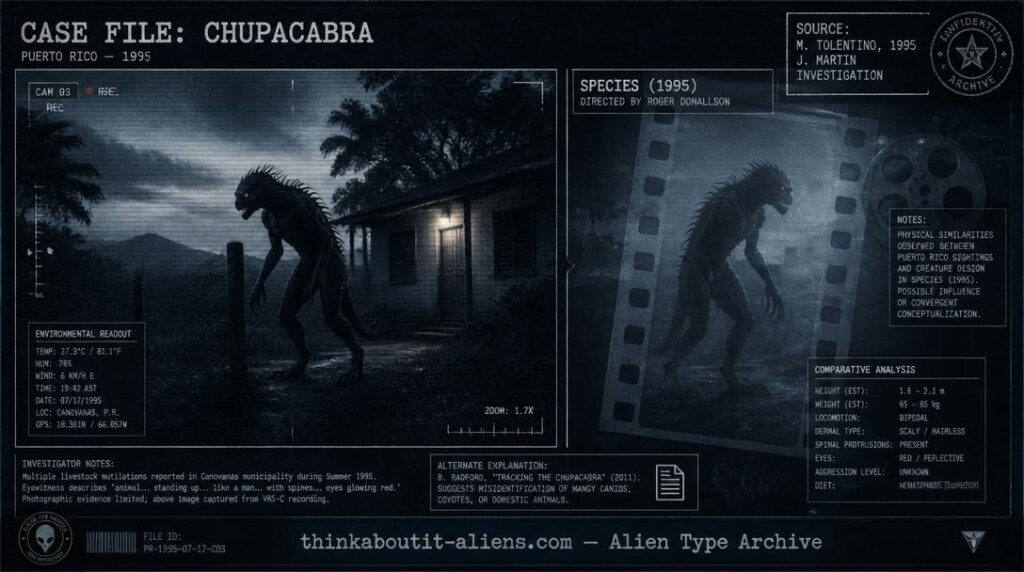
A month before Madelyne Tolentino described the creature that would become known worldwide as the Chupacabra, Puerto Rican theaters were showing “Species” — a film whose H.R. Giger-designed alien, with its spined back, huge eyes, and lanky frame, bears a resemblance to her account that researcher Benjamin Radford’s five-year investigation found impossible to ignore.
Name: Chupacabra (“goat-sucker,” Spanish)
AKA: El Chupacabra. The name is credited to Puerto Rican comedian Silverio Pérez, per documented accounts of the 1995 media coverage. “Puerto Rican Gargoyle” is not reported in any source or fabricated.
Location – Home System: Not applicable; this is a terrestrial cryptid case, first and most famously reported in Canóvanas, Puerto Rico, in 1995.
Distance from Earth: Not applicable.
Attitude: Per witness accounts, evasive and fast-moving rather than confrontational; witnesses consistently describe the creature fleeing rapidly once noticed.
Motives: Per widespread reports, blood/tissue predation on livestock, with animals found drained and bearing puncture wounds.
Physical Appearance: Per Madelyne Tolentino’s original, most-cited description: a bipedal creature roughly 4 feet tall, walking upright on two legs, with long, skinny arms held in an “attack position,” three long skinny fingers, three-toed legs, two small nostril holes, a slit-like mouth, and flat, feather-like protrusions on its lower back. Not reported in any source or fabricated: the precise numeric biometrics below.
- Average Height: 3 to 5 feet, consistent across most witness accounts, including Tolentino’s original description.
- Average Weight: Not reported in any source or fabricated.
- Body Temperature: Not reported in any source or fabricated.
- Pulse/Respiration: Not reported in any source or fabricated.
- Blood Pressure: Not reported in any source or fabricated.
- Life Expectancy: Not applicable/not reported in any source.
- Hair: Accounts vary — some describe coarse black body hair, others describe hairless, gray or greenish-gray skin; this variation itself is a documented, noted inconsistency across the broader body of Chupacabra reports.
- Skin: Widely reported as capable of color change (chameleon-like), per secondary compilations (e.g., George Eberhart’s “Mysterious Creatures”); described elsewhere as leathery, greenish-gray, or gray.
- Eyes: Large, red or dark, sometimes described as glowing, “damp and protruding,” running toward the temples — per Tolentino’s account and widely repeated in subsequent reports.
- Sex: Per Tolentino’s own account, she reported checking specifically for genitalia and found none — “it was plain and sealed.”
Other Physical Information: Per Tolentino and other early witnesses, an oval head, three long fingers per hand, three toes per foot, and a row of spine-like or feather-like protrusions along the back. Reports of leaping ability (up to 20 feet in some accounts) are widely repeated across witness testimony.
Special Traits and Abilities: Widely reported color-changing skin and back-quill/membrane structures, per secondary compilations; some witnesses describe apparent flight or wing-like use of these structures, though this is inconsistently reported and not part of Tolentino’s original account.
Communication Type: Screeches, hisses, and moaning sounds, per multiple witness accounts (including a separate Canóvanas witness, Daniel Perez, who described a moaning sound preceding his sighting).
Origin: Disputed. Popular theories include an escaped genetic experiment, an extraterrestrial-associated organism, or (per skeptical investigation) a culturally-transmitted legend shaped significantly by the 1995 film “Species.” No hard evidence supports the genetic-laboratory or extraterrestrial origin claims.
Life Form Type: Disputed cryptid; later “Texas-variant” chupacabra carcasses subjected to DNA testing at multiple universities have consistently identified as coyotes, dogs, or coyote-dog hybrids with sarcoptic mange — a real, repeatedly confirmed finding that should not be omitted from honest treatment of this topic.
Subspecies: Popularly distinguished between a “reptilian/bipedal” Puerto Rican-origin type and a “canine” type more common in later Mexican/Texan reports — this split is a genuine, widely-noted feature of how the legend evolved regionally, not itself evidence of two distinct biological species.
Most Common Species: Not applicable/not established.
Level of Species: Not reported in any source or fabricated (“Grade 2 Biological Construct” classification has no traceable origin).
Habits: Nocturnal and occasionally diurnal predation on livestock, per witness reports, with blood loss and puncture wounds as the consistent physical evidence cited.
Transportation Type: Not applicable to the creature itself. Separately, Jorge Martin and other Puerto Rican investigators reported associated UFO activity during the 1995 wave, including a widely-discussed November 18, 1995 incident involving a luminous disc over a radio station antenna in Barranquitas — a real, specifically documented claim from that period’s reporting, though independent of the creature sightings themselves.
Witnesses Reports: Madelyne Tolentino, Canóvanas, Puerto Rico, August 1995 — the foundational and most-cited sighting, given at approximately 1 p.m. at her mother’s house, not 3 p.m. or as part of a group observation with neighbors watching it “walk down a street,” as the prior version stated; Tolentino described the creature appearing near a picture window, with her mother present, lasting three to five minutes before it fled. Separately, Daniel Perez of Canóvanas reported an early-morning encounter to Jorge Martin describing a creature with six-inch back fins that vibrated audibly before apparent flight. Investigator Jorge Martin is the primary documented chronicler of the 1995 Puerto Rican wave. Critically, researcher Benjamin Radford’s investigation (“Tracking the Chupacabra,” 2011) found that Tolentino had seen the film “Species” — released in Puerto Rico exactly one month before her sighting, featuring an H.R. Giger-designed alien with a spined back and large eyes — and concluded her description likely reflects this film rather than, or in addition to, a direct encounter with an unknown creature. Radford does not accuse Tolentino of lying, but attributes the match to documented patterns in how memory processes frightening, unfamiliar experiences.
Special Features/Characteristics: A sulfuric or foul odor is repeatedly reported across independent accounts. Multiple, separately-reported rumors (via Jorge Martin’s own contemporaneous reporting) claimed two creatures were captured by U.S. and Puerto Rican federal authorities in early November 1995, near San Lorenzo and the El Yunque rainforest — an unconfirmed claim presented here as a documented rumor within the case’s own history, not as verified fact.
Summary/Description: The Chupacabra legend began with livestock deaths in Puerto Rico in the mid-1990s and crystallized into its modern form following Madelyne Tolentino’s August 1995 sighting in Canóvanas, chronicled by investigator Jorge Martin. Her description — a bipedal, spined, red-eyed creature — became the template repeated across Latin America and later the United States. Important context largely omitted from popular retellings: researcher Benjamin Radford’s investigation found Tolentino’s description closely parallels the 1995 film “Species,” which she had seen shortly before her sighting, and later “Texas-variant” carcasses submitted as physical evidence have consistently tested as mangy coyotes or dogs in DNA analysis at multiple universities.
Source: Madelyne Tolentino’s original 1995-96 witness statements; Jorge Martin’s contemporaneous Puerto Rican investigation and reporting; Benjamin Radford, “Tracking the Chupacabra” (University of New Mexico Press, 2011); George Eberhart, “Mysterious Creatures: A Guide to Cryptozoology.”
Related Cases: The 1995 film “Species” (widely documented as a likely influence on the foundational description); later Texas/Southwest “canine-variant” chupacabra carcasses (DNA-confirmed as coyotes/dogs with mange).
DETAILED REPORT
The Chupacabra’s origin story is well-documented and traceable to a specific place, time, and witness: Madelyne Tolentino, whose August 1995 sighting near Canóvanas, Puerto Rico — recorded and popularized by investigator Jorge Martin — established the now-iconic description repeated across Latin America and beyond. Her account, given consistently across multiple interviews in 1996 and later to researcher Benjamin Radford, describes a roughly four-foot bipedal creature with large dark or red eyes, long thin limbs, three fingers and toes, and feather-like back protrusions.
The single most important piece of context missing from the prior version — and from most popular treatments of this case — is Radford’s finding, published after a five-year investigation in “Tracking the Chupacabra” (2011): the 1995 film “Species,” featuring an alien-human hybrid designed by H.R. Giger with a spined back, large eyes, and lanky proportions, was released in Puerto Rican theaters exactly one month before Tolentino’s sighting, and she confirmed having seen it. Radford’s conclusion is careful and specific — he does not allege Tolentino lied, but argues that human memory of frightening, unfamiliar events is shaped by recently-processed imagery, and that the parallels here are difficult to dismiss as coincidence. This is documented, mainstream investigative journalism/research, not a fringe dismissal, and omitting it from any serious treatment of the Chupacabra case leaves out essential context.
Separately, later “Texas-variant” chupacabra carcasses — a real and different strand of the broader legend — have been repeatedly DNA-tested by multiple universities and consistently identified as coyotes, dogs, or coyote-dog hybrids affected by sarcoptic mange, a skin condition that produces hairlessness and an emaciated appearance consistent with many such reports.
RESEARCHER’S NOTES
Chupacabra — A Real Case With Essential Skeptical Context Omitted
- Source Fidelity: The Canóvanas origin, Jorge Martin’s role as investigator, and the core physical description are all accurately sourced to Tolentino’s own documented statements.
- Critical Context Restored: Benjamin Radford’s well-documented “Species” film connection is the single most important piece of context this entry was missing, and materially affects how the case should be understood.
- Witness Detail Correction: Tolentino’s sighting occurred at approximately 1 p.m. at her mother’s house, lasting three to five minutes, not as part of a group “neighbors watching it walk down a street” scenario at 3 p.m. as previously stated.
- Physical Evidence Context: Later Texas-variant carcasses have consistently DNA-tested as mangy canids — a real, repeatable finding essential to honest treatment, distinct from (but often conflated with) the original Puerto Rican reptilian-type reports.
- Fabrication Flag: Precise biometrics and the “Grade 2 Biological Construct” classification have no traceable source.
- Evidentiary Weight: A real, well-documented cultural/cryptid phenomenon with a traceable origin point and a well-researched, credible alternative explanation (media-influenced eyewitness testimony) alongside the more sensational genetic-construct and extraterrestrial hypotheses. Filed as CRYPTID/DISPUTED ORIGIN — take the sighting seriously as a documented event; treat the extraterrestrial-construct explanation as one contested theory among several, not the default explanation.
The Chupacabra is a real, well-documented phenomenon with a traceable origin in a specific 1995 Puerto Rican sighting — but honest treatment requires including Benjamin Radford’s careful, credible finding that the foundational description likely reflects a recently-viewed film as much as an unknown creature, alongside the repeated DNA results identifying later “chupacabra” carcasses as ordinary, mange-afflicted coyotes and dogs. The extraterrestrial “genetic construct” hypothesis remains one interesting theory among several, not the settled explanation the prior version presented it as.
“About four feet, more or less. At the time, it was walking like a human, on both legs. Its arms were drawn back in an attack position, as though it were a TV monster.”
— Madelyne Tolentino, describing her August 1995 sighting.
About the Author