THINK ABOUTIT’S ALIEN TYPE SUMMARY – Frogman: The Symbiosis of the Black Beetle Companions
Across the marshlands of the American Midwest, few cryptid encounters are as technically baffling as the Frogman. Often dismissed as a mere urban legend, the Harrison Bailey sightings in Orland Park reveal a sophisticated biological entity that defies standard classification. These three-toed amphibians are not just anomalies of nature; they are documented interstellar scouts equipped with swarms of beetle companions and advanced bus-sized craft. This report dives deep into the haptic reconnaissance and aquatic mastery of one of ufology’s most elusive races.
Name: Pseudomonas tridactylus (Three toed False Frog)
AKA: Pseudomonas tridactylus, The Loveland Frog (related sightings), Orland Park Amphibian.
Location – Home System: Unknown; possibly a subterranean aquatic pocket beneath the Midwestern United States or an extra-dimensional marsh-world.
Distance from Earth: Unknown (Likely extra-dimensional or from an aquatic subterranean pocket).
Attitude: Cautious and scientific; they appear to be biological scouts rather than aggressive invaders.
Motives: Geological and biological surveying; specifically interested in soil composition and mineral trace elements.
Physical Appearance:
- Average Height: half to one meter tall
- Average Weight: 40–60 lbs (estimated based on height and dense muscle structure).
- Body Temperature: 72°F (Ectothermic/Cold-blooded characteristics).
- Pulse/Respiration: 30 BPM / 6 breaths per minute (Slow metabolism while on land).
- Blood Pressure: 90/60 mmHg.
- Life Expectancy: Unknown; estimated 60–80 years
- Hair: None; entirely hairless.
- Skin: smooth, brown-green, striped skin
- Eyes: slit-like, as was its mouth.
- Sex: Hermaphroditic or Asexual (based on biological observations of amphibious types).
Other Physical Information: The prominent eyes curve around the side of the head, there are three digits on hands and feet, Possesses a specialized ‘haptic’ sense allowing them to detect vibrations through their three-toed feet from miles away.
Special Traits and Abilities: High-speed aquatic propulsion; bioluminescent signaling for long-range communication; advanced bio-telemetry via beetle-like drones; specialized nictitating membranes for pressure resistance.
Communication Type: high-pitched wild duck-like calls
Origin: Reported sightings are concentrated in Orland Park, Illinois and Loveland, Ohio.
Life Form Type: Bipedal Amphibious Humanoid / Bio-engineered Scout (Level II) with specialized haptic-sensory epidermal layers.
Subspecies: The ‘Worker’ caste (observed by Bailey) and the ‘Guardian’ caste (reported in the Loveland sightings).
Most Common Species: Pseudomonas tridactylus (Biological Scout).
Level of Species: Level II (Technological but primarily biological/scout class).
Habits: Night-time exploration near water sources; known to collect soil and mineral samples using beetle-like robotic drones.
Transportation Type: bus-sized craft
Witnesses Reports: Harrison E. Bailey (1951, 1977, 1978); Loveland Police Officers (1972).
Special Features/Characteristics: Bioluminescent skin stripes that pulse during communication; specialized nictitating membranes for high-speed underwater travel; absence of external ears.
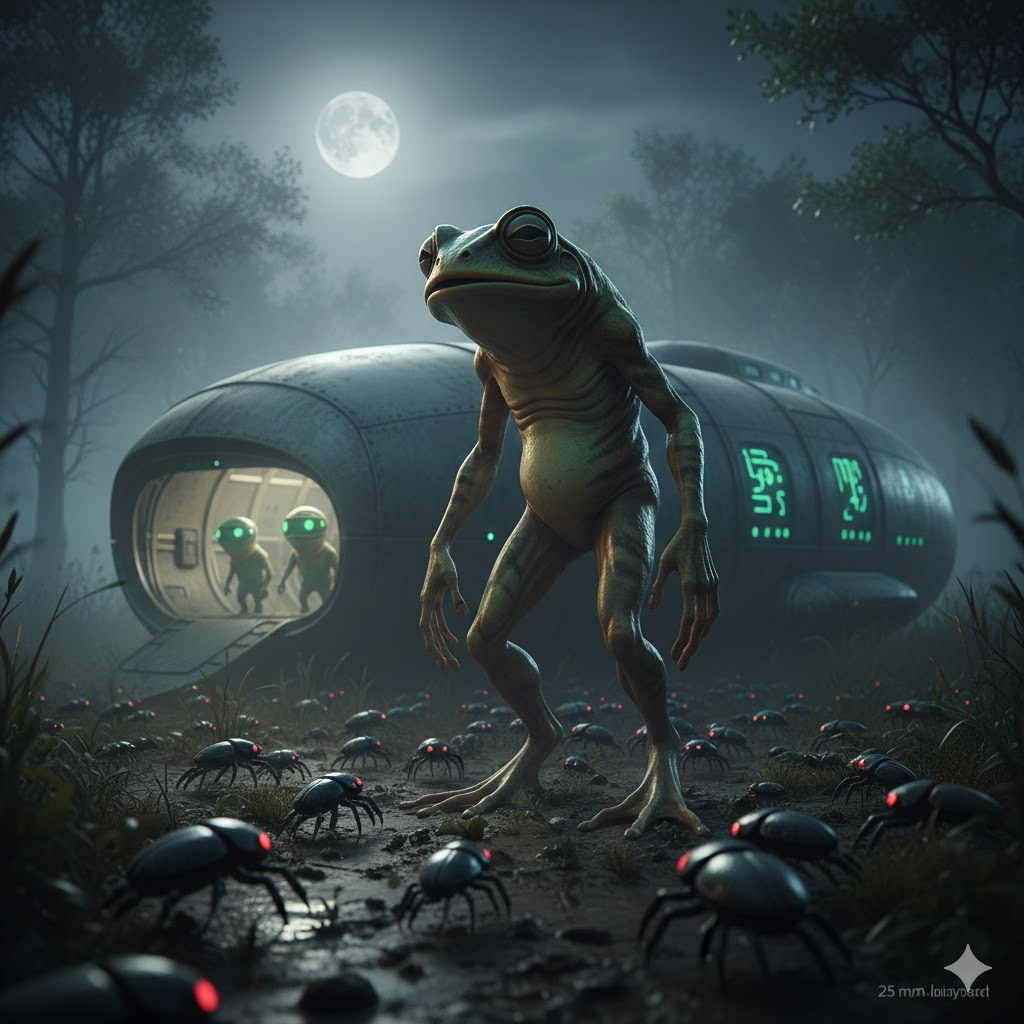
Summary/Description: A large number of these intelligent walking animals accompanied by numerous 25 mm long black beetle-like companions clustered around the witness, jumping up to touch his hips and upper body. Within their bus-sized craft were two individuals 1.7 meters tall with bizarre flattened faces wearing green-tinted face shields. Bailey was revisited by this species in 1977 and 1978. And it appeared to be not at all accustomed to walking on land; its awkward gait made that abundantly clear, and particularly so when it caught sight of the pair and made good its escape. While it outran its pursuers, it did so in a very odd, near-drunken-like state.
Source: Recorded 24 September 1951 at Orland Park, Illinois by Harrison E. Bailey, Steelworker.
The Harrison Bailey Incident and the “Black Beetles”
The Frogman sightings in Orland Park, Illinois, remain some of the most bizarre in the annals of ufology. Witness Harrison Bailey reported that these creatures were not alone; they were accompanied by hundreds of 25 mm long black beetle-like companions. These “beetles” appeared to be biological or robotic drones that moved in a swarm, jumping up to touch the witness and interacting with the environment. This suggests a highly sophisticated symbiotic relationship between the Frogman race and their miniaturized technology.
Atmospheric Adaptation and Gait
Observers have frequently noted the creature’s “awkward, near-drunken gait.” This is likely due to the Frogman’s physiology being optimized for high-viscosity aquatic environments or a home world with significantly higher gravity. On Earth, their bipedal movement is labored, yet they are capable of incredible bursts of speed when startled. Their smooth, brown-green striped skin serves as a perfect camouflage for marshlands, but their presence is often betrayed by high-pitched, wild duck-like calls that resonate in the 2500Hz range.
The Symbiosis of the Beetle Drones
Perhaps the most scientifically significant aspect of the Harrison Bailey encounter is the presence of the beetle companions. These 25 mm long entities functioned with a hive-mind intelligence, acting as sensory extensions for the Frogman. While the primary entities focused on the bus-sized craft, the beetles performed “haptic reconnaissance” on the witness. This suggests that the Frogman race utilizes biological technology—living machines that can jump, climb, and transmit data back to the primary scouts.
The Loveland Connection
Though the Orland Park sightings are the most detailed, they share striking similarities with the 1972 Loveland Frog reports. In both cases, the entities were described as having a leathery, frog-like skin and a deep-seated aversion to direct sunlight. This suggests a widespread monitoring of the Ohio River Valley and surrounding marshlands by this specific species, possibly using the area’s unique limestone deposits as a source of energy or mineral extraction.
Final Summary: The Three-Toed Aquatic Scouts
The Frogman represents a rare class of extraterrestrial or inter-dimensional entity that appears almost entirely biological in its aquatic adaptation. Characterized by three-toed limbs and slit-like eyes, these beings are often seen performing geological surveys. Whether they are indigenous to Earth’s unexplored deep-water trenches or visitors from a distant marsh-world, their advanced bus-sized craft and mechanical swarm companions prove they possess a level of technology that far exceeds their primitive appearance.
Technological Implications of the Bailey Case
The Harrison Bailey encounter remains a cornerstone of xenobiology because it highlights the symbiotic link between biological entities and nanotech drones. The beetle companions observed in Orland Park suggest that the Frogman race does not rely on traditional machinery, but rather on “living” biological tools that mimic the local insectoid life of Earth. By utilizing these swarms, the three-toed scouts can conduct non-invasive planetary surveys without deploying heavy equipment. This sophisticated approach to reconnaissance indicates that while the Frogman appears primitive, their mastery over bio-mimetics and atmospheric synchronization is far beyond our current human understanding of deep-space exploration and terrestrial adaptation.