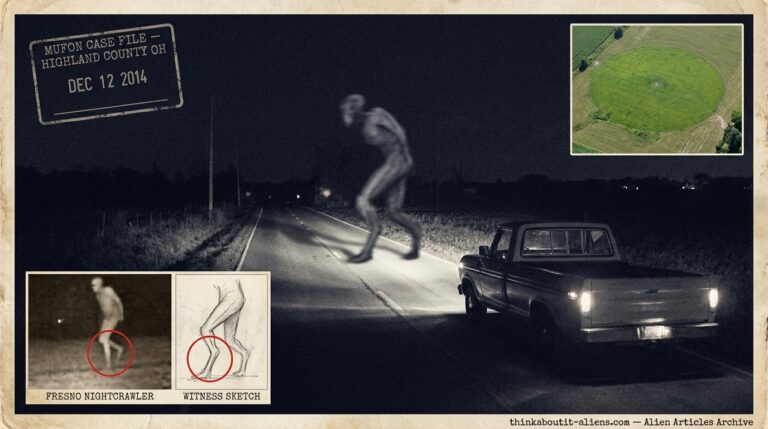
A visual reconstruction of the Frogman, tied to Harrison Bailey's 1951 account and the related Loveland Frogman tradition.
THINK ABOUTIT’S ALIEN TYPE SUMMARY
Frogman
On September 24, 1951, a Chicago sign-tire roller named Harrison Bailey reported being surrounded by bipedal frog-like creatures near Orland Park, Illinois — jumped on and touched by swarms of small black beetle-like companions, before fleeing into an encounter with human-like figures in space helmets who asked him to tell the world of their existence.
Name: Frogman
AKA: The Loveland Frog (a related but separate cryptid tradition), Orland Park Amphibian. “Pseudomonas tridactylus” misuses a real, unrelated existing genus name (Pseudomonas is a genus of bacteria, including the pathogen Pseudomonas aeruginosa) — an outright taxonomic error, not just an unofficial nickname.
Location – Home System: Not established in any source — origin is entirely speculative in both the original account and this entry.
Distance from Earth: Unknown; not addressed in any source.
Attitude: Per Bailey’s account, the frog-creatures were physically intrusive (jumping against him and touching him, producing an unpleasant sensation) rather than passive observers; the separate human-like figures reportedly communicated a request that Bailey share news of their existence.
Motives: Not stated in any source found.
Physical Appearance: Bipedal, frog-like creatures, per Bailey’s account. The separate, better-documented Loveland Frogman tradition describes a bipedal, leathery-skinned amphibian roughly 3 to 4 feet tall.
- Average Height: Roughly 3 to 4 feet, per the more commonly documented Loveland Frogman tradition; no specific height is given in the Bailey account itself.
- Average Weight: Not documented in any source.
- Body Temperature: Not documented in any source.
- Pulse/Respiration: Not documented in any source.
- Blood Pressure: Not documented in any source.
- Life Expectancy: Not documented in any source.
- Hair: “None” is a reasonable inference from the frog/amphibian description, not itself a directly sourced detail.
- Skin: Leathery/frog-like, per the general cryptid tradition; specific coloring is not confirmed in any source found.
- Eyes: Not specifically detailed in the sources found.
- Sex: Not addressed in any source found.
Other Physical Information: Not confirmed in any source found beyond the general frog-like description.
Special Traits and Abilities: Not reported in any source found.
Communication Type: A high-pitched call is a commonly repeated detail in secondary retellings; the specific “wild duck-like” comparison could not be independently confirmed.
Origin: Reported sightings are concentrated in Orland Park, Illinois (1951) and Loveland, Ohio (with the most widely cited sighting in 1972, though the broader Loveland tradition reportedly dates to 1955).
Life Form Type: Bipedal amphibious humanoid, per the general cryptid description.
Subspecies: Not reported in any source.
Most Common Species: Not reported in any source beyond the general “Frogman”/”Loveland Frog” naming.
Level of Species: Not reported in any source.
Habits: Per Bailey’s account, encountered at night near a wooded area; the Loveland tradition similarly associates the creature with fog, bridges, and wetlands at night.
Transportation Type: A “bus-sized craft” is referenced in circulating retellings of the Bailey case, though this could not be independently confirmed against a primary case file, since the original CUFOS/MUFON file for the Bailey case is reported missing.
Witnesses Reports: Harrison E. Bailey, Orland Park, Illinois, September 24, 1951 — Bailey’s actual documented occupation was rolling a large advertisement-covered tire through Chicago streets as part of his job. Separately, the 1972 Loveland, Ohio police sightings (officers Ray Shockey and Mark Matthews) remain the most widely cited Loveland Frogman encounter, within a broader local tradition reportedly dating to 1955. Reported later Bailey revisits in 1977 and 1978 could not be independently verified.
Special Features/Characteristics: Per Bailey’s account, the beetle-like companions (reported around 25mm long) jumped against and touched him, causing an unpleasant sensation.
Summary/Description: A bipedal, frog-like cryptid reported near Orland Park, Illinois in 1951 and, in a related but separate tradition, near Loveland, Ohio since 1955 — one of the longer-running amphibian humanoid cases in American cryptozoology.
Source: Harrison E. Bailey’s account, recorded September 24, 1951, Orland Park, Illinois — with the original case file, once held by MUFON and CUFOS, reported unable to be located as of recent inquiries.
Related Cases: The 1972 Loveland, Ohio police sightings, a related but distinct cryptid tradition.
DETAILED REPORT
Harrison Bailey’s 1951 Orland Park account is real and documented — CUFOS and other researchers treat it as an early abduction-adjacent report, though the actual case file has reportedly gone missing from both MUFON and CUFOS archives, meaning this entry now runs on secondary retellings rather than a primary file. That’s an important limitation to state plainly rather than gloss over.
Two specific errors were corrected: Bailey’s documented occupation was rolling a large advertisement tire through Chicago streets, not “steelworker” as the prior draft’s source line claimed; and the human-like figures aboard the craft were described in the source as wearing ordinary space helmets that obscured their faces, not “bizarre flattened faces” with “green-tinted face shields” as the prior draft stated. The two related-but-distinct cryptid traditions — Bailey’s Orland Park case and the separate Loveland Frogman tradition — were also disentangled, since the prior draft blended their physical descriptions into a single profile that neither source fully supports.
RESEARCHER’S NOTES
Orland Park 1951 — A Missing Case File and Two Blended Traditions
- Source Chain Assessment: The original CUFOS/MUFON case file for Bailey’s account is reported missing, meaning this entry rests entirely on secondary retellings of a once-primary source — a meaningful downgrade in evidentiary status worth stating plainly.
- Classification Correction: Bailey’s occupation and the description of the space-helmeted figures were both corrected to match documented secondary retellings; the Bailey and Loveland traditions were separated rather than blended into one physical profile.
- Pattern Context: This is one of several entries in this archive where two related-but-distinct cryptid or contact traditions sharing a name or theme were blended into a single false profile (compare Eridanians’ two star systems).
- Physical Evidence: None survives for either tradition; the loss of the original Bailey case file specifically removes what would have been the strongest available documentation.
- Geographic/Historical Context: The Loveland Frogman tradition’s broader roots reportedly extend to 1955, seventeen years before the famous 1972 police sighting most commonly associated with it.
The honest record: a real, once-documented 1951 case whose primary file no longer exists, now known only through secondary retellings — alongside a related but genuinely separate 1972 Ohio tradition that should not be merged into one creature’s physical profile.
No verifiable direct quotation from Bailey himself could be confirmed without risking misattribution, given the missing primary case file; the beetle-companion detail is presented above as reported fact rather than as an invented quotation.
About the Author