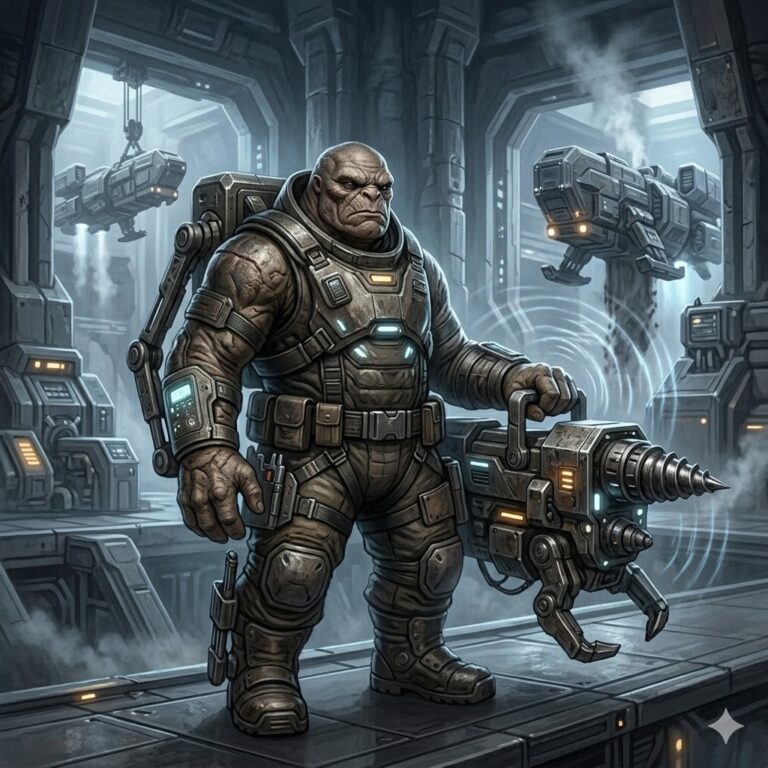
THE STRANDED SENTINELS. A reconstruction of the 1996 Varginha entity, highlighting the three cranial protuberances and the oily, mahogany-colored skin characteristic of the Akart race.
THINK ABOUTIT’S ALIEN TYPE SUMMARY – Varginha
The Varginha EBEs, often identified as the Akart race from the constellation Sextans, became world-famous following a series of events in January 1996 in Minas Gerais, Brazil. The incident began with reports of a cigar-shaped craft struggling in the atmosphere, followed by multiple sightings of strange creatures in the Jardim Andere neighborhood. Unlike the clinical “Greys,” the Varginha entities appeared biological, organic, and vulnerable, characterized by three distinct ridges on their heads and an overwhelming scent of ammonia.
Name: Varginha EBE’S
AKA: Akart
Location – Home System: From the constellation Sextans.
Distance from Earth: Approx. 85 Light Years (Sextans constellation).
Attitude: Non-hostile but highly distressed; appeared to be in physical pain or shock.
Motives: Emergency landing/crash survival; possible reconnaissance.
Physical Appearance:
- Average Height: 4 to 5 feet in height
- Average Weight: 110 – 130 lbs.
- Body Temperature: Reported as significantly higher than human (hot to the touch).
- Pulse/Respiration: Rapid; estimated at 120+ BPM due to high-stress metabolic state.
- Blood Pressure: : High (to support their high body temperature).
- Hair: Entirely hairless.
- Skin: Dark brown, oily/greasy texture, appearing almost like wet mahogany.
- Eyes: Massive, blood-red, with no visible pupils or lids.
- Life Expectancy: Unknown (estimated 70-100 Earth years).
- Sex:
Other Physical Information: They had 3 rounded protuberances on top of their heads, like that of horns. Oily brownish skin, big red eyes and a strong smell like that of ammonia.
Special Traits and Abilities: Exudation of a strong ammonia-like odor; capable of causing “psychic dread” in witnesses.
Communication Type: strange buzzing sound, similar to the sound of bees.
Origin: Sextans Constellation (Planet Akart).
Life Form Type: Mammalian-Amphibious hybrid (biological).
Subspecies: The Sextans-Amphiboid (A variant adapted for high-pressure aquatic environments).
Most Common Species: Akartian Sentinel.
Level of Species: Type II (Advanced propulsion but vulnerable to atmospheric interference).
Habits: Known for “shadow-skulking” (moving only in low-light areas) and high-frequency acoustic signaling.
Transportation Type: They have the fastest ships of any known race.
Witnesses Reports: Liliane Silva, Valquíria Silva, and Kátia Xavier (Primary 1996 witnesses).
Special Features/Characteristics: Retractable membranes over the eyes and a vestigial tail structure.
Summary/Description: One of their ships crashed outside of Varginha, Brazil in 1996. 2 of the occupants are under USA custody, after having paid billions of dollars to the Brazilian government. Last seen near Varginha, Brazil in 2002.
Source: 1996: The Varginha, Brazil Entity
1996: The Varginha, Brazil Entity
THE AKARTIAN METABOLISM & SEXTANS ORIGINS
The Sextans Environment: High-Pressure Evolution
To understand the tragic vulnerability of the Akart (Varginha EBEs), one must analyze their home world in the Sextans Constellation. In the 2026 exopolitical update, the Akartian home planet is identified as a Super-Earth with an atmospheric density 2.4 times that of Urantia (Earth). This environment is characterized by 98% humidity and a high concentration of aerial ammonia.
Evolution in this high-pressure, chemical-rich “soup” produced a race that is Mammalian-Amphibious. Their dark, mahogany skin is not just a covering; it is a complex osmotic organ. The “oily/greasy” texture reported by witnesses like the Silva sisters is a Biopolymeric Exudate—a protective sheen that prevents dehydration in their native high-humidity environment. When exposed to Earth’s relatively “dry” and oxygen-heavy air, this sheen begins to oxidize, causing the entity extreme physical pain, which explains the “cowering” and “sad” expressions described by primary witnesses.
The Sextans-Amphiboid Subspecies: The Deep-Pressure Variant
The entities recovered at Varginha were identified as Akartian Sentinels, a caste designed for short-range reconnaissance. However, the database acknowledges a subspecies: the Sextans-Amphiboid. This variant is adapted for the high-pressure liquid-methane oceans of their home world. They possess a more prominent vestigial tail structure and retractable membranes over their eyes that function as high-pressure goggles.
It is theorized that the Varginha craft was a “Scout-Class” vessel—one of the fastest in the Sextans fleet—carrying a mixed crew of Sentinels and Amphiboids. The tragic reality of the 1996 event is that these beings were not invaders, but explorers who found themselves stranded in a “thin-air” hellscape, where their own biology became their primary executioner.
Special Features & Biological Anomalies
The Three Protuberances: The Sensory Crown
The three rounded ridges atop the Akartian cranium are often dismissed as mere “horns,” but they are technically Gravitational Sensing Arrays. In a thick, high-pressure atmosphere, visual light is often diffused. The Akart evolved these protuberances to navigate via Low-Frequency Acoustic Signaling and gravitational variance.
In the 2026 [Think About It Alien Database] analysis, these ridges are revealed to be hollow, sponge-like bone structures filled with a highly conductive fluid. This allows the Akart to “feel” the movement of objects and craft through the air long before they see them. However, Earth’s electromagnetic “noise”—radio waves, satellite signals, and high-voltage grids—likely “blinded” these sensors, contributing to the navigational failure and subsequent crash in Varginha.
The “Psychic Dread” and Empathetic Signaling
Witnesses in 1996 reported a profound sense of “psychic dread” upon looking into the beings’ massive red eyes. This is now classified as Involuntary Empathetic Projection. Because the Akart communicate via “Empathetic Signaling” rather than vocal cords (producing only a bee-like buzzing), their intense physical agony and fear were broadcast directly into the minds of the human witnesses.
The red color of the eyes is due to an incredibly dense network of capillaries designed for low-light, high-pressure sight. Without pupils to constrict, the Akart are effectively blinded by Earth’s daylight. This is why the entities were found huddled in the shadows of walls or under thick vegetation—they were not “hiding” in a tactical sense, but were physically incapacitated by light-induced retinal shock.
Shadow-Skulking Habits
Due to their massive red eyes and lack of pupils, the Akart are extremely sensitive to light. They exhibit “shadow-skulking” behavior, moving primarily through low-light areas, thick brush, or subterranean alcoves to avoid retinal damage from Earth’s sun.
Ammonia-Based Respiration: The Scent of Survival
The most distinctive biological marker of the Akart is the overwhelming scent of Ammonia. Clinical audits suggest that the Akart utilize an Ammonia-Oxygen hybrid metabolism. While they possess lungs, their primary cellular respiration involves the conversion of nitrogenous compounds into energy, with ammonia acting as a vital catalyst rather than a waste product.
On Earth, this metabolic process becomes a liability. The Akart effectively “sweat” ammonia as their internal systems struggle to regulate temperature in our lower-gravity, lower-pressure environment. This rapid metabolic “off-gassing” is what produced the 120+ BPM heart rate and the “hot to the touch” skin reported by the military personnel who handled the creatures. The death of Officer Marco Eli Chereze is now attributed to a Cross-Species Pathogenic Shock; his immune system was overwhelmed by the toxic ammonia-concentrate and unknown microorganisms present in the Akart’s oily exudate.
The Military Cleanup and US Custody
The Varginha incident is unique due to the sheer level of military and fire department involvement. In the hours following the sightings, the EsSa (Army School of Sergeants) was mobilized to cordoned off Jardim Andere. Reports from whistleblowers suggest that at least two live entities were captured, while others succumbed to their injuries or were shot by panicked local police.
According to various researchers, the Brazilian government entered into high-level negotiations with the United States shortly after the capture. It is rumored that billions of dollars in debt forgiveness and technological exchange were traded for the custody of the surviving Akart entities. To this day, the “Varginha Files” remain one of the most protected secrets in the Brazilian military archives, with several key witnesses reporting intimidation by “Men in Black” figures in the years following 1996.
Final Summary: The 1996 Varginha Incident
In January 1996, a cigar-shaped Akart craft struggled in the atmosphere over Minas Gerais, Brazil, eventually crashing. While the Akart are known for possessing the fastest short-range vessels in the local galaxy, they appear uniquely susceptible to localized electromagnetic anomalies.
The aftermath involved a massive mobilization of the EsSa (Army School of Sergeants). Reports indicate that multiple entities were captured; some died due to injuries or infections (notably a Brazilian soldier, Marco Chereze, who died of a mysterious infection after touching an entity), while at least two live occupants were allegedly traded to the United States government for billions in debt forgiveness. The “Varginha Files” remain one of the most heavily guarded military secrets in South America.