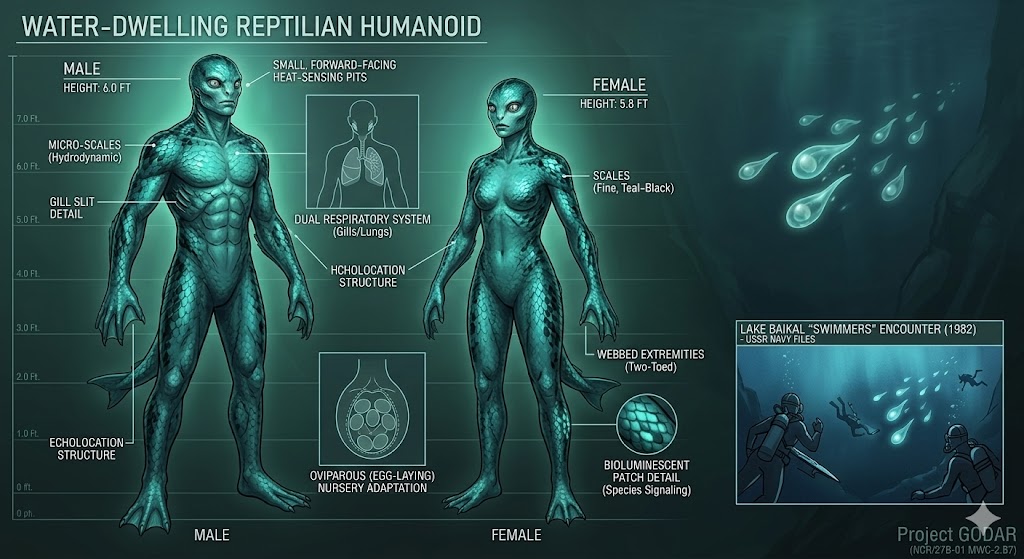
A side-by-side biological comparison of the Aquatic Reptoid phenotype, detailing the dual-respiratory system and hydrodynamic micro-scales.
THINK ABOUTIT’S ALIEN TYPE SUMMARY – Water-Dwelling Reptilian Humanoid
“They are the masters of the lightless depths—beings who possess the predatory efficiency of a crocodile and the cold intelligence of a star-faring civilization.”
The Water-Dwelling Reptilian Humanoid is a highly specialized biological entity that has maintained a presence on Earth for thousands of years, primarily in the planet’s vast, unexplored oceanic trenches and complex cave systems. Often confused with the “Deep Ones” of folklore, these beings are distinct from the Alpha-Draconian soldier castes. They are primarily amphibious observers, possessing biological adaptations—such as gills, webbed extremities, and bioluminescent scales—that allow them to thrive in high-pressure aquatic environments. While generally reclusive and non-interfering, their advanced technology is frequently reported as USOs (Unidentified Submerged Objects) constructed from organic, translucent materials, often seen as glowing submerged crafts near coastal regions and deep freshwater lakes.
Name: Water-Dwelling Reptilian Humanoid
AKA: Aquatic Reptoids, Mer-Reptilians, Deep Observers.
Location – Home System: Suspected origin in the Nunki system (Sigma Sagittarii).
Distance from Earth: ~228 Light-Years.
Attitude: Reclusive, cautious, and territorially defensive.
Motives: Monitoring of Earth’s oceanic health and tectonic activity.
Physical Appearance: Humanoid with reptilian features; sleek and hydrodynamic.
- Average Height: 5.5 to 6.5 Feet.
- Average Weight: 180–220 lbs (Lean, dense muscle).
- Body Temperature: Ectothermic (Fluctuates with water temperature).
- Pulse/Respiration: Dual-system; possesses both lungs and internal gill slits.
- Blood Pressure: 110/70 mmHg (Variable for deep-sea diving).
- Life Expectancy: 150 to 300 Earth Years.
- Hair: None (Entirely hairless).
- Skin: Fine, overlapping scales; slick/oily texture; color ranges from deep teal to black.
- Eyes: Large, yellow or silver; secondary nictitating membrane for underwater vision.
- Sex: Binary (Oviparous—lay eggs in specialized underwater nurseries).
Other Physical Information: Webbed hands and feet; a short, rudder-like tail.
Special Traits and Abilities: Sonar-like echolocation; bioluminescence control.
Communication Type: High-frequency clicks/whistles and short-range telepathy.
Origin: Extra-Solar/Amphibian Hybrid.
Life Form Type: Reptilian-Amphibious.
Subspecies: Freshwater variants (smaller, lighter scales) vs. Deep-Sea variants.
Most Common Species: Deep-Sea Sentinel.
Level of Species: Type I (Planetary Stewards).
Habits: Nocturnal; reside in geothermal vents or coastal caverns.
Transportation Type: Translucent, teardrop-shaped USOs (Unidentified Submerged Objects).
Witnesses Reports:(e.g. incidents of Caponi, Italy 1993 and Varginha Brazil 1996). Black Sea (1982), Amazon Basin sightings, Lake Baikal (1982).
Special Features/Characteristics: Ability to withstand immense oceanic pressure.
Summary/Description: A peaceful but reclusive aquatic race monitoring Earth’s oceans.
Source: Folklore: Japan‘s “Kappa“, the mythology of Sumeria, Dogon Nommos etc. Blue Planet Project, Russian Navy (declassified files), Amazonian folklore.
Visual Diagnostic: Aquatic Genotype Comparative
Accurately cataloging this species requires a definitive visual baseline. This technical diagram, sourced from the Project GODAR archives, presents a side-by-side comparative study of a male and female Water-Dwelling Reptilian Humanoid in their murky, deep-sea environment. The illustration highlights their distinctive Hydrodynamic Micro-Scales, which possess a slick, overlapping teal and black texture optimized for minimizing aquatic friction. Note the large, forward-facing Heat-Sensing Pits and silver-yellow eyes equipped with thick nictitating membranes, adapting them for lightless navigation.
Key inset schematics include the ‘DUAL RESPIRATORY SYSTEM’ (detailing how their gills and lungs operate simultaneously) and the ‘OVIPAROUS (EGG-LAYING) NURSERY ADAPTATION’, which is crucial to their reproduction. Both entities exhibit standard Webbed Extremities (specifically the two-toed feet seen in image_3.png) and a short, rudder-like tail. The background features several glowing, translucent USOs (Teardrop Technology) moving in the distance, providing a technical baseline for their craft. A special detail is the inclusion of the Lake Baikal Encounter (1982) inset, visualizing the historical data provided in the following section.
Sightings History: The Lake Baikal “Swimmers” Incident (1982)
To understand the operational parameters of the Water-Dwelling Reptilian, we must analyze their most famous documented encounter: the 1982 Lake Baikal Incident. Lake Baikal in Siberia is the world’s deepest and oldest freshwater lake, long considered a geopolitical sensitive zone. Declassified USSR Navy files detail a routine training exercise involving seven combat divers (Frogmen) from the Trans-Baikal Military District.
While conducting deep-dive maneuvers in the near-freezing waters, the divers were startled by the sudden appearance of multiple humanoid entities at a depth of nearly 160 feet. These beings, later categorized as the Water-Dwelling Reptilian Humanoid, were not using any visible scuba equipment. Witnesses described them as standing approximately 9 feet tall (suggesting a larger subspecies than the standard deep-sea variant) and dressed in what appeared to be translucent, silvery suits that integrated perfectly with their scales.
A crucial technical detail of the encounter was the Cranial Ridge Helmet. While other aquatic species utilize open Gills or simple masks, these entities wore tight-fitting, transparent bubble-helmets that did not contain any visible breathing apparatus. The divers noted that the creatures moved with effortless, explosive speed, utilizing only their webbed hands and feet. The situation escalated when the Russian team attempted to capture one of the entities using a large net. According to the declassified report, the Water-Dwelling Reptilians immediately deployed an energetic defense, emitting a massive acoustic pulse that “threw” all seven Russian divers nearly 100 feet. The rapid ascent resulted in all divers suffering from extreme decompression sickness (The Bends), leading to the death of three personnel.
The incident remains a cornerstone of Russian ufology and confirms two key facts: First, that the Water-Dwelling Reptilians reside in Earth’s deepest bodies of freshwater, and second, that they possess powerful, localized acoustic weapon technology for non-lethal defense.
Biological Adaptation: The Hydrodynamic Genotype
The biology of the Water-Dwelling Reptilian is a marvel of evolutionary engineering. Unlike their land-based cousins, their scales are microscopic and overlapping, coated in a natural hydrophobic oil that reduces drag to near zero. This allows them to swim at speeds exceeding 40 knots.
Their most unique feature is the Dual-Respiratory System. According to Blue Planet Project technical supplements, these entities possess a modified pharyngeal structure that functions as gills when submerged, extracting oxygen from water. When they venture onto land—usually at night or in damp coastal caves—a secondary set of rudimentary lungs takes over. However, they cannot remain in dry environments for more than 4-6 hours without their scales dehydrating, leading to physical distress.
The USO Phenomenon: Teardrop Technology
The craft utilized by the Water-Dwelling Reptilians are almost exclusively USOs (Unidentified Submerged Objects). These vessels are typically described as teardrop-shaped or “jellyfish-like” in appearance, emitting a soft blue or green glow.
Unlike the metallic crafts of the Greys, these aquatic ships are constructed from a translucent, high-strength polymer that mimics the refractive index of water, making them nearly invisible to sonar and the naked eye while submerged. They are powered by “Cold Fusion” cores that utilize the hydrogen from seawater as a primary catalyst, allowing them to remain stationed in the deep ocean for centuries without returning to a home base.
Blue Planet Project Analysis: The Organic Deep-Sea Cities
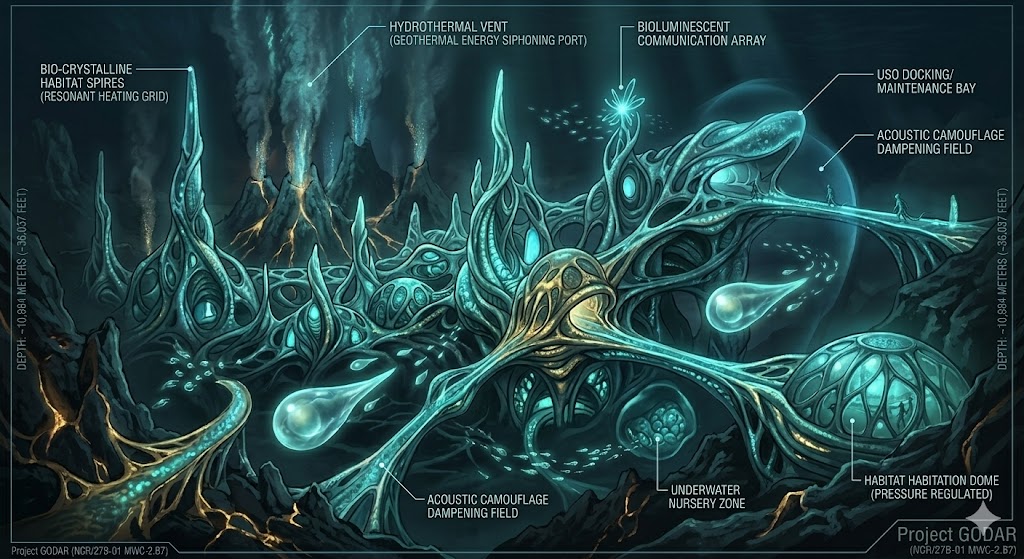
According to technical supplements found in the Blue Planet Project and corroborated by clandestine sonar mapping from the Cold War era, the Water-Dwelling Reptilian Humanoid does not build cities in the traditional sense. Instead, they “grow” their habitats. These structures, often located in the deepest reaches of the Mariana Trench and the Puerto Rico Trench, are classified as Bio-Crystalline Habitats.
1. Structural Bioluminescence and Growth
The Blue Planet Project notes describe these cities as appearing like massive, glowing coral reefs from a distance. However, upon closer inspection by deep-sea remote-operated vehicles (ROVs), the structures are revealed to be composed of a calcium-carbonate-silicate hybrid that is alive. These “buildings” are bioluminescent, pulsing with a soft cyan light that provides both visibility and a form of “resonant heating” to combat the near-freezing temperatures of the abyssal zone.
2. Geothermal Energy Siphoning
Unlike surface civilizations that rely on solar or wind energy, these aquatic cities are strategically placed over hydrothermal vents. The Water-Dwelling Reptilians utilize the extreme temperature gradients to power their “Teardrop” USOs and life-support systems. The cities act as massive heat exchangers, siphoning the mineral-rich discharge of the vents to nourish the “organic” walls of their homes. This creates a closed-loop ecosystem that allows them to remain completely independent of the Earth’s surface for centuries.
3. Acoustic Camouflage
A major hurdle for military sonar (both US and Russian) has been the “Ghosting” effect near these sites. The Blue Planet Project reveals that the organic nature of these cities allows them to absorb and dissipate sonar waves, effectively making a city of several thousand inhabitants appear as nothing more than a natural geological formation or a dense school of biomass.
Final Summary: The Silent Stewards of the Abyss
The Water-Dwelling Reptilian Humanoid serves as a vital, albeit reclusive, component of Earth’s hidden biological hierarchy. While the Alpha-Draconian factions often dominate the headlines with their aggressive agendas, these aquatic counterparts represent a more stable, observational presence. They are the guardians of the world’s oceans, monitoring the planetary health from the inside out.
With a life expectancy of up to 300 years and a biology perfectly adapted to the most hostile environments on the planet, they remain one of the most successful “hidden” species on Earth. Their master of USO technology and their “organic” city-building techniques highlight a civilization that is not just visiting Earth, but is deeply rooted in its most ancient ecosystems. As humanity continues to push the boundaries of deep-sea exploration, encounters with these “Deep Observers” are likely to increase, requiring a diplomatic framework that respects their territorial sovereignty over the world’s oceans.