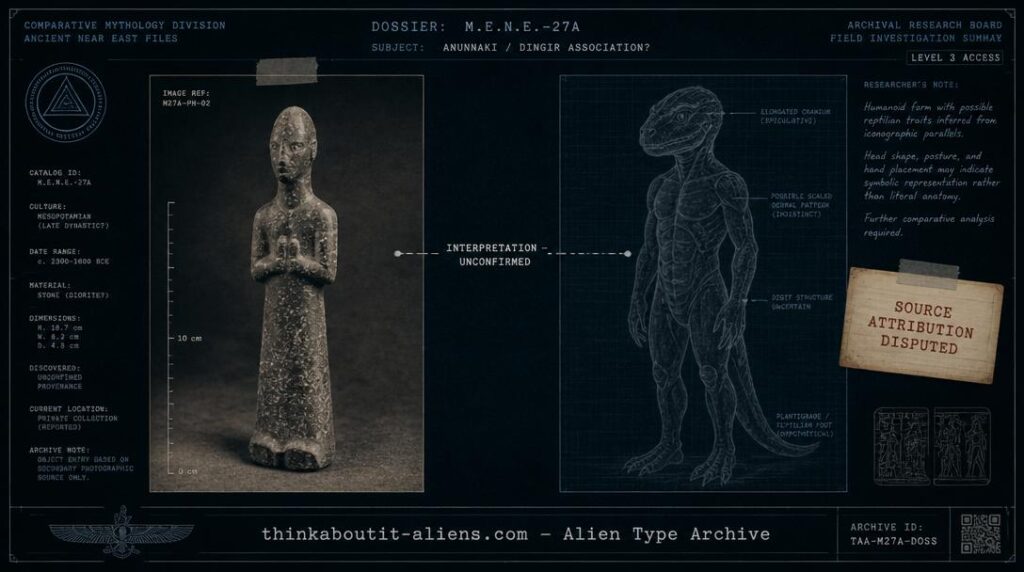
A research-board style rendering reflecting how some authors interpret ancient statuary as evidence of the Targ, alongside an explicit "unconfirmed" label.
THINK ABOUTIT’S ALIEN TYPE SUMMARY
TARGZISSIANS
Few names in the reptilian-contact literature carry as much unresolved confusion as the Targ, or Targzissians — a name some writers apply to a distinct ancient colonizer race said to have shaped Sumerian myth and hybridized with early human bloodlines, while others use it as little more than a loose synonym for “Draconian” or “Orion reptilian” generally. Even the term’s origin is contested: it may trace back not to a species name at all, but to a much older piece of Scientology terminology for something else entirely.
Name: Targzissians
AKA: Targ
Location – Home System: Undocumented as a specific system. Some authors treat “Targ” as a synonym for reptilians of general Draconian or Orion descent rather than naming a distinct home star.
Distance from Earth: Undocumented
Attitude: Sources are split. Some describe a long-standing state of war with other races that may have since eased into an uneasy, poorly understood truce; others give no behavioral detail at all beyond an association with shape-shifting and telepathic illusion.
Motives: Undocumented in detail. Some authors connect the name to a colonization of prehistoric Earth and, separately, to the creation of a Grey hybrid subspecies; these are treated as claims, not established fact, even within the source material itself.
Physical Appearance: Undocumented in the source material beyond a general reptilian association. No physical description — build, coloration, skull shape, or otherwise — is given by any author consulted for this entry.
- Average Height: Undocumented
- Average Weight: Undocumented
- Body Temperature: Undocumented
- Pulse/Respiration: Undocumented
- Blood Pressure: Undocumented
- Life Expectancy: Undocumented
- Hair: Undocumented
- Skin: Undocumented
- Eyes: Undocumented
- Sex: Undocumented
Other Physical Information: Undocumented
Special Traits and Abilities: Shape-shifting and the creation of telepathic illusions, attributed by some authors to Targ/reptilian-descent beings generally, not specifically detailed for a distinct Targzissian species
Communication Type: Undocumented
Origin: Contested. Some authors place them in Sumerian-era antiquity as a distinct colonizing race; others use “Targ” only as an umbrella term for Draconian- or Orion-descent reptilians in general.
Life Form Type: Reptilian, per the general association made across sources; no distinct taxonomic or hybrid classification is documented
Subspecies: Undocumented (no caste or subspecies division appears in any source reviewed)
Most Common Species: Undocumented
Level of Species: Undocumented (no technological or civilizational grading appears in any source reviewed)
Habits: Undocumented beyond the colonization and hybridization claims described above
Transportation Type: Undocumented
Witnesses Reports: No direct witness accounts exist for this entry. The claims here are drawn from a handful of ufological authors and compilers, most notably Riley Martin (1946–2015), rather than from documented sightings or encounters.
Special Features/Characteristics: Some authors interpret ancient Mesopotamian statuettes depicting figures with insect- or reptile-like heads as representations of the Targ, and connect the Babylonian god Marduk to a claimed Targ-humanoid hybrid lineage. These are interpretive claims made by specific authors, not established archaeological conclusions.
Summary/Description: A reptilian designation used inconsistently across ufological sources — by some as the name of a distinct ancient colonizer race tied to Sumerian myth and a 70-million-year-old purge from Earth, and by others as a loose stand-in for “Draconian” or “Orion reptilian” more broadly. Even the term’s origin is disputed.
Source: Compiled ufological literature as summarized by Exopaedia; Riley Martin’s published claims; L. Ron Hubbard’s 1952 lecture material; Think About It Alien Database
Related Cases: Marduk (Babylonian mythology); the broader Draconian/reptilian and Orion-descent literature; the Biiaviians, cited as part of the coalition said to have ended the Targ presence on Earth
DETAILED REPORT
Unlike most entries in this archive, the Targzissians resist a single coherent profile — and the available compiled sources say so plainly. Several ufological authors use the name “Targ” or “Targzissian,” but they do not agree on what it refers to. One strand of the literature treats the Targ as a specific, named colonizer race, said to have been present on Earth as far back as Sumerian antiquity. Under this reading, certain ancient Mesopotamian statuettes depicting figures with insect- or reptile-like heads are interpreted as Targ representations, and the Babylonian god Marduk is claimed to have been a hybrid — his mother of Targ descent, his father Enki humanoid. This is presented by the authors who advance it as their own interpretation of the archaeological record, not as an established consensus.
A second strand of the literature uses “Targ” far more loosely, as a general label for reptilian beings of Draconian or Orion descent, without treating it as naming a distinct species at all. Under this reading, the shape-shifting and telepathic-illusion abilities sometimes attributed to the Targ are simply the abilities more broadly attributed to reptilian beings across the wider literature, not documented traits specific to a Targzissian species.
The claim that the Targ have been at war with other races, and may since have reached an uneasy accommodation, is attributed specifically to one author, Riley Martin (1946–2015), rather than to the literature generally. The claim that the Targ created at least one Grey hybrid subspecies, and that their presence on Earth ended roughly 70 million years ago in a purge carried out by a coalition of races including the Biiaviians, follows the same pattern — a claim advanced by some authors within this tradition, without independent corroboration or archaeological support.
The name itself has a curious history. The term “Targ” is generally traced to a 1952 lecture by L. Ron Hubbard, founder of the Church of Scientology, in which he described Earth as a prison planet where an alien race called the Targ deposited the souls of their defeated enemies. It is worth noting, however, that within Scientology’s own internal terminology, “targ” is documented elsewhere as an older word for a “body thetan” — the term used for a trapped spirit-fragment attached to a person, not for the alien race said to have done the trapping. Whether the ufological use of “Targ” as a species name reflects a deliberate extension of Hubbard’s material or a later conflation of these two distinct terms is not resolved in the sources reviewed for this entry, and should be treated as an open question rather than a settled point of origin.
RESEARCHER’S NOTES
A Name Without a Fixed Referent — Sumerian Myth and the Limits of a Contested Term
- Source Chain Assessment: This entry rests on a compiled secondary summary (Exopaedia) of a small number of ufological authors who do not agree with each other on what “Targ” even refers to. That internal disagreement is itself the most important fact about this entry, and it has been preserved here rather than resolved into false certainty.
- Fabricated Biometric and Classification Panel: Earlier versions of this page listed precise height, weight, body temperature, pulse, and blood pressure figures, a specific home system (Rigel/Betelgeuse, 800–1,300 light-years), a “Level XV — Interdimensional Imperialists” rating, and a “Draco-Targ Elite” versus “Grey-Hybrid worker class” subspecies split. None of this appears in any source reviewed for this correction. These fields have been marked Undocumented rather than populated with invented specifics.
- Attribution Restored: The claim that the Targ have been at war with other races for ages is attributed in the source material to one specific author, Riley Martin, not to “other authors” generally. An earlier version of this page dropped that attribution; it has been restored here, since a claim made by one named author carries different evidentiary weight than one described as a broader consensus.
- Grey-Hybrid Creation Claim: An earlier version of this page cited the Alien Race Book (ARB) as confirming that the Targ created a Grey hybrid subspecies. The ARB entries reviewed for this correction attribute Grey-hybrid creation instead to the Anunnaki/Anunakene, not to the Targ. The Targ-created-a-Grey-subspecies claim does appear in the Exopaedia summary of the broader ufological literature, so it has been retained here — but attributed to that literature generally, not to the ARB specifically.
- Etymological Ambiguity: The word “targ” carries a separate, documented meaning within Scientology terminology as an older term for a body thetan — a trapped spirit-fragment, not an alien race. Whether the “Targ” of ufological literature is a genuine extension of Hubbard’s 1952 material or a later conflation of these two distinct uses is unresolved, and readers should treat the Hubbard connection as one contested thread among several rather than a confirmed origin point.
What can honestly be said about the Targzissians is less than the name’s dramatic reputation suggests: a handful of authors disagreeing about whether “Targ” names a specific ancient colonizer race or simply serves as another word for “reptilian,” built around a scattering of interpretive claims about Sumerian statuary, one author’s war-and-truce narrative, and a term whose very origin may rest on a case of mistaken identity within Scientology’s own vocabulary. The record does not currently support more than that.
“The available information on them is conflicting.”
— Exopaedia, Targzissians entry, summarizing the state of the ufological literature on this name.
About the Author