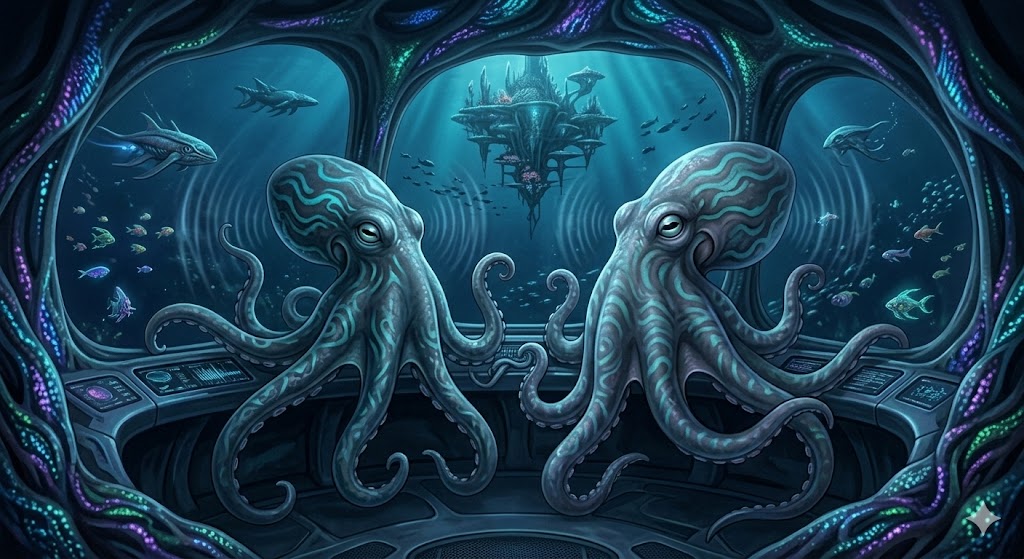
Octolimb technology is purely organic, utilizing decentralized neural networks to pilot vessels grown from living calcium and chitin.
THINK ABOUTIT’S ALIEN TYPE SUMMARY – Octolimbs
“What if the smartest being on Earth doesn’t walk on two legs, but swims with eight?”
In the specialized corridors of the Think About It Alien Database, the Octolimbs are described as the ultimate proof of extraterrestrial seeding. While the Nordics and Greys focus on the surface, the Octolimbs have claimed the 70% of our planet that remains unexplored: the deep oceans. With three hearts, blue blood, and an intelligence that is decentralized across their limbs, these entities represent a “Parallel Evolution” that began in the Gliese system. Often mistaken for large marine life, Octolimbs possess a technology that is purely biological, allowing them to remain hidden in the abyss while monitoring the ecological health of Earth. As we enter the high-disclosure year of 2026, new deep-sea sonar data suggests that these “Water-Walkers” are preparing to reveal themselves as the original stewards of our oceans.
Name: Octolimbs, Octiartus proselytus (Strange Eight-limbed)
AKA: The Ceph-Heads, Water-Walkers, The Ancient Survivors
Location – Home System: Aqueous world in the Gliese 581 system
Distance from Earth: ~20.5 Light Years
Attitude: Highly intelligent, solitary, curious, yet fiercely territorial
Motives: Biological experimentation and oceanic preservation
Physical Appearance: Eight-limbed, bulbous-headed, non-skeletal entities
- Average Height: 4’0″ – 5’5″ (When upright on land); 12’ – 15’ span
- Average Weight: 60 – 80 kg (Dense muscle and specialized fluid)
- Body Temperature: Variable (Cold-blooded; matches environment)
- Pulse/Respiration: Triple-heart rhythm; utilizes gills and skin-breathing
- Blood Pressure: 120/80 (Fluctuates significantly during camouflaging)
- Life Expectancy: 300 – 500 Earth years
- Hair: None; skin is covered in adaptive chromatophores
- Skin: Texture-shifting; can be smooth, spiky, or rock-like at will
- Eyes: Large, horizontal pupils; panoramic 360-degree vision
- Sex: Sequential hermaphrodites (Can change sex over life cycle)
Other Physical Information: No bones; can squeeze through gaps 1/10th their size
Special Traits and Abilities: Bioluminescence; high-speed ink-jet propulsion; limb regeneration
Communication Type: Visual-chromatic (Changing skin color) and sub-aquatic sonar
Origin: Evolved in sub-surface oceans of a super-Earth
Life Form Type: Bio-Fluidic Invertebrate
Subspecies: The Abyssal Guardians and the Coastal Mimics
Most Common Species: The Sentinel Octolimb
Level of Species: Level VI – Biological Masters
Habits: Constructing complex coral-like structures; solving puzzles for leisure
Transportation Type: Organic “Living Ships” grown from calcium and chitin
Witnesses Reports: Deep-sea divers; South Pacific indigenous lore (Kanaloa)
Special Features/Characteristics: Blue blood (copper-based); three independent hearts
Summary/Description: Highly advanced invertebrates monitoring Earth’s oceans.
Source: Recorded 22 August 1955 at Riverside, California by Kermit Douglas and seven other children. Panspermia Research Papers; Hawaiian Creation Myths; Think About It Database
Decentralized Intelligence and Chromatic Language
The Nine-Brain Network
The most striking technical detail of the Octolimbs is their neural architecture. They do not have a single centralized brain; instead, they possess a central processing hub and eight “mini-brains” located at the base of each limb. This allows an Octolimb to perform eight complex, independent tasks simultaneously—such as repairing a biological craft while defending against a predator and communicating via skin-shimmering. In the Think About It Database, this is referred to as “Distributed Consciousness,” a form of intelligence so alien to humans that it makes traditional telepathy almost impossible without a specialized “Frequency Translator.”
Chromatic Communication: The Language of Light
Octolimbs do not use vocal cords. Their skin is their “voice.” By utilizing millions of Chromatophores, they can ripple through thousands of colors, textures, and patterns per second. This is a high-bandwidth visual language that can convey complex scientific data or emotional states instantaneously. During a contact event, an Octolimb may appear to “strobe” wildly; to a human, it looks like a seizure, but to another Octolimb, it is a detailed briefing on planetary magnetic fluctuations.
Biological Panspermia and the “Ice-Comet” Theory
Advanced geneticists cited in the KGB laboratory files have long noted that the DNA of Earth’s cephalopods is radically different from any other life form on the planet. The Octolimb theory suggests that these entities were the original “Inoculation” of Earth’s primitive oceans. They travel through space in a state of Cryo-Stasis inside water-ice comets. When these comets hit a suitable world, the “seeds” hatch and begin to evolve. Earth’s modern octopuses are considered “Degenerate Relatives” who lost their high-technology during the long adaptation to Earth’s specific gravity and solar radiation.
The Living Architecture of the Abyss
Bio-Digital Integration and the “Chitin-Network”
A critical technical discovery regarding the Octolimbs, often highlighted in recovered Majestic-12 oceanic dossiers, is their use of “Living Technology.” Unlike the metallic alloys used by the Norcans, Octolimb vessels and outposts are grown from a specialized form of self-repairing, high-pressure-resistant Chitin and Calcium Carbonate. These “Living Ships” are essentially enormous, non-sentient biological organisms that the Octolimbs interface with via neural-conductive tentacles. In the Think About It Database, it is noted that these craft do not emit heat or radiation; instead, they utilize Bioluminescent Pulsing to communicate with the surrounding marine life, effectively camouflaging the craft as a natural part of the deep-sea ecosystem.
The Cephalopod Genesis and the 2026 Oceanic “Wake-Up”
The Octolimb influence on Earth’s evolutionary biological tree is a subject of intense study among “Panspermia” researchers. Technical scans of modern Octopus vulgaris DNA reveal 33,000 protein-coding genes—significantly more than a human. The Octolimb archives suggest that this genetic complexity was intentionally left behind as a “biological backup” should the primary Octolimb civilization ever need to reclaim the planet. As of 2026, anomalous acoustic signals—referred to by NOAA as “The Bloop 2.0″—have been detected near the Mariana Trench. Analysis suggests these are not geological but are sophisticated Sonar-Chromatic Bursts emitted by Octolimb “Sentry-Pods” that are activating in response to rising oceanic temperatures and human deep-sea mining.
Final Summary: The Sovereign of the Depths
The Octolimbs serve as a reminder that the extraterrestrial presence on Earth is not limited to the sky. As the “Ancient Survivors” documented in the Think About It Alien Database, they occupy a unique niche as biological masters of the deep. Their technology is not composed of cold metal and wires, but of living tissue and genetic codes. As we push toward further oceanic exploration in 2026, the discovery of Octolimb outposts in the Mariana Trench may be the final proof needed to confirm that Earth has always been a multi-species habitat.
By understanding the Octolimb, we learn to appreciate an intelligence that is fluid, decentralized, and perfectly adapted to the most extreme environments. They are the guardians of the abyss, watching the surface-dwellers with a 360-degree panoramic gaze that spans millions of years of history.