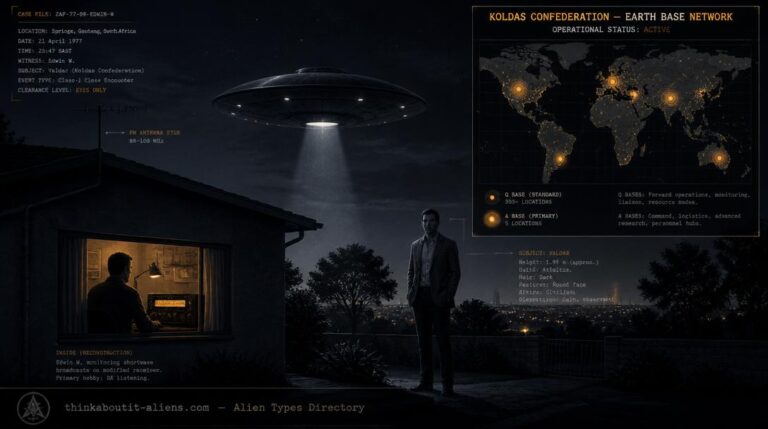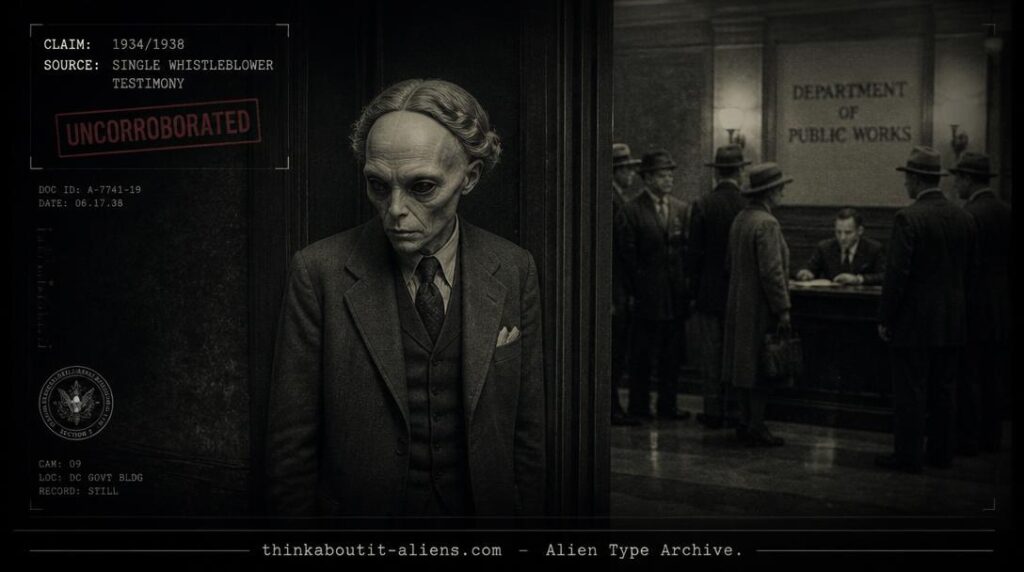
A dossier-style illustrative rendering of the Kondrashkin, based on sourcing describing a disguised, human-passing figure connected to a reported 1930s Roosevelt-era technology offer.
THINK ABOUTIT’S ALIEN TYPE SUMMARY
Kondrashkin
Al Bielek’s own account of the “K-Group” doesn’t describe a decades-long infiltration campaign — it describes a rejected 1938 technology offer to President Roosevelt, after which, in Bielek’s own words, they simply “disappeared in the woodwork.”
Name: Kondrashkin (also spelled “Kondroshkin” by Al Bielek).
AKA: The K-Group. Described by Al Bielek as “blue-greys,” explicitly distinguished from “the little greys.”
Location – Home System: Not specified in any source consulted. No home planet or star system is named anywhere.
Distance from Earth: Not specified in sourcing.
Attitude: Not characterized in sourcing beyond the two documented episodes described below.
Motives: Per Al Bielek’s account, offered the United States a new atomic-energy technological base in 1938, following an initial approach to President Roosevelt in 1934.
Physical Appearance: Pale skin with a slight greenish tint, almost no hair, otherwise human-looking. Must bleach their skin and wear wigs to pass as human — the reason for either is not explained in any source.
- Average Height: Not specified in sourcing.
- Average Weight: Not specified in sourcing.
- Body Temperature: Not specified in sourcing.
- Pulse/Respiration: Not specified in sourcing.
- Blood Pressure: Not specified in sourcing.
- Life Expectancy: Not specified in sourcing.
- Hair: Almost none, naturally.
- Skin: Pale, with a slight greenish tint.
- Eyes: Not specified in sourcing.
- Sex: Not specified in sourcing.
Other Physical Information: Sourcing states they must bleach their skin and wear wigs to move undetected in human society, without explaining why either measure is necessary.
Special Traits and Abilities: Not specified in sourcing.
Communication Type: Not specified in sourcing.
Origin: Not specified. No home system is named in any source consulted.
Life Form Type: Human-looking, per sourcing. No further biological classification is given.
Subspecies: None documented.
Most Common Species: Not specified in sourcing.
Level of Species: No classification is offered in any source. Not applicable.
Habits: Per Bibliotecapleyades, reportedly involved periodically in covert US government projects since the 1940s. Per Al Bielek’s more specific account, involved in an unsuccessful 1934/1938 technology-exchange proposal to President Roosevelt, after which they reportedly withdrew from further involvement rather than continuing as embedded advisors.
Transportation Type: Not specified in either source.
Witnesses Reports: Al Bielek, in a recorded interview (Connecting Link, Issue 19, conducted by Susanne Konicov), describes “the K Group or the Kondroshkin” as “the blue-greys,” explicitly distinguished from “the little greys.” He states President Roosevelt made an initial approach to the group in 1934, followed by a 1938 offer of atomic-energy technology that was ultimately declined on military advice — after which, per Bielek’s own words, the group “disappeared in the woodwork.” Bielek separately attributes the alien technology behind the 1943 Philadelphia Experiment to a different “Orion group” involving reptilians and a subgroup he calls “Leverons” — not explicitly the Kondrashkin. This is a single whistleblower’s testimony and is not independently corroborated. A witness listed on an earlier version of this page, “Val Valarian, Orion Technology,” could not be confirmed in any source consulted for this correction and is noted here as unverified rather than dropped outright.
Special Features/Characteristics: None documented beyond the skin-bleaching and wig-wearing disguise pattern described above.
Summary/Description: A human-looking species with pale, faintly greenish skin and almost no hair, requiring skin-bleaching and wigs to pass undetected. No home system is named in any source. The most substantive claim about them is Al Bielek’s account of a rejected 1934/1938 technology exchange with President Roosevelt, after which the group reportedly withdrew rather than remaining embedded in US government projects. Their reported involvement in the actual 1943 Philadelphia Experiment is not directly supported by Bielek’s own testimony, which attributes that technology to a separate group.
Source: Bibliotecapleyades, “Alien Races H–Z” (via Exopaedia’s Kondrashkin page); Al Bielek, interview in Connecting Link, Issue 19 (Susanne Konicov); cross-referenced via Jake Muller, A Guide to ETs/Star Nations and Beings, Vol. 1 (2023).
Related Cases: None currently cross-referenced on this site.
DETAILED REPORT
The Kondrashkin entry is an unusual case in this audit: the most dramatic claim on the earlier version of this page — a connection to Al Bielek and the Philadelphia Experiment — turned out to be genuinely real and traceable, not invented. It just wasn’t told accurately.
The baseline claim, per Bibliotecapleyades’ “Alien Races” compilation as summarized by Muller, is thin: pale, faintly greenish skin, almost no hair, human-looking, requiring skin-bleaching and wigs to pass, with periodic involvement in unspecified US covert projects since the 1940s. No home system is named. Al Bielek’s own interview, published in Connecting Link Issue 19, adds real specificity: he describes “the K Group or the Kondroshkin” as “the blue-greys,” distinct from smaller Grey-type beings, and recounts President Roosevelt’s initial approach to them in 1934, followed by a 1938 offer of atomic-energy technology. Roosevelt initially approved the offer, then rejected it on the advice of the military. Bielek’s own account of what happened next is direct: the group “disappeared in the woodwork.”
That detail matters, because the earlier version of this page built an entire narrative around the opposite claim — that the K-Group didn’t withdraw, but instead went underground and became embedded, deep-cover advisors steering Project Rainbow and the Philadelphia Experiment from within. Bielek’s own testimony doesn’t support that. In fact, elsewhere in the same body of interview material, Bielek attributes the alien technology actually used in the 1943 Philadelphia Experiment to a separate group he calls “the Orion group,” involving reptilians and a subgroup he names “the Leverons” — not the Kondrashkin. Treating the Kondrashkin as the technical architects of the Philadelphia Experiment overstates what even this source claims.
RESEARCHER’S NOTES
Real Source, Wrong Story — What Al Bielek Actually Said About the K-Group
- Source Verified, Not Invented: Unlike most entries in this audit, the Al Bielek/Roosevelt/Philadelphia Experiment connection checks out — it’s traceable to an actual published interview and independently confirmed on Exopaedia’s own Kondrashkin page.
- But the Story Was Rewritten: Bielek’s own account says the K-Group withdrew after their 1938 offer was declined. The earlier version of this page invented an ongoing, decades-long infiltration campaign that directly contradicts Bielek’s own words.
- The 1943 Experiment Is Misattributed: Bielek credits the actual Philadelphia Experiment’s alien technology to a separate “Orion group” involving reptilians and a subgroup called “Leverons” — not the Kondrashkin specifically. Conflating the two overstates what this source actually claims.
- Fabricated Data Removed: An Orion Confederation/Betelgeuse/Rigel origin, a full biometric panel, two named subspecies, a “Level IV” classification, and a “Saurian-Humanoid Hybrid” designation were all invented. No home system is named in any source, and no biological classification beyond “human-looking” exists anywhere.
- An Unverified Attribution: “Val Valarian, Orion Technology,” listed as a source on the earlier version, could not be confirmed in either source consulted here. Flagged rather than dropped, in case supporting material surfaces later.
Corrected from an invented decades-long infiltration conspiracy to what the actual sourcing supports: a thin physical description, an unexplained disguise pattern, and one whistleblower’s account of a specific, rejected 1938 deal — after which, by his own telling, the story ends.
“They disappeared in the woodwork.”
— Al Bielek, interview in Connecting Link, Issue 19
About the Author