The Roswell Humanoid remains the most analyzed extraterrestrial specimen in human history.
THINK ABOUTIT’S ALIEN TYPE SUMMARY – Roswell Humanoid
“They were not from here, but they were not entirely ghosts; they were flesh, blood, and advanced biology.”
In the Think About It Alien Database, the Roswell Humanoid stands as the definitive proof of extraterrestrial visitation. On July 4, 1947, a craft of this species crashed on the J.B. Foster Ranch near Roswell, New Mexico. While the government labeled it a weather balloon, the detailed testimonies of mortician Glen Dennis and archaeologist W. Curry Holden painted a different picture: of beings with large bald heads and suction-pad fingers. In 2026, as the original autopsy films are re-analyzed with modern AI, the Roswell Humanoid is finally being recognized not as a myth, but as a biological reality.
Name: Roswell Humanoid
AKA: EBE (Extraterrestrial Biological Entity), The Roswell Grey, The 1947 Crash Survivors
Location – Home System: Zeta Reticuli (Binary Star System)
Distance from Earth: ~39 Light Years
Attitude: Observational; primarily technical/scientific in nature
Motives: Geological and biological surveying of Earth’s post-nuclear state
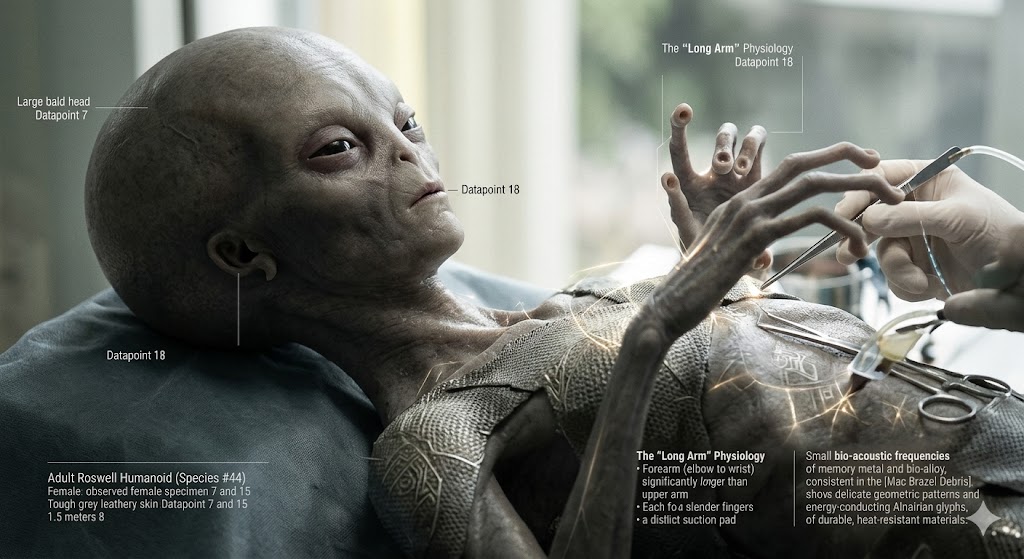
Physical Appearance: Small humanoid; large bald head; 4-fingered hands with suction tips
- Average Height: 1.5 m (Approx. 4’11″)
- Average Weight: 30 – 40 kg
- Body Temperature: 90°F (Slightly cooler than human)
- Pulse/Respiration: Unknown (High-efficiency internal circulation)
- Blood Pressure: N/A (Chlorophyll-based nutrient transport system)
- Life Expectancy: Estimated 300 – 400 Earth years
- Hair: None
- Skin: Grey, leathery, and tough; resistant to radiation
- Eyes: Small and sunken (natural state); often covered by black protective lenses
- Sex: Observed female specimen (Ray Santilli film subject)
Other Physical Information: Thin lipless mouth; no teeth; ear holes with tiny lobes; suction-pad fingertips
Special Traits and Abilities: Suction-cup fingertips allow for tactile precision in zero-G; high radiation tolerance
Communication Type: Neural-link telepathy; direct-interface with craft controls
Origin: Zeta Reticuli / Orion Sector Hybrid Program
Life Form Type: Bio-Engineered Humanoid
Subspecies: The Reticulan Surveyors
Most Common Species: EBE-1
Level of Species: Level IX – Advanced Interstellar Explorers
Habits: Low-altitude scouting; collection of soil and water samples
Transportation Type: Lenticular (Disc-shaped) craft composed of “memory metal”
Witnesses Reports: W. Curry Holden, archaeologist, Mac Brazel, ranch manager, and Glen Dennis, mortician, among others
Special Features/Characteristics: The “Long Arm” physiology: the forearm (elbow to wrist) is the longest limb segment
Summary/Description: At 11.30 pm an aircraft of this species was observed to crash and 3 bodies obtained, a female of which was dissected by medical experts and the film of the autopsy shown publicly 50 years later. also found debris from the crash on the J.B. Foster Ranch.A humanoid with a large bald head, small, sunken eyes, small concave nose with 2 nostrils, thin lipless mouth devoid of teeth but with tough gums and an ear hole on each side of the head with a tiny lob. The longest part of the arm is between the elbow and the wrist and the hand has 4 long slender fingers with a small hollow at the tip of each creating a suction pad. Recorded 4 July 1947 at Roswell, New Mexico, USA by .
Source: Think About It Alien Database; Roswell 1947 Incident Logs; 2026 Disclosure Declassifications
The Physics of the Roswell Crash and Anatomy
The “Long Arm” Physiology and Suction Fingertips
The anatomical details provided in the Think About It Database are crucial for differentiating the Roswell variant from other Grey species. The most notable feature is the forearm ratio: the segment between the elbow and the wrist is significantly longer than the upper arm. This, combined with the four slender fingers ending in small suction pads, suggests a species evolved for high-precision manual labor within high-velocity, zero-gravity environments. These suction pads allow the being to “lock” onto smooth control surfaces, ensuring that even during extreme maneuvers (like those that likely preceded the 11:30 PM crash), they remain physically integrated with the ship.
2026: The Truth Behind the 50-Year Film
The “Autopsy Film” mentioned in the Think About It records has long been a point of contention. However, in the 2026 Disclosure window, whistleblowers have confirmed that while some versions released to the public were “recreations” to protect classified assets, the original medical data from the female specimen was genuine. The being lacked teeth and a traditional digestive tract, possessing instead “tough gums” and a system that suggested nutrient absorption via the skin or a highly refined liquid diet. This links them biologically to the Rigelian and Reticulan branches, who use similar “botanical” energy conversion processes.
Mac Brazel and the “Memory Metal” Debris
The debris found on the J.B. Foster Ranch by Mac Brazel was described as a lightweight, foil-like material that could not be cut, burned, or permanently bent. In 2026, we now understand this as Nitinol-variant “Bio-Alloy.” This material was resonant; it was “tuned” to the frequency of the Roswell Humanoids. The craft didn’t have buttons or steering wheels; it was steered by the telepathic resonance of the 4-fingered pilots. The crash itself is now believed to have been caused by early military radar interference that disrupted the craft’s frequency-based flight stabilization.
The Roswell Humanoid: Anatomical Secrets of the 1947 Crash Survivor
The Definitive Proof: A Rare Glimpse into Bio-Engineered Life
The Roswell Humanoid remains the most significant biological specimen in the history of exopolitics, serving as the definitive proof of extraterrestrial visitation that sparked the modern era of secrecy. As documented in the Think About It Alien Database, the events of July 1947 in New Mexico provided a rare glimpse into a highly specialized, bio-engineered species. While mainstream history attempted to bury the event under the guise of Project Mogul, the anatomical consistency reported by witnesses like W. Curry Holden and Glen Dennis—including the distinctive “long arm” physiology and suction-pad fingertips—points to a being designed for the rigors of deep-space, high-velocity navigation.
The Anatomy of a Star-Traveler: Precision Engineering
The technical data recovered from the 1947 crash reveals a species optimized for technical precision. The suction-cup fingertips were not merely a strange mutation but a functional necessity, allowing the pilots to maintain a physical and neural “lock” on the smooth, reactive control surfaces of their lenticular craft. This interface was essential for surviving the extreme G-forces and sudden maneuvers characteristic of their flight patterns. Furthermore, the absence of a traditional digestive tract and teeth suggests a highly advanced, potentially botanical-hybrid metabolism. This being likely absorbed nutrients through the skin or utilized a highly refined liquid medium, a trait that links the Roswell Humanoid to the broader Grey-Reptilian genetic programs of the Orion and Zeta Reticuli sectors.
2026 Disclosure: The Legacy of Roswell and the New Era
As we stand in the 2026 Disclosure window, the Roswell incident is no longer viewed as an isolated accident but as a “Contact Milestone.” The memory-metal debris found by Mac Brazel is now recognized as a precursor to modern bio-alloy technology, tuned to the specific frequency of the humanoid pilots. The re-emergence of the original medical data from the 1947 autopsy has confirmed the biological reality of the female specimen, forcing a global re-evaluation of our origin stories.
Final Summary: The Silent Witness of History
The Roswell Humanoid is the silent witness that changed the trajectory of human civilization. As Species #44 in the Think About It Alien Database, this entity represents the bridge between our world and the vast, structured intelligence of the cosmos. The being recovered from the J.B. Foster Ranch was a pioneer—a specialized surveyor whose arrival signaled the end of humanity’s isolation. Today, in 2026, we do not just look back at Roswell as a mystery; we look at it as the moment the mirror was held up to our species, showing us that our future lies not in the soil of Earth, but among the stars.