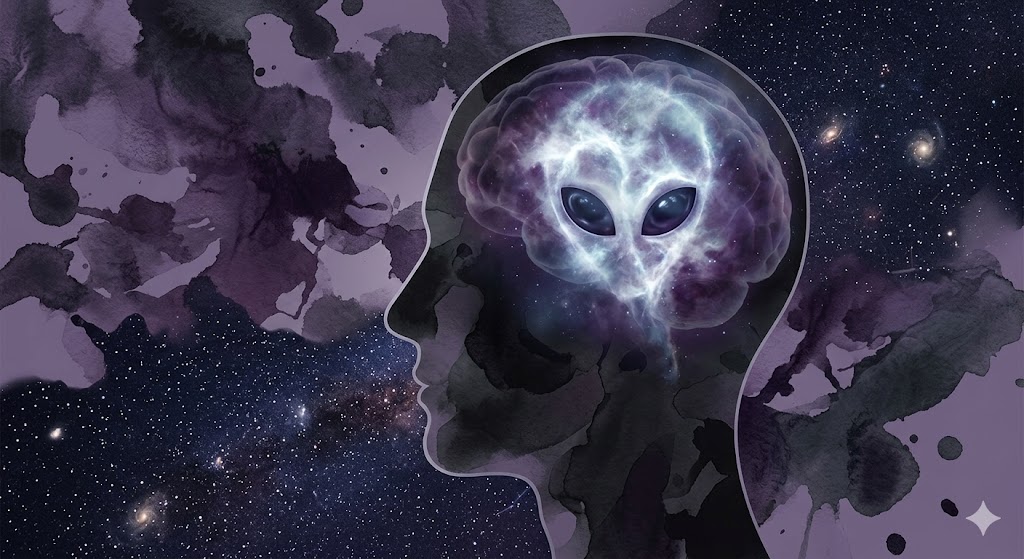
Why are millions of people convinced that we are being watched by non-human intelligences? The answer might not lie in the cockpit of a UFO, but within the complex wiring of the human brain. From the need for a “cosmic father” figure to the way our minds process sleep paralysis and sensory anomalies, the psychology of alien belief offers a profound look at how we interpret the unknown. As traditional structures shift, the “extraterrestrial” has become a modern mythos that fills a deep-seated human need for connection and purpose in a vast, silent universe.
Understanding the psychological factors of UFO sightings isn’t about debunking experiences; it’s about exploring the “inner space” that shapes our outer reality. Whether it’s the power of social contagion, the role of schizotypy in paranormal experiences, or the search for transcendence in a secular age, psychological research provides a vital lens. Join us as we peel back the layers of the human psyche to discover why the idea of aliens is one of the most persistent and powerful concepts in modern history.
What Psychology Says About Extraterrestrial Belief
NASA has discovered a mysterious satellite they call the ‘Black Knight’ in orbit around Earth. Theorists believe it is a UFO from another civilized planet. Skeptics dismiss it as space junk.
Extraterrestrial enthusiasts argue heatedly with cynics. How could the ancient Egyptians Have assembled pyramids that were architecturally advanced for their time if not for help from space? Even Albert Einstein said that time travel is possible if we can beat the speed of light.
The theorists view the unbelievers as narrow-minded and dull. In contrast, the skeptics think of them as delusional to trust outrageous claims with little scientific credibility.
Stereotypes vs Psychology
Theorists and skeptics are put to the test in a study done by Viren
Swami University of Westminster and Malaysia University, along with psychologists Jacob Pietschnig, Stefan Stieger, and Martin Voracek.
They composed an Extraterrestrial Beliefs Scale (EBS). They included three sub-tests in the 37 items on the EBS to examine the subjects’ belief on the topic of UFO, the government involvement, and the importance of scientific research.
Sub-Test #1: The Australian Sheep-Goat Method
To evaluate the belief in alien life and visitation, the psychologists used the Australian Sheep-Goat Method which researchers use to assess belief in paranormal activity. As so named, the “sheep” are the people who believe in telekinesis, extrasensory perception, and the afterlife. The “goats” are the ones who doubt the paranormal. Swami assumed that the “sheep” would be likely to also believe in the extraterrestrial theories.
Sub-Test #2: The Five-Factor Inventory
Swami and his team used a version of this to assess the personality traits of the subjects in connection to their beliefs about alien life.
Sub-Test #3: “Schizotypy” Scale
The participants completed a test stating whether they experience schizophrenic-like symptoms such as delusions, limited social relations, disordered thinking, and hallucinations. This was followed by basic demographic inquiries about their age, gender, education, and religious outlook.
The Results
Swami concluded UFO enthusiasts are more likely to be superstitious and believe in paranormal activity and the afterlife, in addition to having bizarre perceptual experiences. They scored high on personality traits such as openness to new experiences, willingness to fantasize, and experimental.
They also recorded that adults with higher education got lower on the extraterrestrial belief scale.
The tally of the affirmations with the UFO-believing factors on the EBS scale was relatively low, scoring two on a five-point scale. Nevertheless, enough participants endorsed the EBS items, enabling the psychologists to detect these patterns in their personalities.
Put Your Extraterrestrial Beliefs to the Test
These are some sample items from the EBS test. Rate yourself from one to seven, one meaning you strongly agree, seven meaning you strongly disagree.
- The government covers up the existence of alien life.
- UFOs observed in the sky are in fact sighting of spacecraft of intelligent extraterrestrials.
- Intelligent extraterrestrial life has visited Earth.
- The military knows that extraterrestrial life exists.
- Extraterrestrial creatures have visited Earth in the distant past or at the dawn of human civilization.
- Crop circle patterns are caused by actions of extraterrestrials
- Extraterrestrial life had once existed on Mars.
- Ancient monuments, for example, the pyramids of Egypt, are evidence of alien life because they couldn’t have been built without technical capabilities beyond those of people at that time.
- Scientists know that extraterrestrial life does exist.
- Skepticism about alien life is a psychosocial trend conditioned or perpetuated by those in power.
Items number 1-6 are the most related to belief in alien invasion and cover-ups. The higher your score is, the more skeptical you are about UFOs and alien life.
As the legendary scientist, Carl Sagan once said, “Just because we have no evidence of extraterrestrial life doesn’t mean that such life does not exist.” Many participants were willing to agree with other items on the EBS (scoring in 5.9), as they repeated his statement.
Source mythicist.me
This post examines the scientific and cognitive frameworks used to explain why people believe in, and frequently report, encounters with extraterrestrials. It highlights key psychological theories, such as projection, where internal anxieties or hopes are cast onto the “blank canvas” of the universe. The article also discusses the impact of popular culture and media on “memory construction,” explaining how shared cultural imagery of “Greys” can influence individual accounts of abduction or sightings, creating a feedback loop between fiction and reported reality.
Furthermore, the summary explores the intersection of evolutionary psychology and spirituality. It suggests that belief in advanced, benevolent aliens may serve as a functional substitute for traditional religious deities, providing a sense of order and protection in an uncertain world. By analyzing the work of psychologists and sociologists, the post concludes that whether or not aliens are physically present, the belief in them is a very real, measurable aspect of the human condition that reveals our deepest fears and highest aspirations.
About the Author