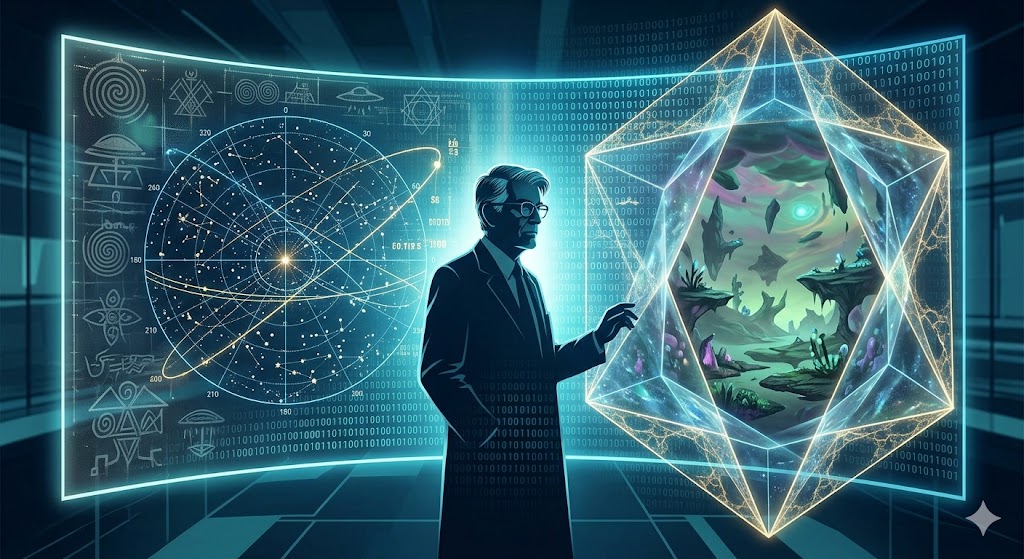
When one of the architects of the modern internet tells you aliens are real, the conversation changes. Dr. Jacques Vallée isn’t a weekend enthusiast or a cable television personality — he’s a computer scientist who helped develop ARPANET precursor technologies at the Stanford Research Institute and created the first computerized mapping of Mars for NASA. His parallel career as one of the most rigorous UFO researchers in history produced a framework that rejects both blind skepticism and the standard extraterrestrial hypothesis, proposing instead that the phenomenon operates as an interdimensional control system shaping human consciousness across millennia.
Vallée’s approach treats UFO data the way a network engineer treats anomalous traffic: methodically, statistically, and without preconceived conclusions. His analysis of over five hundred close-encounter cases revealed patterns that don’t fit the “visitors from another planet” model — entities that change their appearance to match cultural expectations, craft that violate known physics in ways inconsistent with interstellar travel, and a phenomenon that has persisted in recorded history far longer than any single civilization. For researchers ready to move beyond the nuts-and-bolts paradigm, Vallée’s work remains the essential bridge between data science and the unknown.
Aliens Are Real Says The Founding Father Of The Internet Dr Jacques Vallee
Despite the fact that mainstream media accounts like to portray those who believe in extra-terrestrial life and UFOs as oddballs and fringe figures, many distinguished and highly accomplished individuals have come forward to discuss their belief in these otherworldly activities here on Earth. Of these thousands of credible witnesses, coming from the fields of politics, academia and the military, perhaps the most distinguished of all is Dr. Jacques Valle.
FORMER NASA SCIENTIST SPEAKS OUT ABOUT THE HISTORY OF UFOS
Dr. Valle has had a storied and extensive career in the fields of science and engineering. His many achievements include the first computerized mapping of the surface of Mars for NASA and his work at the Stanford Research Institute (SRI) where he was part of a team that developed the technology that would become the foundation for the modern-day internet.
Dr. Valle has also examined unidentified flying objects and claims of extra-terrestrial activity in more depth than almost any other individual on the planet. His first work on the subject was a Journal piece entitled, “Estimates of Optical Power Output in Six Cases Of Unexplained Aeriel Objects With Defined Luminosity Characteristics, ” which was published in the Journal of Scientific Exploration. This essay examined the interception of UFOs by six different pilots.
His curiosity piqued, Dr. Valle then embarked on a stunningly ambitious quest to examine no less than five hundred different accounts of UFO sightings from the age of Biblical antiquity until 1879, which marked the period of development of the modern industry. His findings and commentary can be found in his book ‘Wonders of the Sky’.
Dr. Valle found after examining hundreds of different case accounts that UFO sightings and encounters share definite physical features. For instance, the heat felt and described by witnesses seems constant over different cultures and across the centuries. In fact, Dr. Valle said that similarities between ancient sightings of UFOs and modern-day encounters tend to be more similar than many would presume.
De Valle has subjected each of his cases to the full investigatory vigor that one would expect from such an accomplished scientific man and comes to some incredibly interesting conclusions, particularly regarding the way that alien encounters have shaped human history and religion.
Executive Summary:
The Data Scientist in the Dark — Jacques Vallée’s Interdimensional Hypothesis and the UFO Control System
The article profiles Dr. Jacques Vallée’s dual career as an internet pioneer and UFO researcher, positioning him as one of the most credentialed voices in the field. It traces his professional background from NASA’s Mars mapping project through his work at the Stanford Research Institute, then pivots to his UFO research, beginning with his published analysis of optical power output in six pilot interception cases. Vallée’s examination of over five hundred close-encounter reports led him to reject the standard extraterrestrial hypothesis in favor of a multidimensional model in which the phenomenon functions as a control system — an intelligence that adapts its presentation to match the cultural and technological expectations of each era.
The piece positions Vallée as the inspiration for the character of Lacombe in Steven Spielberg’s Close Encounters of the Third Kind and highlights his ongoing influence on serious UFO research. His core argument — that the entities behind the phenomenon may not be physical travelers from distant stars but interdimensional intelligences manipulating human perception — is presented as a challenge to both mainstream debunkers and the extraterrestrial-hypothesis faithful. The article serves as an entry point for readers unfamiliar with Vallée’s work and a reminder that the most credible voices in ufology often come from the hardest sciences.
“Vallée treats the UFO mystery as a data science challenge, suggesting that these entities may be multidimensional rather than merely interstellar.”
About the Author