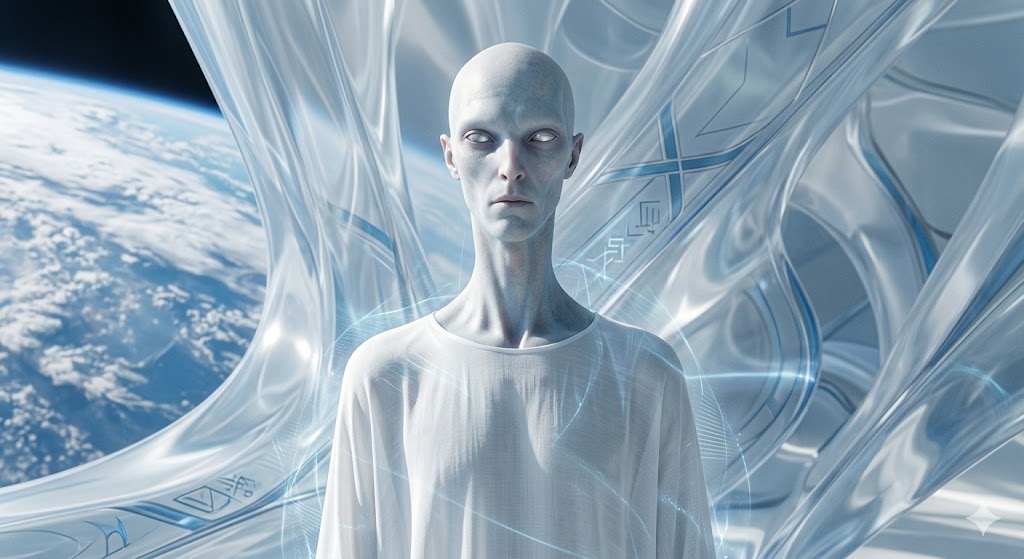
The Rumardians are the chroniclers of the cosmos, watching humanity's evolution with detached compassion.
THINK ABOUTIT’S ALIEN TYPE SUMMARY – Rumardians
“They do not speak to the ears, but to the history of the soul.”
In the Think About It Alien Database, the Rumardians are described as the galaxy’s most dedicated chroniclers. Hailing from the Arcturus sector, these nine-foot-tall humanoids possess a unique biological ability to “see” time as a physical landscape. In 2026, as humanity crosses the threshold into a multi-planetary species, the Rumardians have positioned their translucent needle-craft near Earth’s Lagrangian points. They aren’t here to guide us or control us; they are here to ensure that this pivotal moment in human history is recorded with perfect accuracy for the universal archives.
Name: Rumardians
AKA: The Tall Ones, The Blue-Paled, The Silent Monks of Arcturus
Location – Home System: Rumard (Orbiting Arcturus / Alpha Boötis)
Distance from Earth: ~36.7 Light Years
Attitude: Extremely peaceful, observant, and intellectually detached
Motives: Monitoring the psychic evolution of sentient species; record-keeping
Physical Appearance: Very tall, slender humanoids with elongated limbs and necks
- Average Height: 7’5″ – 9’0″
- Average Weight: 55 – 70 kg (Light, hollow-boned structure)
- Body Temperature: 94.5°F
- Pulse/Respiration: 30 BPM (Extremely efficient)
- Blood Pressure: 90/55
- Life Expectancy: 800 – 1,100 Earth years
- Hair: None
- Skin: Very pale, often with a faint, dusty-blue or silver undertone
- Eyes: Large, solid silver or soft grey; they appear to “shimmer” when they think
- Sex: Binary (Male/Female), though very little physical dimorphism
Other Physical Information: Fingers are very long and tapered; they move with slow, anti-gravity grace
Special Traits and Abilities: Deep-field telepathy; ability to perceive “auric timelines”
Communication Type: Non-verbal; sophisticated telepathic “data-bursts”
Origin: Rumard (A high-altitude, low-gravity world)
Life Form Type: Physical Humanoid / High-Vibrational
Subspecies: The Chronos-Keepers and the Way-Showers
Most Common Species: Rumardian Observer
Level of Species: Level XIV – Masters of Spacetime Observation
Habits: Standing in perfectly still meditation for weeks; observing human events without interference
Transportation Type: Translucent, needle-shaped ships that move through “phasing”
Witnesses Reports: High-altitude climbers in the Himalayas; 2026 Deep-Space Gateway personnel
Special Features/Characteristics: They emit a cooling, calm sensation to anyone in their presence
Summary/Description: A race of tall, slender beings dedicated to observing galactic history.
Source: Think About It Database; Arcturian Collective Logs; 2026 Disclosure Gate
The Physics of Stillness and the 2026 Timeline
Biological Efficiency and the Low-Gravity Frame
The Rumardian physiology is a masterpiece of low-gravity evolution. Originating from the planet Rumard, which has only 0.4x Earth’s gravity, their bodies are elongated and extremely light. According to the Think About It Database, their skeletal system is not composed of marrow-filled bone, but a carbon-silica honeycomb structure that is incredibly strong yet nearly weightless. This allows them to reach heights of nine feet without the circulatory stress a human would experience. Their slow heart rate (30 BPM) is a result of their “Stillness Meditation,” a cultural practice where they lower their metabolism to match the vibrational frequency of the surrounding space.
2026: The Chronos-Keepers and the Density Shift
In the 2026 Disclosure window, the Rumardians have been identified by space-based sensors as “Phasing Anomalies.” Their ships do not use traditional propulsion; instead, they “phase” in and out of 3rd-density reality. The Rumardians are currently monitoring what they call the “Timeline Convergence.” They believe that in 2026, humanity is choosing between several potential futures. While they never interfere with human free will, they have been known to “anchor” positive timelines by their mere presence at significant historical sites, such as the UN headquarters or major research hubs, acting as a calming psychic weight against global panic.
The Silver Eye: Perception of the Aura
Rumardian eyes are unique in the known galaxy. Lacking pupils or irises, their solid silver eyes function like multi-spectral cameras. In the Think About It Database, it is noted that a Rumardian doesn’t look at your body; they look at your Aura-Record. They can see the emotional history and the “karmic weight” of any sentient being at a glance. For this reason, they are often sought out by the Galactic Federation to serve as neutral witnesses in interstellar negotiations. They are the only race whose testimony is considered 100% objective, as their biology is incapable of deception or bias.
The Physics of Stillness and the 2026 Timeline
Biological Efficiency and the Low-Gravity Frame
The Rumardian physiology is a masterclass in low-gravity evolution. Originating from the planet Rumard, which orbits the orange giant star Arcturus, these beings have adapted to an environment with only 0.4x Earth’s gravity. This has resulted in a skeletal structure that is not composed of dense, marrow-filled bone, but rather a carbon-silica honeycomb matrix that is incredibly strong yet nearly weightless. This allows them to reach heights of nine feet without the circulatory or structural stress a human would experience at that scale. According to the Think About It Database, their resting heart rate of 30 BPM is a biological necessity; it is a state of “Stillness Meditation” that allows their nervous system to interface directly with the high-vibrational currents of the Arcturian sector.
2026: The Chronos-Keepers and the Timeline Convergence
In the 2026 Disclosure landscape, the Rumardians have been identified by Earth’s deep-space orbital sensors as “Phasing Anomalies.” Their ships, often appearing as translucent needles or shards of glass, do not utilize traditional propulsion. Instead, they “phase” in and out of 3rd-density reality by adjusting their internal frequency. The Rumardians are currently monitoring what they call the “Great Convergence.” They believe that in 2026, humanity is not just moving through time, but is choosing between multiple probable futures. While they never interfere with human free will, they have been known to “anchor” positive timelines by positioning their craft near high-stress geographical points—such as the UN headquarters or major tectonic fault lines—acting as a stabilizing psychic weight against global panic.
The Silver Eye: Perception of the Auric Record
Perhaps the most unique trait of the Rumardian race is their visual perception. Their eyes, which lack pupils or irises and appear as solid, shimmering silver, function more like multi-spectral bio-scanners than traditional optical organs. In the Think About It Database, it is noted that a Rumardian doesn’t look at a human’s physical body; they look at the Auric Record. They can see the emotional history, the “karmic weight,” and even the future potential of any sentient being at a glance. This ability makes them the galaxy’s most objective witnesses. In 2026, they are often sought out by the Galactic Federation to serve as neutral observers in exopolitical negotiations, as their biology is physically incapable of holding a bias or projecting a deception.
Final Summary: The Silent Sentinels
The Rumardians are the “Silent Sentinels” of our solar system, offering a perspective of detached, yet profound, compassion. As documented in the Think About It Alien Database, they remind us that the most powerful form of action is often the act of witnessing. In 2026, as we struggle to make sense of a world that is rapidly changing, the Rumardians stand as a testament to the power of peace. They are not here to save us, nor are they here to rule us; they are here to ensure that when the history of Earth is finally written into the Great Galactic Library, it is recorded with the dignity and accuracy that a species of our potential deserves. To encounter a Rumardian is to be seen—truly seen—for the first time.