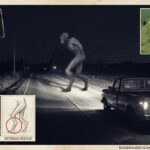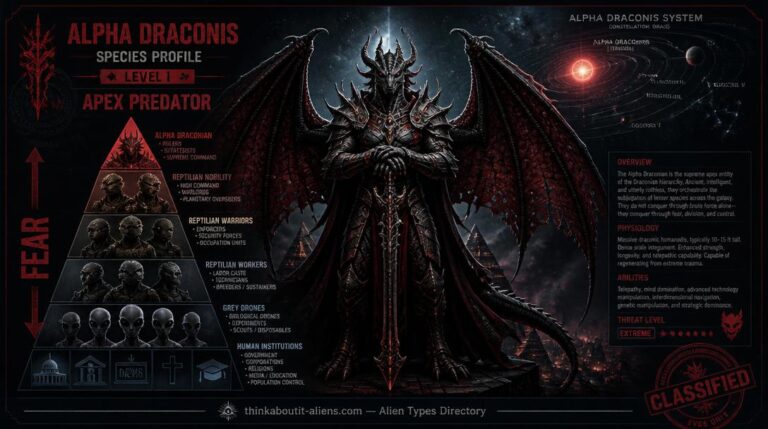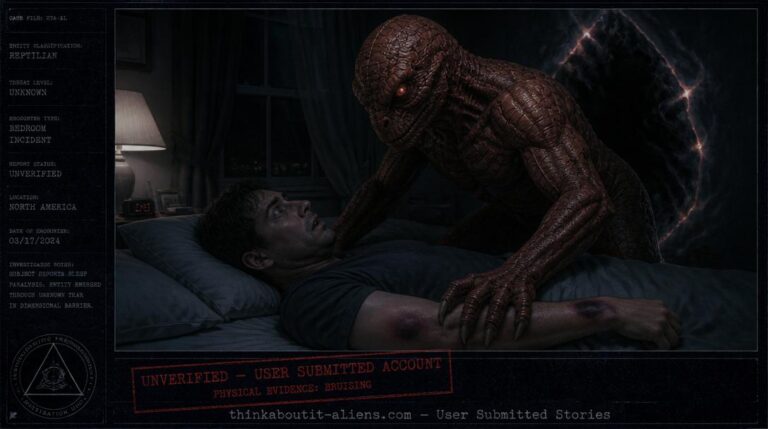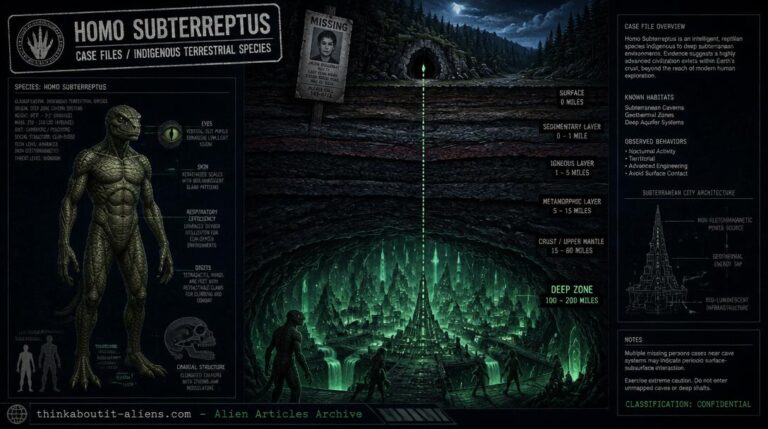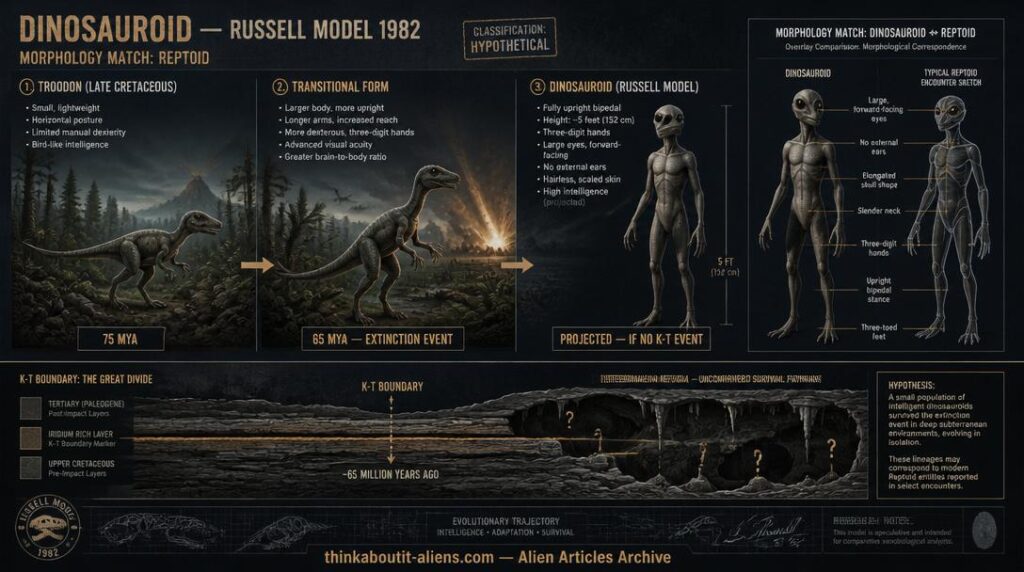
The Dinosauroid model — Troodon's projected evolution to bipedal humanoid intelligence, overlaid with the standard Reptoid encounter profile.
In 1982, Canadian paleontologist Dale Russell posed a question that the scientific establishment has never been able to forget — or comfortably answer: what would have happened if the Troodon dinosaur, with its expanding brain-to-body ratio, binocular vision, and increasingly dexterous hands, had not been wiped out by the K-T extinction event 65 million years ago? Russell’s answer — developed in collaboration with sculptor Ron Séguin and published through the National Museum of Natural Sciences in Ottawa — was the “Dinosauroid“: a bipedal, hairless, large-eyed humanoid standing approximately five feet tall, with three-fingered hands, no external ears, and a cranial structure capable of housing a brain equivalent to or larger than a human’s. The model was not speculative fiction — it was a peer-reviewed extrapolation of documented evolutionary trends in the Troodon lineage.
What makes the Dinosauroid significant for the Think About It species taxonomy is the morphological overlap with reported Reptoid entities: the height range, the three-digit hands, the large cranium, the absence of external ears, and the upright bipedal posture all match the standard Reptoid profile compiled from thousands of encounter reports. If the Dinosauroid model is correct — if a theropod dinosaur was genuinely on an evolutionary trajectory toward humanoid intelligence — then the Reptilian entities described in the abduction literature may not be extraterrestrial visitors at all but Earth’s senior indigenous intelligent species, evolved underground across 65 million years while mammals dominated the surface. This article provides the legitimate scientific foundation for the Inner-Terrestrial Reptilian hypothesis.
Dinosauroids (Human Dinosaurs…Saurians)
What Dale Russell actually proposed (science-based)
In 1982, Dale Russell, a respected paleontologist, explored a thought experiment, not a prediction:
- He focused on Troodon, a small, bipedal theropod dinosaur with:
- A relatively large brain for its body size
- Binocular vision
- Grasping hands
- Russell asked:
If Troodon had survived the K–Pg extinction (formerly K/T) and continued evolving for tens of millions of years, what might it look like?
The result was the “dinosauroid”:
- Reptilian/scaled skin texture covering the body
- Digitigrade legs (walking on the toes, like birds and many dinosaurs)
- Three-toed feet with claws
- A more pronounced snout/muzzle compared to humans
- Large eyes positioned on the front of the face
- Lean, athletic build
- Three-fingered hands
- Minimal to no tail
The evolutionary reasoning:
Russell extrapolated from Troodon’s traits – assuming continued brain growth, the development of tool use would favor manipulative hands, and an upright posture would free the forelimbs. The large eyes reflect the dinosaur ancestry, and the scaled skin maintains the reptilian heritage.
Importantly:
- Russell did not claim such beings existed
- He did not claim dinosaurs evolved into spacefaring civilizations
- He treated the model as speculative and illustrative
Scientific criticism and skepticism
Many scientists objected, arguing that the model was too anthropocentric:
- Intelligence does not require a humanoid body
- Evolution has no goal or direction toward “human-like” forms
- Russell arguably projected human anatomy onto dinosaurs
Modern paleontology suggests:
- If intelligent dinosaurs evolved, they likely would not look human
- Traits like lips, hands, posture, and skull shape were speculative and biologically questionable
As a result:
- The dinosauroid is viewed today as a useful but outdated speculative model
- It remains popular in discussions of evolutionary theory, not as a serious prediction
Where the UFO / Atlantis narrative diverges from science
The ideas about:
- Amphibian humanoids
- Prehistoric advanced civilizations
- Atlantis-like destruction
- Survivors colonizing space
- UFO occupants returning to Earth
…are not connected to Russell’s work and fall into:
- Speculative fiction
- Pseudoscience
- Ancient astronaut / cryptohistorical narratives
There is:
- No fossil evidence
- No archaeological evidence
- No genetic or astrophysical evidence
…supporting the existence of a prehistoric non-human technological civilization on Earth.
Bottom line
- ✅ Russell’s dinosauroid = scientific thought experiment
- ⚠️ Humanoid dinosaurs = highly speculative
- ❌ Ancient reptilian or amphibian spacefaring civilizations = unsupported by evidence
That said, the idea remains influential in science fiction, philosophy of evolution, and discussions about convergent intelligence.
Executive Summary:
Dinosauroids — Dale Russell’s 1982 Troodon Thought Experiment and the Inner-Terrestrial Reptilian Foundation
Dale Russell’s 1982 Dinosauroid model — a peer-reviewed evolutionary extrapolation published through the National Museum of Natural Sciences (Ottawa) — demonstrates that the Troodon dinosaur was on a trajectory toward bipedal humanoid intelligence: expanding brain-to-body ratio, binocular vision, increasingly dexterous three-digit hands. The resulting Dinosauroid model — five feet tall, hairless, large-eyed, three-fingered, no external ears — morphologically overlaps with the standard Reptoid profile from encounter literature.
The article provides the scientific foundation for the Inner-Terrestrial hypothesis: that Reptoid entities may be Earth-native saurians who survived underground rather than extraterrestrial visitors from the Draco constellation. The K-T extinction is reframed not as the end of dinosaur intelligence but as the event that drove it underground.
“Dale Russell didn’t set out to validate the Reptilian hypothesis. He was extrapolating an evolutionary trend. But the model he produced looks remarkably like what abductees have been describing for decades.”
About the Author