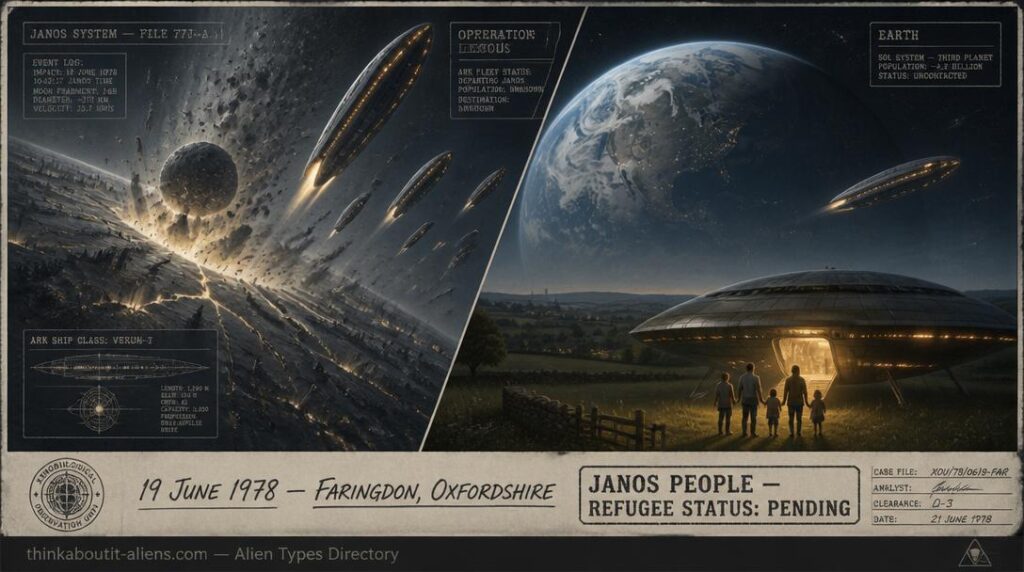
The Janos People — a civilization's destruction by moonfall, the interstellar ark exodus, and the 1978 Faringdon, Oxfordshire contact that brought their story to Earth.
If a thousand starships arrived in Earth orbit tomorrow carrying ten million human-like refugees from a destroyed planet, would we let them land? That is the question at the heart of “An Open Letter to the Janos People” — one of the most emotionally distinctive documents in contactee literature. Written by Frank Johnson, the author and investigator behind the 1978 Janos contact case, this open letter is addressed directly to the Janosian civilization: a race of humanoid beings who, according to testimony recovered under hypnotic regression from a five-member English family near Faringdon, Oxfordshire, were forced to evacuate their home planet aboard interstellar arks after a catastrophic moonfall destroyed Janos. Unlike virtually every other alien contact narrative in the literature, the Janos case does not frame the extraterrestrials as invaders, observers, or cosmic teachers — the Janosians are refugees, and their request is not for worship or obedience but for a place to live.
The contact occurred on June 19, 1978, when John, Frances, Gloria, and two young girls — Natasha and Tanya — were taken aboard a Janosian ship and shown visual records of the destruction of Janos and the civilization that existed before the rockfall. The witnesses were interviewed extensively by Johnson and hypnotic regression specialist Geoff McCartney, producing testimony that included thirteen words of the Janos language (which Johnson notes form a coherent linguistic family), detailed descriptions of the ship’s engine room and navigation systems, and an explanation of relativistic space-time physics delivered by the Janosian officer Uxiaulia to Frances — physics the witnesses did not possess the background to have invented. Johnson’s open letter proposes specific settlement locations on Earth for the Janosian population, discusses the logistics of coexistence, and frames the arrival of the Janos People not as an alien invasion but as a potential catalyst for human unity. The accompanying credibility analysis systematically dismantles alternative hypotheses — fabrication, hypnotist influence, and the cosmic trickster theory — making this one of the most methodologically self-aware contactee documents ever published.
An open letter to the Janos People
JOHN, FRANCES, GLORIA and the two little girls Natasha and Tanya visited one of your ships, near Faringdon in Oxfordshire, England, on the date we call 19 June 1978. Anouxia talked to John, and Uxianlia talked to Frances. Both were shown pictures of why you had to leave Janos.
They have told me (Frank, the writer of this book) about their visit, and about all you told them and showed them. John has described the big circular room where you make power, what we call the engine room, and he has told me about the pictures Anouxia showed him on the screen in the big curved table in the navigating room.
Frances has told me what Uxiaulia said, and about the pictures he showed her, of the rockfall, and of life in your planet before rockfall. Natasha has told me about the pictures Akilias showed her on a screen. Gloria does not remember much; perhaps you could now help her to remember, now that memory has come back for the others, as you said it would in time. Gloria now has another child, as perhaps you know.
They have not told other people; it was agreed that I should write in a book everything they told me about the Janos people, and this is the book. If there are mistakes in it, I am to blame.
We felt that it was important for ordinary Earth people, in every part of our planet, to hear the story of the Janos people, and to understand why you want to come here to live. We hope that this is in accordance with your wishes.
People are always afraid of what they do not understand; and when they are afraid they make wrong judgements. People on Earth call your ships UFOs or ‘flying saucers‘, as I am sure you know; and they have many very curious ideas about them. Ordinary people nowadays have all heard about the flying saucers, and many have seen them; more than half the people think they are real ships, and come from another world.
Governments and military leaders, for reasons they have never explained to us, try to cover up the UFO question; and they tell us that the flying saucers, your spaceships, are not real things, but are only in the imagination. Most ordinary people do not accept this, and think the governments and military leaders are trying to hide something which they do not want ordinary people to know about. We, the ordinary people, do not like secrecy; and we think it is time the question of the flying saucers or spaceships was brought out into the open, and understood by everyone.
It is time that you showed yourselves more openly to the Earth people. I do not ask you to take risks; I understand you are anxious about your safety:
but I am sure that arrangements could be made for you to speak through our television system, directly to all the people of this planet.
It is not going to be easy to get people to agree to give you a place to live.
This planet is very crowded, with four thousand million inhabitants; but there are places which are not crowded, where you could live. The difficulty is that every part of Earth – except Antarctica which is quite unsuitable for living in – has some people in it; and they are going to be unwilling to move from their homes. However, if they are given a sufficient incentive to move, they could in some cases be persuaded.
I have written about some possible places in my chapter 14: Homecoming. An island, as you yourselves have suggested, would be very good, because it would be a naturally defined area which would not change; land frontiers can be changed, either way. You will see that I have made one suggestion, which is not an island – in the northlands of Norway, Sweden and Finland, countries which I myself know and love. If you already know English, it is easy to learn Swedish; but the Finnish language is difficult. However, many Finlanders can speak Swedish.
You will need quite a lot of space; all I know about your numbers comes from one thing said by Uxiaulia: “There are enough of us to fill one of your large cities”. I have taken this to mean about ten million; if your numbers are much less than this, it makes the problem of finding a place for you that much easier to solve.
How much space you need will depend partly on how you propose to live, and how much land you need for agriculture. It would be unwise to have too little space, because this might lead to disagreements later on, when your children grow up and may feel they have not enough room. Whatever is agreed should remain for a very long time, without causing further problems.
If you like the sea and ships, this will help understanding and friendship; because it is something that many Earth people will understand.
You will be able to help us a great deal with our science and technology, which is a long way behind yours. More knowledge must bring a better life for everyone. At the same time, we can perhaps help you in many ways; it may be that our creative arts are more highly developed than yours. The richness and variety of our cultural inheritance is quite remarkable.
In any case, we have numbers, and numbers mean strength; if Janos and Earth join forces, we shall be strong together, in case some of the unfriendly planets you speak of send their ships to attack us. But we hope not to have any war.
It would be good if your coming back to Earth helped the people of Earth to be more united among themselves, so that they did not waste half their wealth on buying weapons to fight each other with. The ordinary people do not want war; it gives too much power to those in authority.
Let us talk together. If you want to talk to me, John and Frances know where I live; and so does the publisher of this book.
A Note on Credence and Credibility
THERE WILL BE many who will be reluctant to accept this book as factual, for reasons which have more to do with their own personalities and psychological make-up than with the facts of the case.
We are all familiar with the story of the dear old lady who, seeing a giraffe for the first time at the zoo, said: “I don’t believe it”. Almost daily in some part of the world, people are seeing for the first time a flying saucer, spacecraft or some other UFO manifestation: many are convinced by seeing, sometimes too easily; but there are always some who, like the old lady, can not accept what they see as reality-and of course, many ‘sightings’ are undoubtedly mistaken.
And yet, if you see an aeroplane, even one of an unfamiliar type, do you deny its reality? I suggest that it is not the strangeness of the flying saucers that make some unwilling to think of them as engineering hardware with real flesh-and-blood people in them: the UFOs are by now becoming so familiar through published pictures, that they are no longer so strange, and the term ‘unidentified’ in ‘unidentified flying object’ is fast losing its meaning. I have even heard of a UFO being “definitely identified as an unidentified flying object”.
What puts the flying saucers in a class apart is the feeling that they are extra-terrestrial, from another world. And yet we ourselves, as soon as we set foot on the moon, are extra-terrestrial in a modest way. No one suggests that we should not ‘believe’ in Neil Armstrong or Buzz Aldrin, for all they travelled in a spaceship and wore helmeted suits, not unlike those sometimes described as worn by ‘spacemen’ from a flying saucer.
‘Belief’, in fact, is an inappropriate concept when we are talking of UFOs. Either the thing exists or it doesn’t; no one’s ‘belief’ affects it one way or the other. Belief is a state of mind, often with complicated psychological connotations. Often it is culturally conditioned, as with religious belief. It has no bearing on objective phenomena, which exist, or not, as the case may be, quite independently of what people believe or think about them.
Having spent very many hours listening to John and Frances, both under hypnotic regression and in normal conversation, I have not the least doubt that they experienced what they say they did. This is the ‘face-value’ hypothesis, which I have chosen to adopt, as the simplest, most straightforward, and most convincing.
If any reader chooses to prefer an alternative hypothesis, that is his or her privilege. But if he wishes to maintain his own credibility, he must be prepared to show us that his preferred hypothesis is more credible than the one I have chosen.
What are the possible alternative hypotheses?
First, he could prefer the hypothesis that the witnesses invented it all, for some reason known only to themselves, for they have not sought notoriety or reward. While I have learnt to have a great respect for them as personalities, I have to say that they simply did not know enough. They were relating matters, the significance of which often escaped them for lack of background information, but which made immediate sense to me. To take a single example: the thirteen words of the Janos language, which they repeated to me, hang together naturally in a linguistic family relationship; they could not have known this.
Again, the invention of the falling moon theme would require a considerable amount of astronomical knowledge, which they simply did not possess; though they are capable of understanding it when it is explained to them. I would not be so sure that they are yet quite clear about the relativistic space-time physics on which the journey from Janos to Earth depended; but Frances faithfully repeated Uxiaulia’s admirably clear explanation of it.
Second, the author could have invented it. I only wish I could; if I had that kind of creative imagination, I could earn a large fortune as a science fiction writer.
Third – a favourite one, this – it was all in the mind of the hypnotist. Not all of it: because some of the most important facts came out in normal recall, on occasions when the hypnotist was not present. It is true that Geoff McCartney has an interest in ufology, and has read a number of books about it; but this has chiefly helped us by giving him a personal motivation to be willing to take on the case, and to work very hard on it; it has not contributed factually. Indeed, on the rare occasions on which Geoff’s personal background reading may be said to have intruded, it was unhelpful and confusing.
Are these alternative hypotheses credible?
There is a possible further alternative, which cannot be dismissed so lightly; though after careful thought, I have to reject it as far-fetched and unsupported by any evidence: and the witnesses who, after all, are in the best position to know, will have none of it. This is the alternative, which has provided matter for several books, which regards all UFO manifestations as a kind of confidence trick played, not by human hoaxers, but by some icily remote and vast intelligence, cosmic in scale, which has a twisted sense of humour.
The notion has had some airing in the literature, that the UFOs are not what they seem: that the people in them are clever disguises, made to seem acceptable to us, for something very much nastier and infinitely sinister. The trick, it seems, is so cunningly worked that people like Frances, who is an acute judge of personalities, are entirely taken in.
Frankly, I find this one the most way-out and insubstantial of the lot; its exponents have given us no solid grounds for believing it.
Lastly, there are the various intellectual dodges.
‘Subjectivity’ is the one which has the widest currency at the moment. But does it mean anything?
All experiences have a subjective element; otherwise we could not experience them. I have no direct perception of the objects before my eyes: what my conscious personality has to work on is at best a mental construct, often distorted by what I expect to see, made up from data supplied by my optic nerves from the retinae. My view of the world is unavoidably indirect, and my subjectivity plays an important part in it.
But it would be arrant nonsense to deduce from this that the world before my eyes exists only in my subjective mind.
When John tells me that a particular piece of metal in the spaceship is shaped thus, and has these dimensions, I prefer the common-sense view that the piece of metal is approximately as he describes it; I do not find it necessary to take refuge in an escape formula, such as: “Well, he had an experience, which is real to him”.
Formulae like this – and there are others, such as the ‘parallel universes’ one – are bolt-holes for people to hide their heads in – people who cannot face the uncomfortable, challenging truth, that the world we live in is larger than we thought.
Books for Further Reading
The following books are listed here for the convenience of those who would like to extend their reading in ufology and allied fields.
I must, however, make it clear that the inclusion of a book in this list does not imply that I am prepared to endorse its reported data, or to support its author’s conclusions.
It would be invidious and impertinent if I were to attempt any kind of evaluation; all I will say is that all these books are on my own shelves.
BAxTER, JOHN and THOMAS ATKINS: The Fire Came By. Macdonald and Jane’s; Futura 1977
BERLITZ, CHARLES: Without a Trace (an account of the Bermuda Triangle).Souvenir Press; Panther 1978
BERLITZ, CHARLES: Mysteries from Forgotten Worlds. Souvenir Press; Corgi 1974 BLUM, RALPH and JUDY: Beyond Earth. Corgi 1978
BOURRET, JEAN-CLAUDE: The Crack in the Universe. Neville Spearman 1977
BOWEN, CHARLES (edited by): Encounter Cases from Flying Saucer Review. Signet 1977
BOWEN, CHARLES (edited by): The Humanoids. Neville Spearman; Futura1974
CHAPMAN, ROBERT: UFO – Flying Saucers over Britain? Arthur Barker; Mayflower 1968
HOLROYD, STUART: Briefing for the Landing on Planet Earth. W. H. Allen;Corgi 1977
HOLZER, PROFESSOR HANS: The Ufonauts. Panther 1979
HYNEK, DR J. ALLEN: The Hynek UFO Report. Sphere 1978
Executive Summary:
An Open Letter to the Janos People — Refugees, Rockfall, and the Question of Extraterrestrial Asylum
This document comprises two sections from the book The Janos People by Frank Johnson: the open letter addressed directly to the Janosian civilization, and the author’s detailed credibility analysis of the case. The contact occurred on June 19, 1978, near Faringdon in Oxfordshire, England, when five witnesses — John, Frances, Gloria, and two children, Natasha and Tanya — were taken aboard a Janosian spacecraft. Onboard, the contactees were shown visual records of the destruction of planet Janos by a catastrophic moonfall, met individual Janosian officers (Anouxia, Uxiaulia, Akilias), and were given detailed technical information about the ship’s propulsion and navigation systems. The testimony was recovered through extensive interviews and hypnotic regression sessions conducted by investigator Geoff McCartney. Johnson estimates the Janosian refugee population at approximately ten million, based on Uxiaulia’s statement that there were “enough of us to fill one of your large cities,” and proposes specific settlement locations including Scandinavian northlands and islands.
The credibility section is unusually rigorous for contactee literature. Johnson systematically addresses four alternative hypotheses — witness fabrication, author invention, hypnotist contamination, and the cosmic trickster theory — and rejects each on evidential grounds. He notes that the witnesses described technical details and linguistic structures whose significance they did not understand, that key testimony emerged during normal recall sessions without the hypnotist present, and that Frances accurately relayed relativistic physics explanations she lacked the background to invent. The open letter itself is remarkable for its tone: it reads not as a UFO report but as a diplomatic communication, proposing terms of coexistence, discussing agricultural land requirements, anticipating frontier disputes, and suggesting that a Janosian-Earth alliance would create mutual strength against hostile interstellar civilizations. Johnson explicitly frames the Janos case as a test of human character — whether humanity can respond to an extraterrestrial refugee crisis with compassion rather than fear.
“It is not going to be easy to get people to agree to give you a place to live. This planet is very crowded, with four thousand million inhabitants; but there are places which are not crowded, where you could live… Whatever is agreed should remain for a very long time, without causing further problems.”
— Frank Johnson, The Janos People
About the Author