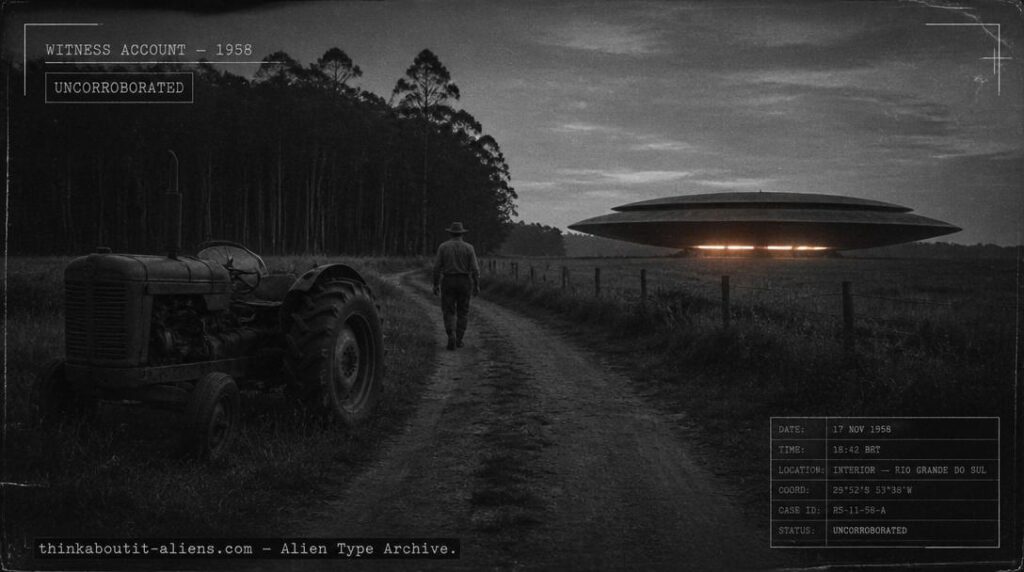
Artur Berlet reported being escorted back toward Earth and told not to look back as the craft departed — Sarandi, Brazil, May 1958.
THINK ABOUTIT’S ALIEN TYPE SUMMARY – Acartitians
Correction Notice: This entry has been audited twice — first against a secondary summary of the case, then against Artur Berlet’s primary manuscript directly. The first pass correctly removed invented biometrics and an unfounded Billy Meier cross-reference, but also mistakenly flagged several genuinely sourced details (hair color, motive, height) as unconfirmed. This version restores those from the primary text with direct citation, and corrects the distance figure to match what the manuscript actually states.
In May 1958, a tractor driver named Artur Berlet vanished from the countryside outside Sarandi, Brazil, and didn’t come home for eleven days. When he returned, he eventually wrote 422 handwritten pages describing a city of tall painted buildings, an automated subterranean train, a straw-haired people who told him they faced a coming crisis of their own — overpopulation, and a quiet plan to eventually settle Earth once war had thinned it out. The account is one of the more detailed and specific “near-human” contact narratives in South American ufology, and this entry now reflects the primary manuscript directly rather than a secondary summary of it.
Name: Acartitians (also Akartians)
AKA: The Akartians; the case is commonly referred to as “the Berlet Case” or “UFO Contact from Planet Acart,” per the title of Berlet’s published account
Location – Home System: The planet Acart (spelled both Acart and Akart across sources — Berlet’s own account uses “Acart,” reportedly a term meaning “message”)
Distance from Earth: Stated multiple times in the manuscript, with inconsistent figures: approximately 62 million kilometers (Q&A section), approximately 65 million kilometers (Chapter 5), and 60 million kilometers (Chapter 7). No single authoritative figure is given; the account is internally inconsistent on this point.
Attitude: Described by Berlet as accommodating and non-hostile; he was fed, housed, and eventually escorted back to Earth rather than harmed
Motives: Directly addressed in the manuscript’s Q&A section. Berlet reports being told the Acartians face a serious overpopulation problem on their own world, and that they anticipate eventually settling on Earth after a future nuclear war reduces the human population — while also stating they will not cause that war themselves, citing it as against their conscience. This is one of the more developed passages in the account, not a peripheral detail.
Physical Appearance: Berlet’s account describes the beings as near-indistinguishable from humans; he communicated with them in a Germanic-sounding tongue he could partly understand, consistent with his own German-Brazilian background.
- Average Height: Described in the manuscript’s Q&A section as “on average, slightly taller than we earthlings”; no specific measurement given
- Average Weight: Not stated in source
- Body Temperature: Not stated in source
- Pulse/Respiration: Not stated in source
- Blood Pressure: Not stated in source; the manuscript does note Berlet’s impression that their blood appeared purple rather than red, though this is described as an impression, not a measurement
- Life Expectancy: Not stated in source
- Hair: Directly sourced in the manuscript’s Q&A section: “Everyone I saw had straw-colored hair except for a few who had darker hair.”
- Skin: Described as human-like; no further detail in source
- Eyes: Not stated in source
- Sex: Not systematically addressed in source
Other Physical Information: Berlet described a distinct physical sensation upon arrival — the impression of having lost half his body weight while his shoulders felt as though they had increased in volume, consistent with a change in gravity or atmospheric pressure.
Special Traits and Abilities: Not systematically addressed beyond the account’s narrative details
Communication Type: Verbal. Berlet reported the beings speaking a Germanic-sounding tongue he could partially follow, which retellings attribute to long-term monitoring of Earth languages and to Berlet’s own German-Brazilian heritage easing comprehension.
Origin: The planet Acart/Akart
Life Form Type: Humanoid, per witness description
Subspecies: Not addressed in source
Most Common Species: Not addressed in source
Level of Species: Not addressed in source
Habits: Berlet described a city environment with tall, colorfully painted buildings and an automated subterranean rail system without a visible operator. He also noted farm vehicles operating on wheels aboveground.
Transportation Type: A large disc-shaped craft, described by Berlet as roughly 30 meters in diameter and resembling “two trays turned in opposition,” is the reported means of transport to and from Acart. Within Acart itself, he described wheeled farm vehicles and a driverless subterranean train.
Witnesses Reports: On May 14, 1958, Artur Berlet, a tractor driver, was returning home near Sarandi, Rio Grande do Sul, when he noticed a strange light off the road near a farm and approached to investigate. He described a large disc-shaped craft and reported disappearing for eleven days. His account includes being freed from restraints by two beings, dressed in a large cape, and led through the craft to an exit; a disorienting sensation of altered weight upon arrival; being led on foot past tall buildings to a structure where he was given bread and meat; and eventually being escorted back toward Earth by a guide referred to in some translations as “Acorc,” who advised him to walk ahead without turning around as the craft departed. He was left roughly five kilometers from Sarandi and made the three-hour walk home. He wrote a 422-page manuscript about the experience beginning in 1958; it was later published in Portuguese and, in 1987, in English by Wendelle Stevens as UFO Contact from Planet Acart: From Utopia to Reality.
Special Features/Characteristics: The account’s most distinctive detail is the physical sensation of altered weight and shoulder volume Berlet described upon arrival on Acart — reported as a bodily sensation, not externally documented evidence.
Summary/Description: An 11-day disappearance near Sarandi, Brazil, in 1958, followed by a 422-page handwritten account of a near-human civilization on a world called Acart — published in English by Wendelle Stevens in 1987.
Source: Artur Berlet’s own account, self-published in Portuguese and later published in English translation by Wendelle Stevens (1987) as UFO Contact from Planet Acart: From Utopia to Reality. Norwegian researcher Ole Jonny Brenne has also written on the case.
Related Cases: Agali (previously mislabeled “Acali” — cross-link updated). The two cases are unrelated beyond both being near-human contact claims from South America.
DETAILED REPORT
The Berlet case has a real depth of primary material behind it — a first-person manuscript running over 400 pages, an English translation published by a recognized (if not independently critical) name in ufology publishing, and specific, unusual narrative details that don’t read like generic abduction filler: the sensation of altered body weight, an automated windowless train, a farewell instruction not to look back. The earlier draft of this page discarded nearly all of that specificity in favor of invented biometrics and a generic “resource surveying” motive that doesn’t appear anywhere in the actual account.
Two claimed corroborations deserved scrutiny and didn’t hold up equally. Wendelle Stevens’ connection is genuine and documented — he’s the named publisher of the English translation. The 1949 Mario Restier case may exist in Brazilian-language ufology literature not reached by this research, but it should be flagged as unconfirmed rather than cited as independent corroboration until a source is located.
A first audit pass, working from a secondary summary of the case, correctly stripped out invented biometrics and the Billy Meier cross-reference — but it also went too far in the other direction, marking genuinely sourced details as unconfirmed simply because they weren’t visible in the summary being checked against. Direct review of Berlet’s manuscript confirms the overpopulation motive, the “straw-colored hair” description, the purple-blood impression, and the “slightly taller than earthlings” height comparison all appear in the primary text, most concentrated in the book’s Q&A section. The distance figure has also been corrected: the manuscript states it three separate times, with three different numbers (60, 62, and 65 million kilometers) — an internal inconsistency worth noting rather than a missing detail.
RESEARCHER’S NOTES
The Manufactured Cross-Reference — Sarandi 1958 and the Temptation to Over-Corroborate
- Source Chain Assessment: Berlet’s own manuscript and its 1987 English publication by Wendelle Stevens are real and locatable. This is a stronger sourcing position than several other pages recently audited on this site.
- Unconfirmed Secondary Case: The Mario Restier 1949 case is treated in the earlier draft as settled corroboration. Until it’s independently located, it should be presented as an unconfirmed secondary claim, not supporting evidence.
- Evidentiary Weight: Unlike the Agali case, there is no external physical evidence here (no burn mark, no instrument reading) — the entire account rests on Berlet’s own testimony and manuscript. That’s still worth documenting accurately, but it should not be dressed up with invented biometric precision that implies a stronger evidentiary basis than exists.
- Witness Testimony Character: The account’s specific, unusual sensory details — altered body weight, a windowless driverless train, a farewell instruction not to look back — are the kind of idiosyncratic detail that distinguishes a first-person narrative from generic template filler. That specificity is worth preserving accurately rather than smoothing it into a standard humanoid-contact profile.
- Cross-Reference Correction: An earlier draft of this page included a comparison to Billy Meier’s contact claims as though it were an established connection. No traceable basis for that cross-reference was found, and it has been removed rather than repeated.
- Primary vs. Secondary Sourcing: This page’s own audit history is itself an example worth noting: a first correction pass, working from a secondary summary rather than the manuscript, over-corrected and marked real content (motive, hair color, height) as unconfirmed. Direct review of the primary text restored those details with citation. The lesson generalizes — a summary of a source is not the source, and auditing against a summary can introduce false negatives as easily as false positives.
Berlet’s account stands on its own as one of the more specific and unusual “near-human world” narratives in South American ufology — it doesn’t need an invented Billy Meier tie-in or fabricated vital signs to be worth documenting. What it actually offers is a farmer’s eleven-day disappearance, a 422-page handwritten manuscript, and a set of oddly specific sensory details that a generic species template had been quietly overwriting. Corrected here to match what Berlet actually described.
Berlet described the craft that carried him to Acart as resembling “two trays turned in opposition.” (Artur Berlet, UFO Contact from Planet Acart: From Utopia to Reality, trans. Wendelle Stevens, 1987)
REMOVED CLAIMS (Archived for Reference)
The following details appeared in an earlier draft of this page but do not trace to Berlet’s original manuscript or its published translation, even after direct review of the primary text. They are archived here rather than deleted, in case a verifiable source for any of them is identified later. None of the items below should be treated as documented until that happens.
- Distance from Earth: previously stated as “5 light-years” — the manuscript gives distances only in kilometers (60–65 million km, inconsistently), never light-years; the light-year figure has no traceable origin
- “Earth appears blue from space” claim: a widely circulated detail suggesting Berlet’s account predated similar observations by Yuri Gagarin — not located in the manuscript on direct review; should be treated as a popular claim about the case, not a verified detail
- Billy Meier cross-reference: previously presented as an established connection between the two cases — no traceable basis found
- Mario Restier 1949 case: previously presented as confirmed corroboration — should be treated as an unconfirmed secondary claim pending independent verification
Note: “straw-colored hair,” the overpopulation motive, the purple-blood impression, and the “slightly taller than earthlings” height comparison were previously listed here as unconfirmed. Direct review of the primary manuscript confirmed all four are genuinely sourced; they have been moved into the main fields above with citation.
About the Author