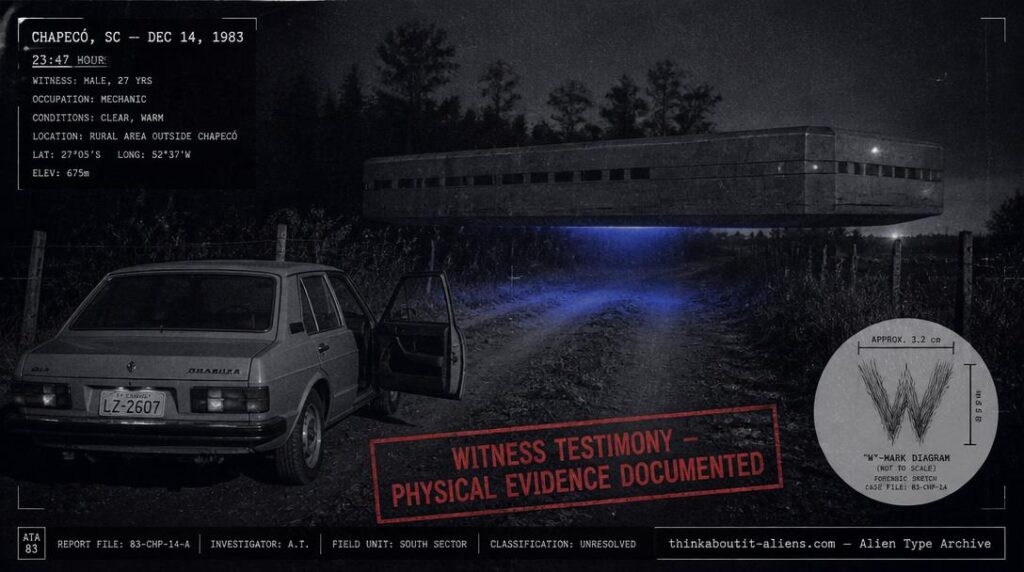
A visual reconstruction of the December 14, 1983 Chapecó encounter — the documented case behind the entity Cabalá and the world of Agali.
THINK ABOUTIT’S ALIEN TYPE SUMMARY – Agali
On the night of December 14, 1983, a real estate broker named Antônio Nelso Tasca claims he was pulled aboard a rectangular, matte-gray craft near Chapecó, Santa Catarina, and met a being who identified herself telepathically as Cabalá — messenger of a world called Agali. He came back with a painless, hair-intact burn between his shoulder blades in the shape of a “W,” a magnetometer reading his investigator couldn’t explain, and a message about disarmament and planetary survival that he spent the rest of his life repeating. This is one of Brazilian ufology’s most examined contact cases — investigated on the ground, photographed, and instrumented within days — and it deserved better than the version that had circulated on this site.
Name: Agali (world of origin); the contact entity is named Cabalá
AKA: Previously mislabeled on this site as “Acali” / “The Akaali.” Also referenced in Brazilian coverage as “the Tasca Case” (Caso Tasca).
Location – Home System: Not specified by name in the testimony. Cabalá told Tasca they were, at the time of speaking, in an underground/underwater location approximately 180 meters below sea level
Distance from Earth: Not stated in any source.
Attitude: Described by Tasca as calm and reassuring; Cabalá’s first words to him, translated, were to the effect of “be calm, I am of peace and love.“
Motives: Per Tasca’s account, Cabalá delivered a warning that weapons capable of ending life on Earth needed to be deactivated immediately, framed as a risk to Earth’s “celestial path” and to other worlds/dimensions. Environmental preservation was a secondary theme of the same message. (The earlier draft presented the visit as environmentally motivated only, dropping the disarmament core.)
Physical Appearance: Cabalá is described as approximately 1.2 meters tall, dressed in a long indigo-blue dress with a matching sash tied in front, and blue slip-on shoes, with no other adornment. Other, smaller beings were also reported present but not described in detail.
- Average Height: ~1.2 meters, per Tasca’s description of Cabalá specifically (not a species average — sample size of one witness account)
- Average Weight: Not stated in any source
- Body Temperature: Not stated in any source
- Pulse/Respiration: Not stated in any source
- Blood Pressure: Not stated in any source
- Life Expectancy: Not stated in any source
- Hair: Not described in any source
- Skin: Not described in any source
- Eyes: Not described in any source
- Sex: Cabalá is described as female; the smaller accompanying beings are not sexed in the account
Other Physical Information: None given beyond dress and approximate height.
Special Traits and Abilities: Telepathic communication (see Communication Type). Tasca also described Cabalá removing his psychological distress and restoring his composure during the encounter — described in the record as an emotional/telepathic calming effect, not a named “ability.”
Communication Type: Telepathic. Tasca reported hearing Cabalá’s words without her lips moving, preceded by an indescribable melodic sound lasting roughly ten seconds.
Origin: Agali (per source; astronomical location not given)
Life Form Type: Humanoid, per witness description
Subspecies: Not addressed in any source
Most Common Species: Not addressed in any source.
Level of Species: Not addressed in any source.
Habits: Not addressed beyond the single documented contact.
Transportation Type: Described by Tasca as a rectangular, matte-gray craft, windowless-seeming from outside but with aligned window-like features, hovering roughly a meter off the ground, radiating heat strong enough to prevent close approach. Investigator Walter Karl Bühler recorded elevated magnetometer readings on Tasca’s belt buckle, his car’s bumper, and a nearby utility line’s neutral cable, consistent with the craft’s reported position.
Witnesses Reports: Tasca reported being drawn off the BR-282 highway near a Coca-Cola factory outside Chapecó by an inexplicable compulsion, encountering the craft, and being pulled aboard by a beam of light after approaching too closely. Aboard, he described extreme cold and darkness before the environment warmed; he encountered small beings and then Cabalá, who calmed him telepathically, placed a diadem on his head, and delivered her message. Tasca’s account — repeated consistently across interviews from 1983 through 2006 — also describes an intimate, genetic-purpose encounter with Cabalá during the abduction, which he wrote about at length in his 1999 book Um Homem Marcado por ETs (“A Man Marked by ETs”). Cabalá reportedly told him the two worlds were now linked “by a bridge of 46 pillars and by our children, Mada and Madana” — an allusion to offspring resulting from the encounter, per Tasca’s own account. This detail is one of the most widely covered aspects of the case in Brazilian press and is included here as part of the documented testimony, not as embellishment; it is Tasca’s own claim, not independently verified by any investigator. He was found roughly five kilometers from the abduction site the next morning, his watch stopped at 10:05.
Special Features/Characteristics: The case’s defining physical evidence is a “W”-shaped mark between Tasca’s shoulder blades, consistent with a third-degree burn in depth but painless, with surrounding body hair left undisturbed — a combination the examining physician, Dr. Júlio Zawadzki, could not medically explain. The mark reportedly remained visible for the rest of Tasca’s life.
Summary/Description: A documented, heavily investigated 1983 Brazilian contact case: a named entity (Cabalá), a specific and unexplained physical mark, instrumented magnetometer readings, and a message centered on nuclear disarmament with an environmental warning attached. Also central to Tasca’s own account, though unverified, is a claimed intimate encounter and resulting offspring — a detail this page previously omitted entirely.
Source: Investigated on-site by ufologist Daniel Rebisso Giese (CIPEX) and later by Dr. Walter Karl Bühler (Sociedade Brasileira de Estudos de Discos Voadores), who conducted magnetometer readings and examined burn documentation photographed by Dr. Júlio Zawadzki. Tasca’s own account is documented in his book Um Homem Marcado por ETs (1999) and in numerous interviews from 1983 to 2006 (Tasca died in 2008).
Related Cases: None currently cross-linked on this network.
DETAILED REPORT
The Tasca case is one of the better-instrumented contact claims in Brazilian ufology, which makes the earlier version of this page a particularly unfortunate case of embellishment displacing documentation. Where the real record offers a named witness, a named entity, on-site investigation within days, physical evidence photographed by a physician, and magnetometer readings taken at the scene, the earlier draft replaced nearly all of it with generic invented biology and a sanitized motive, while getting the date and the entity’s world-name wrong outright.
Daniel Rebisso Giese of CIPEX was the first investigator on the case, producing a detailed report and interviewing Tasca and his family. Dr. Walter Karl Bühler of SBEDV followed up with instrumented fieldwork — magnetometer readings on Tasca’s belt buckle, his car’s bumper, and a nearby utility line — and worked with Dr. Júlio Zawadzki, who photographed and examined the burn mark. That mark is the case’s strongest physical anchor: a “W”-shaped injury consistent with a deep burn but without pain, erythema, or fever, and with the surrounding hair follicles undamaged — a combination that resisted conventional medical explanation.
Tasca’s own testimony is the primary source for the narrative content — the cold, dark interior; Cabalá’s appearance and dress; the melodic tone preceding her telepathic speech; the message about disarmament and planetary risk; and, later in his account, a claimed intimate encounter with Cabalá that he described as resulting in offspring on Agali. That last element is Tasca’s own claim, repeated consistently across decades of interviews and detailed in his 1999 book, and it is one of the most reported aspects of the case in Brazilian press — omitting it, as the earlier draft did, understates what the actual record contains, even though it remains uncorroborated by any investigator.
The Missing Name — Chapecó 1983 and the Cost of Generic Substitution
- Classification issue: This is a documented Contact/Abduction case with a named witness, named entity, and physical evidence — it should never have been reduced to an unnamed “Acali female” in a generic species writeup. The entity’s name (Cabalá) and world (Agali) are consistent across every source found and are the most basic facts of the case.
- Source chain assessment: Multiple independent Brazilian ufology sources, journalistic retrospectives, and Tasca’s own book converge on the same core details (date, location, entity name, burn mark, message content). This is a well-corroborated witness account by ufology standards, even though the underlying claim — contact with extraterrestrials — remains unverifiable by definition.
- Physical evidence weight: The W-shaped burn, examined and photographed by a physician and described as painless with intact hair follicles, is the strongest evidentiary element of the case and should anchor any writeup of it. Its omission in favor of invented biometrics was the earlier draft’s most significant failure..
- Message framing: The disarmament warning is the message’s stated priority in every source reviewed, with ecological concern as a secondary element. Framing this as a purely “ecological” contact, as the earlier draft did, inverts the emphasis of the actual testimony.
Corrected against the record, this is a stronger, stranger, and more specific case than the version that circulated before — a real name, a real physician’s photographs, a real magnetometer reading, and a message about nuclear weapons that a Brazilian real estate broker carried for the rest of his life. None of that makes the underlying claim of contact with Agali verifiable, but it does mean the case deserves to be represented as what it actually is, rather than smoothed into a generic humanoid-species template with invented statistics standing in for the details that were already there.
“I am of peace and love” — Cabalá, as reported by Antônio Nelso Tasca, December 14, 1983 (translated from Portuguese).
About the Author