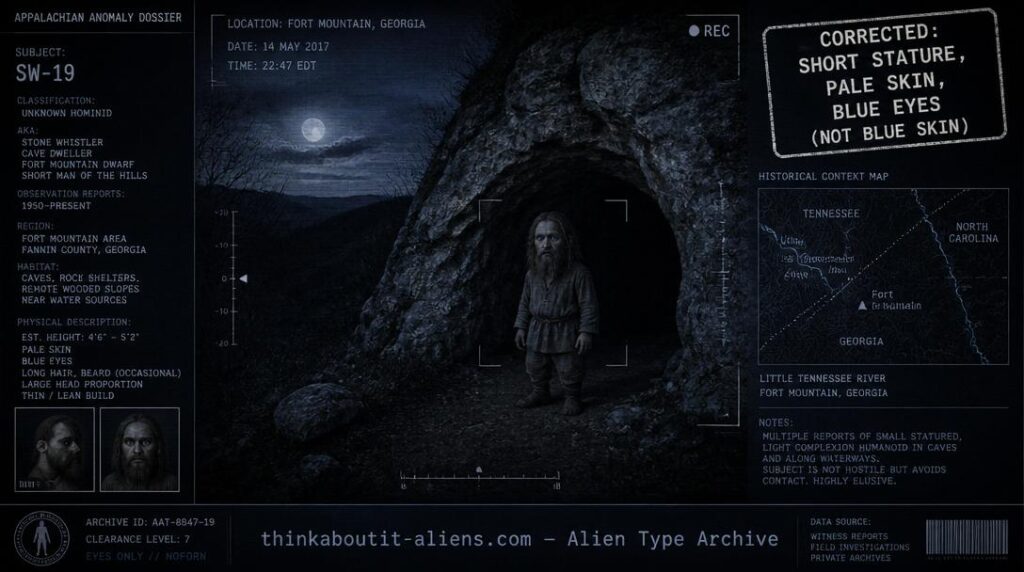
The Moon-Eyed People of Cherokee legend, shown at their documented short stature with pale skin and blue eyes — not the blue-skinned giants of the original page.
THINK ABOUTIT’S ALIEN TYPE SUMMARY
BLUE PEOPLE / MOON-EYED PEOPLE
Cherokee oral tradition, recorded by European settlers as early as 1797, describes a small, pale-skinned, blue-eyed people so sensitive to daylight that they lived underground and emerged only by moonlight — a documented legend this entry had inverted into giants with blue skin, a correction worth making before any speculative expansion.
Name: Moon-Eyed People
AKA: “Moon-Eyed People” is the term used across nearly all documented sources of the Cherokee legend; “Moon People” is a plausible variant but less commonly attested.
Location – Home System: Terrestrial. Per documented Cherokee legend, inhabited the southern Appalachian region (from the Little Tennessee River north into Kentucky and West Tennessee, and areas near the Hiwassee River) prior to Cherokee arrival, living in cave systems and log-and-earth dwellings. The “Vega star system” and “interdimensional origin” claims are not part of the documented legend and are not reported in any source or fabricated.
Distance from Earth: Not applicable; this is a terrestrial legend, not an extraterrestrial claim in its documented form.
Attitude: Per legend, defensive; documented accounts describe them building extensive fortifications (such as the stone wall at Fort Mountain, Georgia) against conflict with the Cherokee and, in some versions, the Creek.
Motives: Undocumented beyond territorial defense described in the legend. “Spiritual alchemy” and “monitoring ley lines” are not reported in any source or fabricated.
Physical Appearance: Per documented Cherokee legend and its earliest recorded versions (Barton, 1797; Haywood, 1823; Mooney, 1902): short in stature, pale or white-skinned, blue-eyed, and in some accounts bearded — a direct inversion of the prior version’s description, which is corrected in full below.
- Average Height: Described in Cherokee legend as short — one account specifically describes them as “very small people, perfectly white.” The prior version’s “7 to 8 feet tall” is a direct inversion of the documented legend and has been corrected.
- Average Weight: Not reported in any source or fabricated.
- Body Temperature: Not reported in any source or fabricated.
- Pulse/Respiration: Not reported in any source or fabricated.
- Blood Pressure: Not reported in any source or fabricated.
- Life Expectancy: Not reported in any source or fabricated.
- Hair: Some documented accounts describe them as bearded, atypical for the region’s indigenous population at the time of first contact.
- Skin: Pale or white, per Cherokee legend — not blue or indigo. The prior version’s blue/cerulean skin description directly contradicts the documented legend and has been corrected; blue skin appears nowhere in Barton’s, Haywood’s, or Mooney’s recorded versions.
- Eyes: Blue, per Cherokee legend — this is the actual source of the “blue” association, not blue skin as the prior version stated. Described as light-sensitive, forcing a nocturnal lifestyle.
- Sex: Undocumented.
Other Physical Information: Per legend, extreme daylight sensitivity forced a nocturnal lifestyle and cave/underground dwelling — this detail is genuine, though the prior version’s added “tapetum lucidum” and “near-blindness without protective headgear” framing is this archive’s own embellishment, not part of the documented legend.
Special Traits and Abilities: Not reported in the documented Cherokee legend. Teleportation, telekinesis, and ESP are drawn from a separate, unverified narrative about “Blue Moovians” (see Summary/Description) rather than from the Moon-Eyed People tradition itself.
Communication Type: Not reported in any source or fabricated.
Origin: Disputed even within the documented tradition — theories include an indigenous group with distinct traits, descendants of pre-Columbian Welsh explorers (the “Madoc” legend), an albino population, or a folk memory of the Adena mound-building culture (per scholar Barbara Alice Mann). No consensus exists among historians studying the legend.
Life Form Type: Human, per every documented version of the Cherokee legend — not an alien, interdimensional, or angelic classification. Those framings originate in later speculative synthesis, not the legend itself.
Subspecies: Not reported in any source or fabricated. “Blue Moovians” and “Delvar Nar” belong to a separate, unverified narrative (see below), not to the documented Moon-Eyed People tradition.
Most Common Species: Undocumented; “Homo-Moovianus” is not reported in any source or fabricated.
Level of Species: Not reported in any source or fabricated.
Habits: Per legend, nocturnal activity (hunting, fishing, building) and construction of fortifications and mounds, including the documented stone wall at Fort Mountain State Park, Georgia (dated by some estimates to 400-500 AD, though its builders remain unconfirmed).
Transportation Type: Not reported in the documented Cherokee legend. “Chariots of fire” is drawn from a Biblical passage (2 Kings 6:17) describing a vision granted to Elisha’s servant — a real verse, but its application to the Moon-Eyed People is this narrative’s own speculative connection, not a documented link between the two traditions.
Witnesses Reports: Cherokee oral tradition, recorded by Benjamin Smith Barton (1797), John Haywood (1823), and James Mooney (1902); a stone effigy discovered near Murphy, North Carolina (1840s), popularly associated with the legend. No verified 19th-century Kentucky cave-explorer accounts or Jacques Cousteau “blue men” accounts specific to this legend were located; Cousteau is documented as having made general remarks about blue-skinned peoples in unrelated contexts, not as part of the Moon-Eyed People tradition.
Special Features/Characteristics: Severe daylight sensitivity, per every documented version of the legend — the one physical detail most consistently preserved across all sources.
Summary/Description: The documented Cherokee “Moon-Eyed People” legend describes a short, pale-skinned, blue-eyed people who lived in the southern Appalachians before the Cherokee arrived, were driven out after conflict, and are of disputed origin (indigenous group, pre-Columbian Welsh settlers, albino population, or folk memory of Adena mound-builders). Separately, this entry’s page had incorporated an extensive, uncredited first-person narrative describing “Blue Moovians” from the lost continent of MU, a Norwegian island called “Formørk Øy,” and blue-skinned beings called “Delvar Nar” — none of which could be traced to any source beyond that single narrative. It should be treated as one person’s speculative synthesis, not an established or corroborated tradition, and not conflated with the documented Cherokee legend above.
Source: Benjamin Smith Barton, “New Views of the Origin of the Tribes and Nations of America” (1797); John Haywood, “The Natural and Aboriginal History of Tennessee” (1823); James Mooney, “Myths of the Cherokee” (1902). The “Blue Moovians”/”Formørk Øy” material is sourced only to a single, uncredited narrative and could not be independently corroborated.
Related Cases: The Madoc/Welsh Indians legend; the Fort Mountain, Georgia stone wall; Adena mound-builder culture (per scholar Barbara Alice Mann’s alternative interpretation).
DETAILED REPORT
The Cherokee “Moon-Eyed People” legend is a genuinely old and well-documented piece of Appalachian folklore, first set down in writing by American botanist Benjamin Smith Barton in 1797, based on an account relayed by Colonel Leonard Marbury. Barton’s version — and the later accounts collected by John Haywood (1823) and James Mooney (1902) — consistently describe a short, pale or white-skinned, blue-eyed people, sometimes bearded, who could not tolerate daylight and lived a nocturnal, cave-dwelling existence before being driven west by the Cherokee (or, in some versions, the Creek). Their origin remains genuinely disputed among historians: theories range from an indigenous population with distinctive traits, to descendants of a legendary pre-Columbian Welsh expedition under Prince Madoc, to an albino population, to scholar Barbara Alice Mann’s proposal that the legend preserves a folk memory of the Ohio Valley’s Adena mound-building culture.
The prior version of this entry inverted the legend’s most basic physical details — describing 7-to-8-foot blue-skinned giants where the documented tradition describes small, pale, blue-eyed people. This is a significant correction, not a minor one, since it affects the entry’s central premise.
Beyond the Moon-Eyed People material, the prior version included an extensive narrative about “Blue Moovians” from the lost continent of MU, a hidden Norwegian island called “Formørk Øy,” and blue-skinned beings called “Delvar Nar” who rescue shipwrecked sailors. No source beyond a single, uncredited first-person account could be located for any of this material — it does not appear in Cherokee sources, Norse folklore compilations, or any independently-verifiable UFO/cryptid literature consulted. It is preserved here only as a description of what that single narrative claims, clearly separated from the documented Cherokee tradition, rather than presented as corroborated fact.
The biblical citations (Numbers 22:23-31, describing Balaam’s donkey seeing an angel invisible to Balaam; 2 Kings 6:17, describing Elisha’s servant’s vision of “chariots of fire”; Luke 24:4, describing two men in “shining garments” at Jesus’s tomb) are accurately quoted scripture, but their interpretive connection to “blue people” or the Moon-Eyed legend is this narrative’s own speculative synthesis — none of these verses describe blue skin, and this linkage is not part of either the biblical tradition or the Cherokee legend on its own terms.
RESEARCHER’S NOTES
Moon-Eyed People — A Real Legend, Inverted at Its Core
- Critical Correction: Height and skin color are inverted from every documented source — the legend describes short, pale-skinned people, not blue-skinned giants. This is the most significant correction made to this entry.
- Source Fidelity — Genuine Legend: The core Cherokee tradition, its earliest recorded sources (Barton, Haywood, Mooney), the Fort Mountain wall, and the disputed-origin theories (Welsh, albino, Adena) are all real and accurately preserved here.
- Unverified Narrative Flagged: The “Blue Moovians”/”Formørk Øy”/”Delvar Nar” material traces to a single, uncredited source and could not be corroborated elsewhere; it is retained only as a clearly-labeled account of what that narrative claims, not as established tradition.
- Speculative Synthesis Noted: The biblical and Bhagavad Gita references are accurately quoted, but their connection to this entry’s subject is speculative synthesis original to the uncredited narrative, not a documented link within either religious tradition.
- Evidentiary Weight: The Cherokee legend itself is folklore of disputed historical basis, taken seriously by some historians and folklorists as possibly reflecting real population displacement, and dismissed by others as embellished or invented tradition. Filed as FOLKLORE/DISPUTED HISTORICAL LEGEND for the Moon-Eyed People proper; the additional “Blue Moovian” material is filed as SINGLE-SOURCE, UNCORROBORATED.
The Moon-Eyed People are a real and genuinely old piece of Appalachian legend, worth documenting honestly on their own terms — which means correcting a description that had quietly turned small, pale, blue-eyed people into blue-skinned giants. The additional material about Blue Moovians and a hidden Norwegian island remains interesting as a piece of internet-era mythology, but it should be labeled for what it is: one writer’s speculative synthesis, not a second corroborating tradition.
“The Cheerake tell us, that when they first arrived in the country which they inhabit, they found it possessed by certain ‘moon-eyed-people,’ who could not see in the day-time. These wretches they expelled.”
— Benjamin Smith Barton, 1797, recording the earliest documented version of the legend.
About the Author