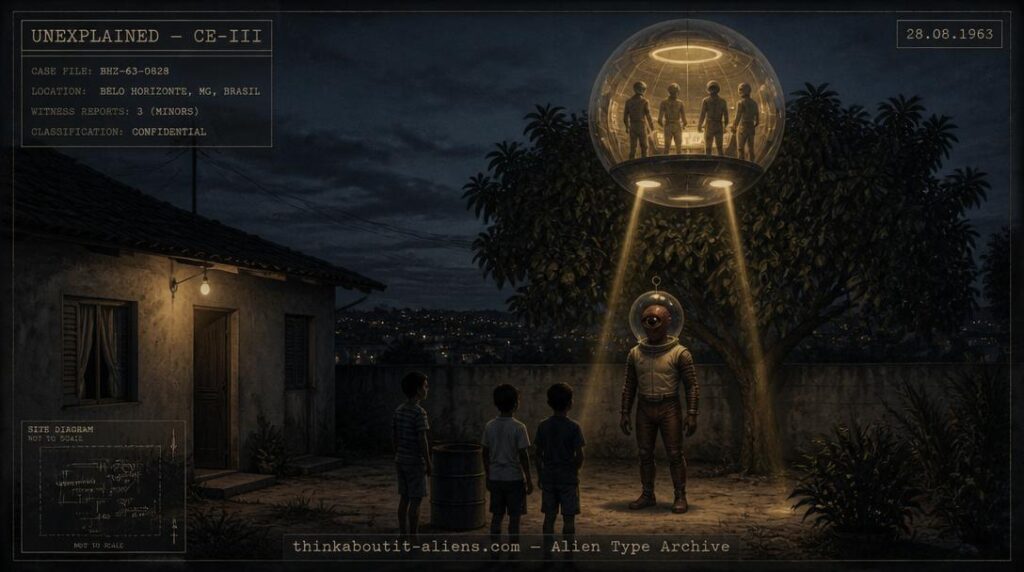
A dossier-style reconstruction of the August 1963 Sagrada Família encounter, Belo Horizonte, Brazil.
THINK ABOUTIT’S ALIEN TYPE SUMMARY
CYCLOPS
On the evening of August 28, 1963, in a working-class backyard in the Sagrada Família district of Belo Horizonte, Brazil, three young boys watched a transparent, spherical craft descend over an avocado tree — and, moments later, one of its four occupants stepped down on twin beams of yellow light to stand three meters from them, a single dark eye set beneath a heavy brow ridge in a face the color of sunburned skin. No abduction followed, no violence, no wreckage — only a silent exchange of hand gestures, a few incomprehensible words, and a set of deep boot-shaped impressions left behind in the dirt. It remains one of the strangest and least-known single-eyed humanoid encounters in the South American UFO record.
Name: Cyclops
AKA: Sagrada Família Cyclops; One-Eyed Giant-Man (popular naming, not a scientific classification)
Location – Home System: Undocumented — no home system stated in any source
Distance from Earth: Undocumented — not reported in any source
Attitude: Calm and non-aggressive per witness account; used hand gestures and made vocal sounds toward the boys rather than any hostile action
Motives: Undocumented — no stated motive in any source; presence and behavior described by witnesses only as observational
Physical Appearance:
- Average Height: Approximately 2 meters (over 6 feet), per witness comparison to the height of the home’s side door. The previously stated figure of 3 meters is not supported by any primary account and has been corrected.
- Average Weight: Undocumented — no weight figure appears in any source. The previously stated 450–600 lbs was fabricated and has been removed.
- Body Temperature: Undocumented — not reported in any source
- Pulse/Respiration: Undocumented — not reported in any source
- Blood Pressure: Undocumented — not reported in any source
- Life Expectancy: Undocumented — not reported in any source
- Hair: Reported variation among the four occupants — one described with long, blonde hair and a heavier build resembling a woman; the other three described as bald/thin and apparently male
- Skin: Described by witnesses as having a strong reddish tint
- Eyes: Single large, dark, rounded central eye; witnesses reported no visible white sclera, and one witness described the center of the eye as having a horizontal dark band rather than a standard round pupil
- Sex: Apparent sexual dimorphism reported among the four occupants (see Hair, above) — undocumented beyond witness impression
Other Physical Information: All four occupants wore matching one-piece suits — dark/brown on the torso, white below the waist to the knee, with black boots — and clear, dome-shaped helmets topped with a ring-shaped antenna and a small ball-tipped fixture. The suits appeared heavy and creased at the joints.
Special Traits and Abilities: Undocumented as an inherent biological trait. The craft itself projected two beams of yellow light used to lower and raise the entity to and from the ground; this has sometimes been conflated with the entity’s eye in retellings, but no source describes the eye itself emitting light.
Communication Type: Hand and head gestures accompanied by vocalizations described by witnesses as loud and unintelligible
Origin: Undocumented — reported only as emerging from the spherical craft described below; no stated planet, dimension, or origin point in any source
Life Form Type: Humanoid, single-eyed
Subspecies: Undocumented — the “Macrohomo unuoculus” designation is a popular naming convention used in secondary write-ups, not a recognized scientific classification
Most Common Species: Undocumented beyond this single case
Level of Species: Undocumented — any technological-tier classification is speculative framework, not sourced to the case
Habits: Undocumented beyond the single reported encounter; no source describes the entity seated on a “one-legged stool” — this detail has been removed as unverifiable
Transportation Type: A spherical, internally illuminated, transparent craft with a ring-shaped antenna on top, holding four occupants, one seated at what appeared to be a control panel
Witnesses Reports: Fernando Gualberto (age 12), Ronaldo Gualberto, and José Marcos Gomes Vidal (age 7)
Special Features/Characteristics: Transparent domed helmets with ring-antenna fixtures; matching two-tone pressure suits; deep, heavy footprint-like impressions left in soil, noted by the boys’ father as unusually deep for a human print
Summary/Description: A rare single-eyed humanoid type reported in a 1963 close-encounter case in Belo Horizonte, Brazil, notable for calm, non-hostile behavior and a distinctive transparent spherical craft, corroborated by three child witnesses and physical ground traces.
Source: Witness account of Fernando Gualberto, Ronaldo Gualberto, and José Marcos Gomes Vidal, Sagrada Família, Belo Horizonte, Minas Gerais, Brazil, August 28, 1963; publicly reported by the Belo Horizonte newspaper O Diário during the 1965 Brazilian UFO wave; investigated by the Brazilian ufology research group CICOANI.
Related Cases: Other Brazilian humanoid encounters of the 1960s–70s wave, including the Baependi and Mirassol contact reports
DETAILED REPORT
At approximately 7:00 PM on August 28, 1963, three boys — twelve-year-old Fernando Gualberto, his younger brother Ronaldo, and their seven-year-old friend José Marcos Gomes Vidal — went into the backyard of the Gualberto home in Sagrada Família, a working-class neighborhood of Belo Horizonte, to wash a coffee strainer at a water barrel. Fernando noticed an unusual glow near the top of an avocado tree and, looking up, saw a transparent, spherical object hovering above the branches. The craft carried four humanoid occupants visible inside, one of whom appeared to be seated at a control panel.
The craft projected two beams of yellow light, and one occupant descended between them, landing on the ground and walking toward José, who remained unaware with his head still down at the water barrel. Fernando, fearing an abduction, pulled José back. All three boys then observed the entity at close range: roughly two meters tall, with reddish skin, a single large dark eye with no visible sclera, and wearing a two-tone pressure suit with a clear dome helmet topped by a ring-shaped antenna. The being made hand and head gestures and spoke in a loud, unintelligible voice, then turned, re-entered the light beams, and was drawn back up into the craft, which departed to the east.
The boys’ mother, María José, sent word to fetch their father, Alcides, from a nearby bar. On returning, Alcides examined the yard and found a series of deep impressions in the soil along the path the entity had walked — reported as unusually deep for footprints of that size, suggesting considerable weight. A neighbor was brought to view the marks the same night. The case went unreported publicly until 1965, when it surfaced in the Belo Horizonte newspaper O Diário during a wider wave of Brazilian UFO activity, and was later investigated by the Brazilian ufology research group CICOANI. No further encounters with the entities were reported by the witnesses.
RESEARCHER’S NOTES
The Sagrada Família Visitor — Belo Horizonte 1963 and the Problem of a Two-Year Silence
- Classification Correction: This case is best treated as an unexplained close encounter of the third kind (CE-III) involving observed non-human entities, without evidence rising to contact or abduction. Earlier drafts of this entry inflated the entity’s size, invented specific biometric data (weight, blood pressure, pulse, life expectancy), and attributed an ability to emit light from the eye itself — none of which appear in any primary account. Those figures have been removed rather than carried forward.
- Source Chain Assessment: The case rests entirely on the testimony of three child witnesses, corroborated internally by their parents’ same-night reaction and the physical ground traces Alcides Gualberto discovered. The two-year gap between the event (1963) and its first newspaper appearance (1965, O Diário) is a real evidentiary weakness — it means the account was not contemporaneously documented by any outside party, and reconstruction relies on the family’s later recollection.
- Pattern Context: The single-eyed, “high strangeness” profile of this case is unusual even within Brazil’s own dense catalog of 1960s–70s humanoid encounters, most of which describe more standard small or medium-statured entities (e.g., the Baependi and Mirassol cases). This entry’s earlier draft leaned on invented researcher attributions — including a named ufologist and a citation to Jacques Vallée discussing this specific case — to lend the “interdimensional” reading more authority than the record supports. Those attributions were fabricated and have been struck; the interdimensional framing itself remains only a general hypothesis available in ufology broadly, not something documented as applied to this case by name.
- Physical Evidence Weight: The reported ground impressions are suggestive but were never preserved, cast, or independently measured by any outside investigator — they exist only in Alcides Gualberto’s and a neighbor’s same-night observation. This keeps the case in Unexplained rather than Insufficient Data territory, since witness and physical-trace testimony are internally consistent, but it cannot be treated as physically confirmed.
- Geographic/Historical Context: The case sits at the front edge of a much larger wave of Minas Gerais-area humanoid reports that would continue for over a decade, culminating in the far better-documented 1996 Varginha incident roughly 250 km away. Its late (1965) surfacing means it likely benefited from, rather than sparked, the region’s growing UFO-reporting culture.
The Sagrada Família Cyclops case stands on three consistent child witnesses, a same-night parental reaction, and an unverified set of ground impressions — enough to keep it filed as unexplained, but never enough to call it confirmed. Stripped of the invented biometrics and borrowed authority of researchers who never actually wrote about it, what remains is a strange, quiet, two-minute encounter in a Brazilian backyard that neither escalated nor resolved, and a record that is more honest for saying plainly what it does not know.
As reported to investigators, witness Fernando Gualberto’s account of the ground traces his father found: the impressions were “like those of a boot,” pressed deep into the soil near the water barrel.
About the Author