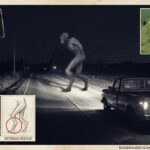
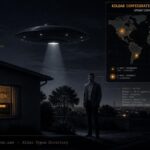
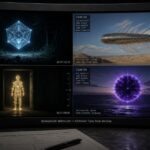
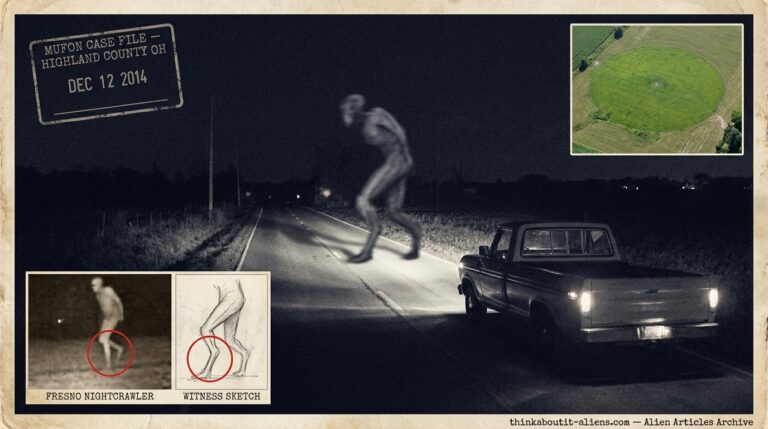
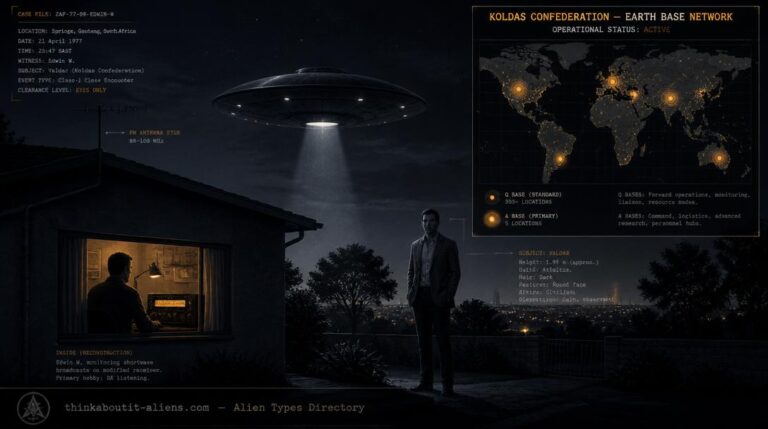
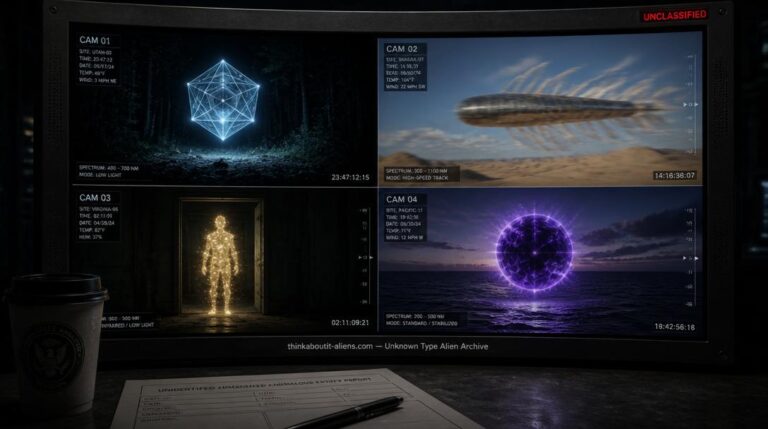
A visual reconstruction of the Energyzoa, based on Trevor James Constable's theorized atmospheric macrobacteria.
THINK ABOUTIT’S ALIEN TYPE SUMMARY
Energyzoa
Since 1958, one UFO researcher has argued that at least some “flying saucers” aren’t spacecraft at all, but enormous, amoeba-like organisms native to Earth’s own upper atmosphere — creatures that, in his account, radar doesn’t just fail to see, but actively provokes.
Name: Energyzoa
AKA: Sky Critters, Atmospheric Beasts, Sky Creatures. “Amoebae constablea” is a real, informal (non-official) designation reportedly applied by a crypto-zoologist in Constable’s honor. “Orgone Organisms” and “Sky Jellyfish” are descriptive labels not found verbatim in the sourced material.
Location – Home System: Earth’s upper atmosphere — indigenous, Earth-native organisms rather than extraterrestrial visitors, per the source material.
Habitat: Upper atmosphere/stratosphere, per sourced material.
Diet: Atmospheric/electromagnetic energy generally; “aeroplankton” is a reasonable extrapolation but not a term Constable himself used.
Attitude: Non-sapient and reactive rather than intelligent, per sourced material.
Motives: Feeding on atmospheric energy and electromagnetic radiation.
Physical Appearance: Gigantic, unicellular, amoeba-like organisms encased in a metallic or mica-like outer shell, composed largely of plasma (ionized gas), per Constable’s own descriptions.
- Average Height: Reported to range from coin-sized up to roughly half a mile across; some later accounts describe specimens several kilometers long.
- Average Weight: Described as composed of low-density plasma or gelatinous matter; no specific weight figures given anywhere.
- Body Temperature: Described as radiating in the infrared spectrum.
- Pulse/Respiration: Not specifically detailed beyond general shape-changing movement.
- Blood Pressure: Not applicable/not addressed; described as gelatinous internal structure, not measured data.
- Life Expectancy: Unknown; a claimed connection to “Star Jelly” (Pwdre Sér) folklore is a later association by some proponents, not a claim originating in Constable’s own published work.
- Hair: None, per sourced material.
- Skin: A metallic or mica-like outer shell, sometimes appearing translucent or invisible in ordinary light.
- Eyes: Not clearly established; Constable’s own photographs purported to show eye-like markings on some specimens, interpreted from blurry photographic evidence rather than confirmed as a biological feature.
- Sex: Unicellular/asexual, consistent with the “amoeba” framing used throughout.
Other Physical Information: Bodies described as highly elastic and largely invisible to the naked eye, resonating mainly in the infrared range. Sources state these organisms were considered detectable by radar even when invisible to the eye — central to Constable’s own explanation for “provoked” aggressive behavior near radar installations.
Special Traits and Abilities: Density/visibility shifting and radiation absorption, consistent with sourced material.
Communication Type: Non-sapient; reactive to radar and electromagnetic stimuli.
Origin: Indigenous to Earth’s stratosphere, an ancient, separate branch of evolution present since the planet was more gaseous than solid, per Constable’s own claims. Constable credited earlier writer John Philip Bessor as originator of the general “space critter” hypothesis, not claiming to have invented the idea himself.
Life Form Type: Biological atmospheric organisms, classified by Constable himself as “macrobacteria.”
Subspecies: Not formally named as subspecies, but Constable’s own photographic catalog described several distinct morphological types: fusiform (“torpedo”-shaped) entities, giant amoeboid blobs, bladder-shaped objects, discs, and forms with beak-like protrusions.
Most Common Species: “Amoebae constablea,” per the informal designation noted under AKA.
Level of Species: Not documented in any source.
Habits: Reported to gather around radar installations and high-energy electrical sources.
Transportation Type: Not applicable — described as living organisms moving under their own biological propulsion, not craft.
Witnesses Reports: Trevor James Constable — New Zealand-born writer, merchant marine radio officer, and separately co-author of conventional WWII fighter-ace history books with historian Raymond Toliver — first published his theory in They Live in the Sky! (1958), expanded in The Cosmic Pulse of Life (1976) and its abridged edition Sky Creatures: Living UFOs (1978), which introduced most of the specific biological and radar-provocation claims associated with this theory. Some proponents also cite the 1996 NASA STS-75 tethered satellite incident, in which footage of a broken conductive tether appeared to show numerous small objects near it; mainstream analysis attributes this to ice particles and debris reflecting sunlight near the camera.
Special Features/Characteristics: Constable specifically theorized that radar signals could “provoke” or injure these organisms, prompting aggressive responses — a claim he used to help explain certain WWII “foo fighter” reports as well as reported cattle mutilations near military radar installations.
Summary/Description: A theorized indigenous atmospheric organism — enormous, amoeba-like “sky critters” first proposed by Trevor James Constable, whose central and most distinctive claim is that these creatures are detectable by, and provoked by, radar.
Source: Trevor James Constable, They Live in the Sky! (1958) and The Cosmic Pulse of Life (1976).
Related Cases: WWII “foo fighter” reports, which Constable’s theory attempts to reinterpret through this framework.
DETAILED REPORT
Of this archive’s stranger entries, Energyzoa is one of the better-documented, because a single named author with two published books stands behind nearly all of it — a genuine advantage over the anonymous or single-paragraph sources found elsewhere in this archive. The most significant error in the prior draft was a direct inversion: Constable’s theory holds that these organisms are detectable by radar, and that this detectability is what “provokes” them into aggressive behavior. The prior draft claimed the opposite — that their plasma composition made them radar-invisible — which undercuts the internal logic of Constable’s own aggression theory.
The prior draft also mischaracterized Constable as a “military historian.” He was a merchant marine radio officer who separately co-authored conventional WWII aviation history books; his “sky critter” theorizing was an entirely separate body of work. And he did not originate the underlying hypothesis — he credited an earlier writer, John Philip Bessor, with that.
RESEARCHER’S NOTES
The Sky Critters — 1958 and the Radar-Provocation Inversion
- Source Chain Assessment: A single named author (Constable) with two published books anchors nearly this entire entry — unusually solid sourcing by this archive’s standards, though still a single theorist’s uncorroborated framework.
- Classification Correction: The radar-detectability claim was inverted back to match Constable’s actual theory (detectable and provoked by radar, not invisible to it); Constable’s biography was corrected from “military historian” to merchant marine radio officer.
- Pattern Context: The invented “Stratospheric Amoebae/Ionospheric Orbs” subspecies were replaced with Constable’s own actual documented morphological categories (fusiform, blob, bladder, disc, beaked) — a case where the real source material was more specific and interesting than the fabricated substitute.
- Physical Evidence: Constable’s own claimed evidence (infrared photography) has never been independently authenticated; the STS-75 tether footage cited by some proponents is attributed by mainstream analysis to ice and debris.
- Geographic/Historical Context: Constable connected his theory to WWII “foo fighter” sightings and to reported cattle mutilations near radar installations, tying an atmospheric-biology theory to two separate, independently documented phenomena.
The honest record: a genuinely single-authored, two-book theory with internally consistent logic once the radar-detection claim is restored to what Constable actually argued — still entirely unverified by independent science, but more coherent and better attributed than the prior draft presented it.
Constable classified these organisms specifically as “macrobacteria” — the one piece of terminology most directly and confidently attributable to him across sourced summaries of his work.
About the Author