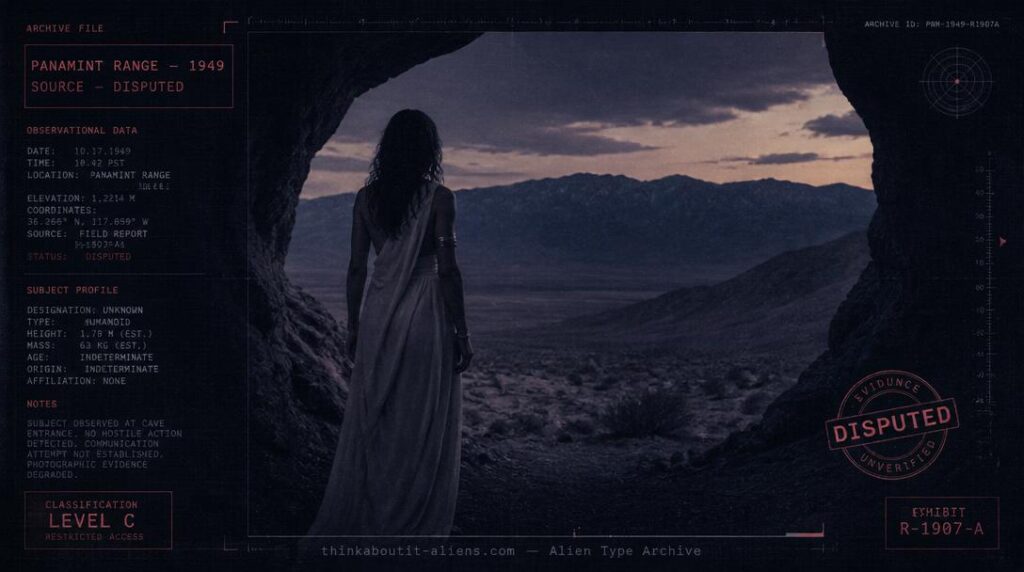
A visual reconstruction of the Hav-Musuvs, from a 1949 magazine account of disputed authenticity regarding the Panamint Mountains.
THINK ABOUTIT’S ALIEN TYPE SUMMARY
Hav-Musuvs – (or MuSuvians)
In a 1949 magazine account, an elderly Paiute man is quoted describing a hidden people called the Hav-musuvs, who arrived in the Panamint Mountains region by ship when Death Valley was still a harbor, and who retreated into vast caverns as the inland sea dried — the authenticity of the account itself, however, remains disputed.
Name: Hav-Musuvs (or MuSuvians)
AKA: Suvians, per the source.
Location – Home System: Per the source, a subterranean city within and beneath the Panamint Mountains of California, reached originally by sea. “Original origin possibly Sirius or Ancient Mediterranean” is not stated in the primary source, which only speculates that their dress and city style suggest a “neo-Grecian” cultural influence — not a literal claim of Mediterranean or Sirian origin.
Distance from Earth: Not applicable — no distance is claimed beyond Shaw’s speculative Mars theory in an unrelated entry in this archive; for the Hav-Musuvs specifically, no distance of any kind is claimed in the source.
Attitude: Described in the source as peaceful, private, and living “in their eternal peace away from the noise of white-man’s guns” in their mountain stronghold.
Motives: Not extensively detailed beyond maintaining their isolation and, per the story’s own framing, occasional compassionate contact (see Witnesses Reports, below).
Physical Appearance: Per the primary source, directly quoted: “They are a beautiful people. Their skin is a golden tint, and a head band holds back their long dark hair. They dress always in a white fine-spun garment which wraps around them and is draped upon one shoulder. Pale sandals are worn upon their feet.”
- Average Height: Not given a specific figure in the source — described only in the general terms above.
- Average Weight: Not reported in any source.
- Body Temperature: Not reported in any source.
- Pulse/Respiration: Not reported in any source.
- Blood Pressure: Not reported in any source.
- Life Expectancy: Not reported in any source.
- Hair: Long and dark, held back by a headband, per the source.
- Skin: A “golden tint,” per the source.
- Eyes: Not described in the source.
- Sex: Not specifically addressed in the source beyond references to both men and women.
Other Physical Information: Per the source, the beings had fingers without visible nails and unusually long feet that functioned somewhat like a monkey’s.
Special Traits and Abilities: Per the source, use of a lethal “long, silvery tube” weapon, and travel along cliff faces using distinctive “snowy-white animals” said to be unique to the region.
Communication Type: Described in the source only as “a strange tongue,” without further detail.
Origin: Per the source, arrived by “huge rowing-ships” when the Death Valley region was a harbor connected by sea to the Gulf of California; the source speculates, based on dress and city style, that they may represent a “neo-Grecian” cultural influence — presented as speculation, not established fact.
Life Form Type: Described in the source only as a “beautiful people” of human-like appearance.
Subspecies: Not reported in the primary source. Grouping the Hav-Musuvs under a “Nordic” or “Telosian” umbrella conflates this legend with the separate, distinct Mount Shasta “Telos” tradition — the source itself treats these as analogous but separate legends.
Most Common Species: Not reported in any source.
Level of Species: Not reported in any source; “Galactic Federation” membership is not part of the primary 1949 source and is a later addition with no clear traceable origin.
Habits: Isolation from surface conflict, and gradual development of increasingly advanced “silvery eagle” flying craft over generations, per the source.
Transportation Type: “Silvery eagles” — flying craft said to have grown more advanced over time — and, in earlier eras, “rowing-ships” for sea travel, per the source.
Witnesses Reports: The entire account traces to a single 1949 Fate Magazine article, “Tribal Memories of the Flying Saucers,” credited to a writer using the name “Oge-Make,” framed as a conversation with an unnamed elderly Paiute man. Its authenticity as genuine Paiute oral tradition, as opposed to a period piece of contactee-era writing, has been questioned by researchers and should be presented as disputed rather than as settled ethnographic record. The story includes an episode of a grieving Paiute chief who sought out the Hav-musuvs after his wife’s death and was taken in by them.
Special Features/Characteristics: Fine white draped garments and pale sandals, per the source. Claims that these garments “never show signs of wear or dirt” are not stated in the source.
Summary/Description: A golden-skinned, dark-haired people described in a 1949 magazine account, framed as Paiute tradition, who arrived by ship when the Death Valley region was a harbor, built a city in caverns within the Panamint Mountains, and developed increasingly advanced flying “silvery eagle” craft over generations.
Source: “Tribal Memories of the Flying Saucers,” Fate Magazine, 1949, credited to “Oge-Make.” This is a single-source account whose status as authentic Paiute oral tradition versus period contactee-era writing is disputed among researchers.
Related Cases: The separate Mount Shasta “Telos” subterranean legend, an analogous but distinct tradition sometimes conflated with this one.
DETAILED REPORT
The Hav-Musuvs legend traces to a specific, datable source: a 1949 Fate Magazine article credited to a writer using the pseudonym “Oge-Make.” Whether this represents authentic Paiute oral tradition or a piece of contactee-era writing presented as Native American folklore is genuinely disputed by researchers, and this entry states that plainly rather than treating the account as settled ethnographic fact — a distinction that matters both for accuracy and for how a real indigenous tradition gets represented.
Within the source itself, one direct detail was reversed in the prior draft: the primary account describes long, dark hair held back by a headband, not the “blonde or golden (Nordic-style)” hair the prior draft claimed. Two real, specific documented details were also missing entirely: a lethal weapon described as a “long silvery tube,” and travel along cliff faces using distinctive “snowy-white animals” said to be unique to the region.
RESEARCHER’S NOTES
Death Valley’s Hidden People — A Disputed 1949 Magazine Source
- Source Chain Assessment: A single 1949 Fate Magazine article anchors this entire entry, with its own status as authentic tradition versus period writing genuinely disputed by researchers.
- Classification Correction: Hair color was corrected from “blonde/Nordic” to the source’s own “long dark hair”; two documented but previously missing details (the silvery tube weapon, the snowy-white cliff-traveling animals) were restored.
- Pattern Context: This entry’s disputed-authenticity status is comparable to other entries in this archive drawing on claimed indigenous oral tradition — worth applying the same caution consistently rather than only when directly flagged.
- Evidentiary Weight: A single magazine article from a pseudonymous author, framed as an unnamed elderly informant’s account — minimal by any evidentiary standard, regardless of how the underlying tradition question is resolved.
- Geographic/Historical Context: Death Valley’s real geological history (as a dry lakebed, not a literal harbor within human timescales) provides useful context for evaluating the story’s “ancient inland sea” framing.
The honest record: a single 1949 magazine account, framed as Paiute tradition but disputed as such by researchers, describing golden-skinned, dark-haired beings in the Panamint Mountains — genuinely evocative, genuinely unverifiable, and genuinely uncertain in its own claimed origin.
“They are a beautiful people. Their skin is a golden tint, and a head band holds back their long dark hair.”
— “Tribal Memories of the Flying Saucers,” Fate Magazine, 1949.
About the Author