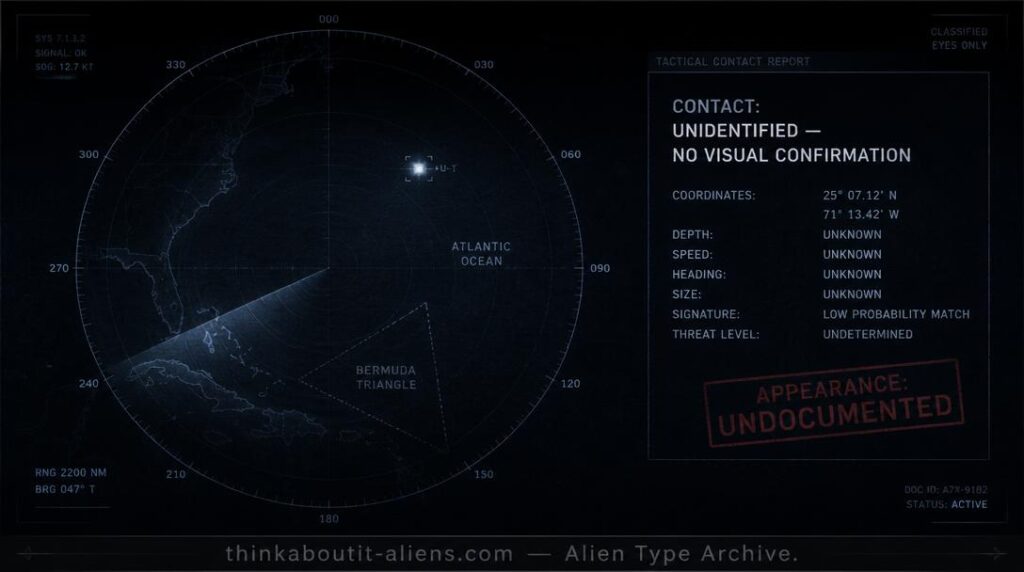
A dossier-style illustrative rendering of the Killimat-Arr — no figure is shown, since no physical description of this species exists in any source.
THINK ABOUTIT’S ALIEN TYPE SUMMARY
Killimat-Arr
The source material for the Killimat-Arr states, in plain language, that no description of their appearance exists — and yet an earlier version of this page described them in detail down to their blood pressure, leaving a thirty-foot reptilian giant standing on a source that never described so much as their skin color.
Name: Killimat-Arr
AKA: K-Arr.
Location – Home System: Crux constellation, near the star Gacrux (Gamma Crucis).
Distance from Earth: Not specified in sourcing.
Attitude: Not characterized in sourcing beyond being consistently difficult to detect.
Motives: Explicitly stated as unknown in the source.
Physical Appearance: No description of appearance is provided anywhere in sourcing. The source states this explicitly rather than simply omitting it.
- Average Height: Not specified in sourcing.
- Average Weight: Not specified in sourcing.
- Body Temperature: Not specified in sourcing.
- Pulse/Respiration: Not specified in sourcing.
- Blood Pressure: Not specified in sourcing.
- Life Expectancy: Not specified in sourcing.
- Hair: Not specified in sourcing.
- Skin: Not specified in sourcing.
- Eyes: Not specified in sourcing.
- Sex: Not specified in sourcing.
Other Physical Information: None documented. No wings, scales, coloration, or size are described in any source.
Special Traits and Abilities: Not specified in sourcing.
Communication Type: Not specified in sourcing.
Origin: Crux constellation, near Gacrux. No home planet is named.
Life Form Type: Not specified in sourcing. No classification — reptilian, saurian, or otherwise — is given anywhere in the source material.
Subspecies: None documented.
Most Common Species: Not specified in sourcing.
Level of Species: No classification is offered in any source. Not applicable.
Habits: Not specified in sourcing beyond being difficult to detect.
Transportation Type: Not specified in sourcing.
Witnesses Reports: No named witnesses or dated cases exist in sourcing. Per Santori’s ARB, the Killimat-Arr have reportedly been detected approximately 8 times, usually in the Bermuda Triangle area, using specialized camera and radar systems the US and Russia are said to have developed specifically to spot them. No further detail accompanies this claim.
Special Features/Characteristics: None documented.
Summary/Description: A species from the Crux constellation, near the star Gacrux, reported as exceptionally difficult to detect. The US and Russia are said to have developed specialized camera and radar systems specifically to spot them, and they have reportedly been detected around 8 times, usually in the Bermuda Triangle area. Their reason for visiting Earth is stated as unknown, and no physical description of any kind exists in sourcing.
Source: Santori, Alien Race Book (ARB), 2011, p. 32; cross-referenced via Jake Muller, A Guide to ETs/Star Nations and Beings, Vol. 1 (2023).
Related Cases: Cross-referenced with “Aquafarians,” a broader aquatic-beings category noted in sourcing. No dedicated Aquafarians profile currently exists on this site.
DETAILED REPORT
The Killimat-Arr entry required correcting a basic factual error before addressing the fabrication: the earlier version of this page names Acrux (Alpha Crucis) as the species’ home star. Santori’s 2011 Alien Race Book, the sole source for this entry, specifically names Gacrux (Gamma Crucis) — a different star in the same constellation. That’s been corrected here.
Beyond the origin point, the source is remarkably direct about its own limits: it states plainly that no description of the Killimat-Arr’s appearance is provided. Not that appearance is unknown or unconfirmed — the source simply doesn’t attempt one. Everything about their reported behavior amounts to this: they are very difficult to detect, their reason for visiting Earth is unknown, and the United States and Russia are said to have developed specialized camera and radar systems specifically to spot them. Using that technology, they have reportedly been detected around 8 times, usually in the Bermuda Triangle area. No case, date, or witness accompanies any of this.
Every other element of the earlier version of this page — the 30-foot height, the reptilian classification, the wings, the scale coloration, the biometric panel, the “Vile Vortices” mythology, and the comparisons to Cherubim, Seraphim, and Feathered Serpents — has no basis in the cited source. This is one of the clearest examples in this archive of a source that is honest about its own absence of detail being overwritten with invented specificity rather than respected.
RESEARCHER’S NOTES
A Name, a Star, and Eight Sightings — Nothing Else Is Documented
- Star Corrected: Gacrux, Not Acrux: The prior version named Acrux as the home star. Santori’s source specifically names Gacrux — a different, specific star in the Crux constellation. This is now corrected.
- No Physical Description Exists: The source explicitly states that no description of appearance is provided. The entire 30-foot reptilian-giant profile — including every biometric figure — was invented wholesale, not exaggerated from a real description.
- Fabricated Data Removed: Two named subspecies, a “Level III” classification, “transdimensional shimmer-craft,” and an extended mythology connecting the species to Cherubim, Seraphim, and South American Feathered Serpent legends were all invented and have been removed.
- What’s Genuinely Sourced: Difficulty of detection, roughly 8 total recorded sightings, a consistent Bermuda Triangle location, and specialized US/Russian detection technology make up the entire real record.
- A Related Category Worth Tracking: Sourcing cross-references the Killimat-Arr with “Aquafarians,” a broader aquatic-beings category that recurs across multiple entries in Muller’s guide and may warrant its own standalone page as this audit continues.
Corrected from an invented 30-foot reptilian titan to what the source actually offers: a name, a corrected home star, a documented pattern of near-total undetectability, and a single honest admission that no one has ever described what these beings look like.
“A very difficult race to detect.”
— Santori, Alien Race Book (2011), as cited by Jake Muller
About the Author