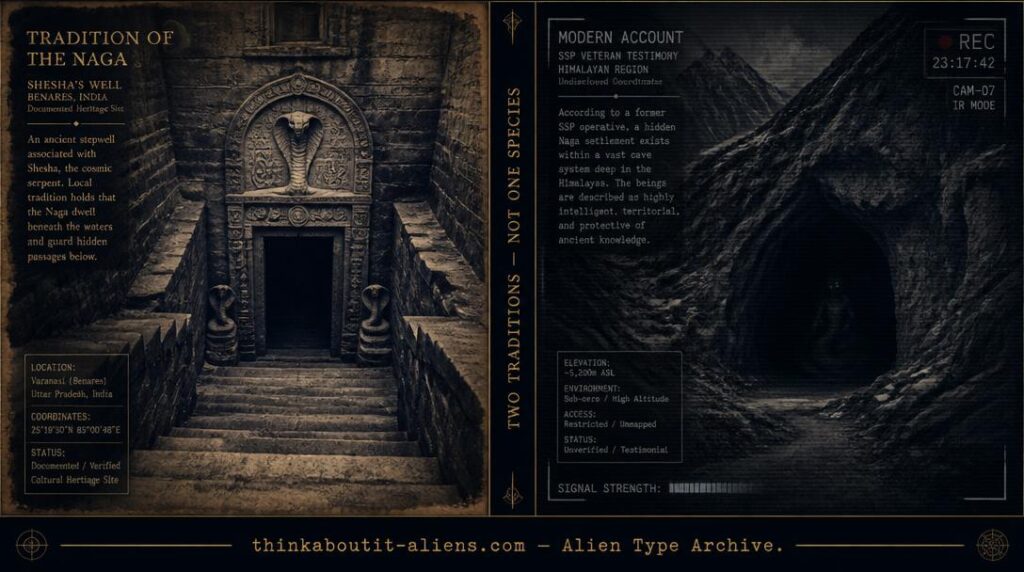
An ancient well in Benares and a modern mountain cave — two real threads, never meant to be one.
THINK ABOUTIT’S ALIEN TYPE SUMMARY
Nagas
Long before any “KGB Antarctic Expedition” or “Golfo Nuevo USO incident” was attached to this entry, the Naga already had a documented history — as a Hindu and Buddhist mythological tradition of half-human, half-serpent beings dwelling in the underground realm of Patala, and, separately, as a modern hybrid described by two SSP veterans as the deliberate crossbreeding of a Draco-type race with a human population. Neither of those two real threads involves Alpha Draconis, a biometric panel, or trans-dimensional Vril craft. Both are presented here on their own terms, without merging them into a single invented species profile.
Name: Nagas (singular: Naga; female: Nagi or Nagini)
AKA: None additionally documented
Location – Home System: In Hindu tradition, the Naga are not extraterrestrial at all — they inhabit Patala, a subterranean netherworld beneath the Earth, rather than another planet or star system. Per one SSP-veteran account, a modern hybridized Naga population is said to originate generally from the Cassiopeia constellation, with no specific star or planet named.
Distance from Earth: Not applicable / Undocumented
Attitude: In Hindu and Buddhist tradition, the Naga are regarded as divine or semi-divine beings, capable of taking human or serpent form. Per one SSP-veteran account, they are intelligent, brave, fearless, and possess considerable psychic ability. A second SSP-veteran account describes the Earth-based tribe specifically as unusually hostile, “quite evil, unlike most others.”
Motives: Undocumented in any source reviewed
Physical Appearance: Two source traditions diverge somewhat. In Hindu and Buddhist mythology, Nagas are described as half-human, half-serpent beings — typically a human torso, arms, and head atop a serpent’s body, sometimes with multiple heads. Per one SSP-veteran account, a modern Naga population resulted from crossbreeding a Draco-type (“Ciakar”) race with a human population, sharing this basic torso-and-serpent-body structure, with some individuals reportedly bearing wings, multiple heads, or multiple tails. A second SSP-veteran account instead describes them more simply as a fully serpentine humanoid, “usually green but they also exist in many other colors.”
- Average Height: Undocumented
- Average Weight: Undocumented
- Body Temperature: Undocumented
- Pulse/Respiration: Undocumented
- Blood Pressure: Undocumented
- Life Expectancy: Undocumented
- Hair: Undocumented
- Skin: Variable — one specific individual encounter describes black scaled skin on the back with a cream-colored belly; a separate, more general account describes green skin, “though they also exist in many other colors”
- Eyes: Bright blue, per one specific individual encounter; not otherwise documented
- Sex: Male Naga, female Nagi or Nagini, per Hindu tradition
Other Physical Information: One SSP veteran describes a personal encounter with an individual whose head was reptilian, whose torso and arms were human, and whose remaining body was serpentine, scaled, and telepathic
Special Traits and Abilities: Considerable psychic ability and telepathy, per both SSP-veteran accounts; no shapeshifting, Jacobson’s organ, or “phase-shifting” ability is documented in any source reviewed
Communication Type: Telepathic, per SSP-veteran accounts; no specific spoken language is documented
Origin: In Hindu tradition, the Naga’s realm is Patala, an underground netherworld, not another planet. Per one SSP-veteran account, a modern Naga population originated as a deliberate hybrid between a Draco-type race and a human population of unspecified African ancestry, generally placed in the Cassiopeia constellation. A separate account states only that the Earth-based tribe is a remnant of a much older empire, without naming its point of origin.
Life Form Type: Half-human, half-serpent, per both the Hindu mythological tradition and the SSP-veteran accounts
Subspecies: In Hindu Puranic tradition, individually named Naga kings include Vasuki, Takshaka, and Shesha, among others. These are traditional mythological figures from Hindu religious literature, not a documented biological caste system.
Most Common Species: Not applicable
Level of Species: Undocumented
Habits: Per SSP-veteran accounts, live underground in caves in the mountains between India and China; some Chinese royal lineages have traditionally claimed descent from the Naga, though how this claim was substantiated is not stated
Transportation Type: Undocumented
Witnesses Reports: No modern named encounter is documented beyond one SSP veteran’s account of a single personal meeting with an individual Naga; the Hindu and Buddhist mythological material is a body of religious and folkloric literature rather than eyewitness testimony. No source reviewed connects the Naga to a 1958 “KGB Antarctic Expedition,” the 1960 Golfo Nuevo (Argentina) USO incident, or Sadhguru’s teachings.
Special Features/Characteristics: In Hindu tradition, an entrance to Patala is traditionally associated with a site known as Shesha’s Well (or the Well of Sheshna) in Benares (Varanasi), India — described by herpetologist Sherman Minton as a forty-step stone stairway leading down to a circular depression and a stone door covered in carved cobras. Nagas also appear in Buddhist tradition, including accounts describing their presence at the birth of Gautama Siddhartha (the Buddha).
Summary/Description: “Naga” refers to two related but distinct traditions that this archive was previously merging into a single invented extraterrestrial species. The first is the long-standing Hindu and Buddhist mythological tradition of divine, half-human, half-serpent beings who inhabit Patala, an underground netherworld, associated with sites such as Shesha’s Well in Benares and appearances in Buddhist birth narratives. The second is a modern account from two SSP veterans describing a Naga population as a deliberate hybrid of a Draco-type race and a human population, living in cave systems in the mountains between India and China, with one account tracing a general point of origin to the Cassiopeia constellation. Neither tradition supports the Alpha Draconis origin, biometric panel, Vril-based technology, or 1960 Argentine Navy USO connection previously presented on this page.
Source: Naga entry on Wikipedia (general Hindu mythological background); Sherman Minton’s account of Shesha’s Well, Benares, India; Penny Bradley, personal communication and public social media statements (2020 Jun 10, 2020 Aug 10); John Whitberg, personal communication — the SSP-veteran material as presented and cross-referenced in Jake Muller, A Guide to ETs/Star Nations and Beings (M–Z), Vol. 2, 2024, pp. 78–79.
Related Cases: None documented. The previously listed “1960 Golfo Nuevo, Argentina” USO incident and “KGB Antarctic Expedition (1958)” have no established connection to the Naga in any source reviewed and have been removed.
DETAILED REPORT
The Naga are, first and foremost, a figure of long-standing Hindu and Buddhist religious and mythological tradition: a divine or semi-divine race of half-human, half-serpent beings said to reside in Patala, an underground netherworld, capable of occasionally taking fully human form. This tradition includes named Naga kings such as Vasuki, Takshaka, and Shesha, and associates the tradition with physical sites on Earth, most notably Shesha’s Well (also called the Well of Sheshna) in Benares (Varanasi), India — described by herpetologist Sherman Minton as a stone stairway of forty steps descending to a circular depression and a stone door carved with cobras, traditionally regarded as an entrance to Patala. Nagas also appear in Buddhist narratives, including accounts of their presence at the birth of Gautama Siddhartha, who became the Buddha.
Separately, two SSP military veterans describe a modern, hybridized Naga population encountered in the course of their service. Penny Bradley states that the Naga resulted from the interbreeding of the Ciakar — a Draco-type race — with a human population of unspecified African ancestry, crossed in a test tube owing to a difference in size between the two. She places their general origin in the Cassiopeia constellation, without naming a specific star or planet, and describes them as living underground in caves in the mountains between India and China, with some Chinese royal lineages traditionally claiming descent from them. She describes them as intelligent, brave, fearless, and gifted with considerable psychic ability, and recounts a specific personal encounter with a female Naga whose head was reptilian, whose torso and arms were human, and whose remaining body was black-scaled with a cream-colored belly and bright blue eyes.
A second SSP veteran, John Whitberg, describes the Naga instead as “a serpentine humanoid, usually green but they also exist in many other colors,” noting that they are spiritually advanced, maintain a tribal social structure, and once held “an empire many thousands of years ago” that accounts for their tribes being “scattered across the galaxy.” He describes the Earth-based tribe specifically as notably more hostile than most other Naga groups.
Neither SSP-veteran account, nor the Hindu and Buddhist mythological tradition, includes any biometric detail, a home star system named Alpha Draconis, Vril-based technology, or any connection to a 1958 Antarctic expedition or the 1960 Golfo Nuevo, Argentina USO incident.
RESEARCHER’S NOTES
The Nagas — Patala, Cassiopeia, and Two Traditions Wrongly Merged
- Classification Correction: This entry previously described a single “high-gravity reptilian race” from Alpha Draconis with a full biometric panel, named castes (“Vasuki,” “Takshaka,” and “Shesha” presented as biological subspecies rather than mythological kings), a species tier (“Level V”), fabricated abilities (limited shapeshifting, a Jacobson’s organ), and an invented connection to the 1960 Golfo Nuevo Argentine Navy USO incident and a 1958 KGB Antarctic expedition. None of this appears in any source reviewed. All fabricated detail has been removed, and the Vasuki/Takshaka/Shesha names have been correctly re-attributed to Hindu Puranic mythology rather than presented as a biological classification.
- Source Chain Assessment: This entry rests on two genuinely distinct traditions: a long-documented Hindu and Buddhist mythological corpus, and a modern, unverified account from two SSP veterans. Neither should be treated as confirming the other, and neither supports the extraterrestrial “Alpha Draconis” framing previously presented here — the mythological tradition places the Naga underground on Earth, not on another planet.
- Pattern Context / Comparative Cases: This entry demonstrates a distinct failure mode from other recent corrections in this archive: rather than one thin source being inflated (compare: Mammalian Humanoid) or two unrelated modern claims merged under a similar name (compare: Markabians), here a genuine, well-documented mythological tradition was treated as raw material for an invented modern extraterrestrial species profile, with real details (Sheshna’s well, the Vasuki/Takshaka/Shesha names) surviving alongside wholly fabricated technical classification.
- Physical Evidence / Evidentiary Weight: No photographic, documentary, or independently verified evidence supports any part of the SSP-veteran material. The Hindu and Buddhist mythological tradition should be understood as religious and folkloric literature with genuine cultural and historical significance, not as an eyewitness or documentary record of an extraterrestrial species.
- Geographic and Historical Context: Shesha’s Well in Benares (Varanasi) is a real, physically described site within a well-documented regional mythological tradition; it should not be conflated with the unrelated, invented “Wells of Sheshna” framing previously used to connect this entry to a broader fabricated conspiracy about world governments monitoring the site.
What survives here are two genuinely separate, worthwhile threads: a long and culturally significant Hindu and Buddhist mythological tradition of underground serpent-people with real associated sites like Shesha’s Well, and a modern, unverified SSP-veteran account of a hybridized Naga population living in the mountains between India and China. Treated honestly and separately, neither supports the sweeping Alpha Draconis “shadow history of our planet” this page once claimed.
SSP veteran Penny Bradley describes the Naga simply as “beautiful, beautiful creatures.”
About the Author