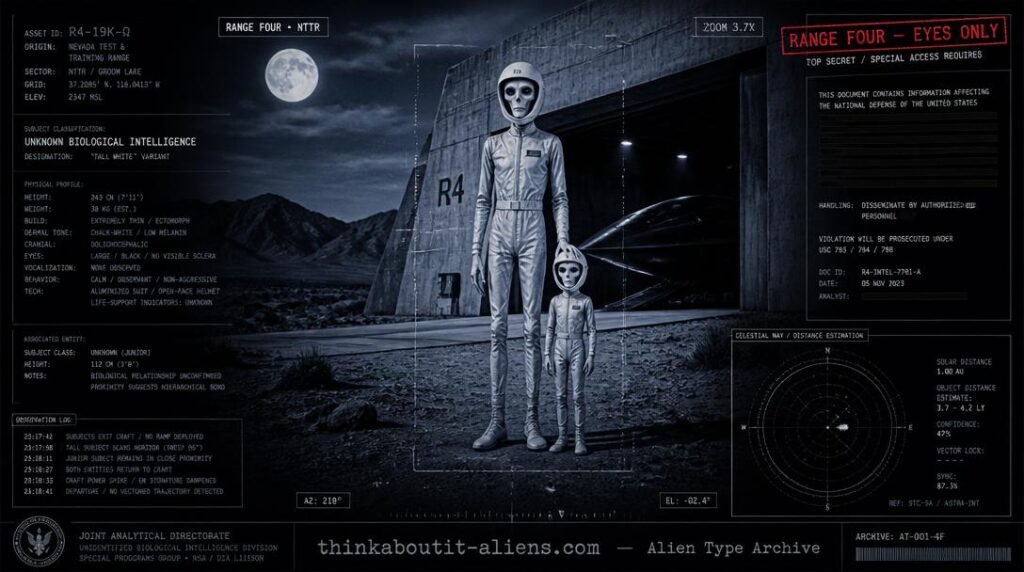
A dossier-style rendering of a Tall White at the Range Four hangar entrance, based on Charles Hall's testimony of the Nellis/Indian Springs facility.
THINK ABOUTIT’S ALIEN TYPE SUMMARY
TALL WHITES
For nearly two years in the mid-1960s, a young Air Force weather observer stationed at a remote gunnery range outside Nellis Air Force Base worked his shifts surrounded by extraterrestrials who came and went through his weather shack with complete freedom, watched him shower in his own barracks, and eventually shot him nearly to death in the desert dust — only to observe his slow, solitary recovery as a kind of test. Airman Charles Hall’s account of the Tall Whites remains one of the most detailed and internally consistent military-contact narratives in the UFO literature, describing not an invasion but something stranger: a quietly negotiated tenancy between a fragile, elegant, aristocratic species and the United States Air Force.
Name: Tall Whites
AKA: Range Four ETs, Indian Springs ETs, Hall’s Aliens
Location – Home System: Undetermined. Charles Hall’s own testimony implies the star Arcturus (Boötes) as significant to their origin, though the Tall Whites themselves never directly confirmed this to him. A separate, distinctly attributed theory from researcher Michael Salla (Exopolitics) proposes Rigel in Orion instead — see Researcher’s Notes.
Distance from Earth: Arcturus is approximately 36–37 light-years away. Hall’s own later “best guess” for their actual home star, based on transit-time calculations, was roughly 105 light-years. (Salla’s alternate Rigel theory would place a origin point at roughly 860 light-years — a separate, unconfirmed claim.)
Attitude: Reserved and class-conscious; capable of warmth and even affection toward trusted individuals, but quick to react with lethal force if startled or threatened. Hall describes them as at times arrogant, at times protective, and consistently controlling toward those they consider under their care.
Motives: Use of the Nellis/Indian Springs facility as a long-term base, apparently tied to ship repair, family life, and a technology-sharing arrangement with US military and government personnel.
Physical Appearance: Tall, extremely thin, and frail-framed, with chalk-white skin and a distinctly humanoid build.
- Average Height: 6 to 7 feet in youth; individuals who reach a “second growth stage” around 400 years of age are described as reaching roughly 8 to 9 feet.
- Average Weight: Undocumented (described only as very thin and lightly built)
- Body Temperature: Undocumented
- Pulse/Respiration: Undocumented
- Blood Pressure: Undocumented
- Life Expectancy: Reportedly around 800 years, roughly ten times a human lifespan, with death attributed to organ failure at that age
- Hair: Thin, straight, blond
- Skin: Chalk-white
- Eyes: Large, wrap-around, described in Hall’s account as blue; one independent secondary account (Richard Boylan) instead describes the sclera as black — sources disagree and neither is definitive
- Sex: Male / Female, organized into family units
Other Physical Information: Small noses and ears held close to the scalp; hands described with slender fingers. Walk with an unusual gait attributed to their being poorly adapted to Earth’s gravity.
Special Traits and Abilities: Move and react far faster than humans; wear specialized suits granting limited levitation and a personal defensive force field; carry a compact weapon capable of inflicting severe injury at close range. Later compilations of Hall’s material also describe running speeds approaching 40 mph, though this figure does not appear in Hall’s own core testimony.
Communication Type: Vocalizations described as barking or chirping, paired with technology-assisted telepathic communication devices used with Hall directly.
Origin: Not disclosed to Hall by the Tall Whites themselves; see Location field above for the competing Arcturus and Rigel theories.
Life Form Type: Humanoid. No genetic classification was given in Hall’s own testimony. Michael Salla’s separate theory frames them as a genetic variant of “Tall Greys,” linked to Nordic-Grey hybridization — a distinct, attributed interpretation rather than an established fact.
Subspecies: Undocumented. “The Teacher” is a title/role held by one individual central to Hall’s account, not a documented caste or subspecies designation.
Most Common Species: Undocumented
Level of Species: Undocumented (no Kardashev-style or comparable classification appears in any primary source)
Habits: Visit Las Vegas in disguise (wigs, makeup, heavy clothing) to gamble and observe human behavior; vacation in the Nevada desert with their children; arrivals and departures reportedly timed to the full moon during warmer months.
Transportation Type: Deep Space Craft — black, titanium-hulled, approximately 500 ft long, 300 ft wide, 70 ft high, capable of faster-than-light travel; Scout Craft — roughly bus- or RV-sized, assembled on Earth using off-the-shelf American aerospace components (Boeing, Lockheed, Airstream), using a fiber-optic coil propulsion system prone to overheating.
Witnesses Reports: Charles Hall (primary witness, USAF Range Weather Observer, 1965–1967); secondary reporting and analysis via Dr. Michael Salla and Dr. Richard Boylan, drawing on Hall’s own books and correspondence.
Special Features/Characteristics: Scout craft interiors retained visible mold markings from Boeing and Lockheed components; touch-sensitive control panels bore cartouche-like symbols resembling Egyptian hieroglyphics, a motif also reported on the walls of an adjoining hangar.
Summary/Description: A tall, frail, chalk-white humanoid species reportedly maintaining a long-term, semi-permanent presence at the Nellis/Indian Springs ranges in Nevada under a classified arrangement with the US military, first documented by Air Force weather observer Charles Hall.
Source: Charles Hall, Millennial Hospitality (book series); Open SETI archival page on Hall’s testimony; Michael Salla, Exopolitics.org analysis; Richard Boylan, drboylan.com
Related Cases: Other Nellis/Indian Springs range personnel referenced in Hall’s account as having been injured or reassigned prior to his posting; Michael Salla’s broader “Tall Grey” and Eisenhower-era ET-agreement research.
DETAILED REPORT
Charles Hall’s account begins with an assignment that, on paper, was entirely mundane. As an Airman First Class in 1965–1966, his job was to release and track weather balloons and radio the readings back to Nellis Air Force Base. What made the posting extraordinary was who else was there: a group of tall, chalk-white extraterrestrials who treated his weather shack as their own territory, appearing and disappearing at will, observing his equipment, and even watching him in his otherwise-deserted barracks. None of this was discussed with his superiors, though it was clearly known — Hall later learned that over a seven-year period, at least 41 previous weather observers on the Nellis ranges had been hospitalized, killed, or driven off the assignment entirely.
Hall’s own survival, and eventual acceptance among the group, followed a violent low point. On one occasion the beings turned on him without warning and left him bleeding in the desert, expecting him to die; his ability to save himself by pressing the wound into the earth to stem the bleeding appears to have earned him a grudging respect. He was given the name “Teacher’s Pet” by military personnel aware of the arrangement, and was eventually positioned — by, in his account, both governments — as an informal point of contact for cultural exchange between the base personnel and the Tall Whites.
Hall describes a group with recognizable family structures, including children who used his equipment as a playground, and adults who displayed protectiveness and status-consciousness toward humans of differing military rank. Communication was aided by a telepathic device the group possessed, though their spoken vocalizations came across to Hall as barking or chirping. Their skin was uniformly chalk-white, their frames thin and frail by human standards, and they aged unusually: reports describe a “second growth stage” around 400 years of age, after which individuals reportedly reached roughly eight to nine feet in height, with death from organ failure occurring around 800 years.
On the question of origin, Hall was told almost nothing directly. The clearest hint came when he mentioned the star Arcturus to a group of Tall Whites and provoked a visible reaction — an older individual asking whether “Charlie” knew where they came from, and “the Teacher” replying that he was close but not quite right. Based on this and his own transit-time calculations from observed arrival and departure schedules, Hall’s best later estimate placed their home star at roughly 105 light-years away, a figure that does not match Arcturus (about 36 light-years) precisely, leaving the true origin point unresolved even in Hall’s own account. A separate and distinctly sourced theory, developed independently by researcher Michael Salla, proposes instead that the Tall Whites are related to “Tall Grey” beings originating near Rigel in Orion — this is Salla’s own interpretive conclusion, not a claim made by Hall or the Tall Whites themselves, and the two theories should not be conflated.
Technologically, Hall’s descriptions are notably grounded. The group’s deep-space vessels were large, black, titanium-hulled craft roughly 500 feet long, capable of what Hall understood to be faster-than-light travel on multi-month transits. Their smaller scout craft, by contrast, were reportedly assembled on Earth using off-the-shelf American aerospace components — Hall specifically recalled Boeing and Lockheed mold markings on interior fittings, and Airstream-sourced overhead compartments — married to a fiber-optic coil propulsion system that Hall attempted to model himself, and which he understood to be prone to overheating, necessitating careful, moonlit, ballistic flight paths rather than continuous powered flight. Their suits, meanwhile, granted limited levitation and generated a personal defensive field, alongside a compact handheld weapon capable of inflicting severe injury.
The group’s documented sociability extended to Las Vegas, which Hall describes them visiting in disguise — makeup, wigs, and heavy clothing — to gamble and observe humans at close range, walking with a distinctive shuffling gait attributed to their poor adaptation to Earth’s gravity. Hall also recounts a substantial shipment of children’s clothing, reportedly purchased from Sears in Los Angeles and delivered by military truck to the Indian Springs base, consistent with his descriptions of a colony housing an estimated 200 or more children at times.
RESEARCHER’S NOTES
The Weather Observer’s Testimony — Nellis 1965–1967 and the Limits of Second-Hand Classification
- Source Chain Assessment: This entry rests almost entirely on one primary witness — Charles Hall — whose account was originally published as fiction across three volumes before he later stated, in a fourth volume and subsequent interviews, that the events were factual. Hall himself has noted that he was subjected to hypnosis by the Tall Whites, raising the possibility that some of his recollections were shaped or implanted rather than organically remembered. This does not disqualify the testimony, but it means every detail here should be read as “according to Hall,” not as independently verified fact.
- Origin Claim Correction: Earlier versions of this page stated the Tall Whites’ home system as Rigel in Orion, roughly 860 light-years away, presented as settled fact. That figure and system actually belong to a separate, distinctly attributed theory proposed by researcher Michael Salla — Hall’s own testimony points instead, ambiguously, toward Arcturus (roughly 36 light-years) or an unidentified star around 105 light-years distant. The two should be kept clearly separate, since one is witness testimony and the other is a researcher’s later interpretive overlay.
- Fabricated Biometric Panel: No primary or secondary source consulted for this entry gives a body temperature, pulse, respiration rate, or blood pressure for the Tall Whites. These figures do not appear anywhere in Hall’s testimony, in Salla’s or Boylan’s analyses, or in independent compilations of the case, and have been marked Undocumented rather than invented.
- Physical Evidence and Corroboration: The case offers no physical artifacts — no photographs, recovered materials, or independent sightings by named third parties beyond Hall’s own colleagues, whose accounts are relayed only through Hall. What corroboration exists is structural: Hall’s descriptions of deep-space and scout craft dimensions, and the Boeing/Lockheed/Airstream component details, have remained consistent across his written and interview accounts over several decades.
- Pattern Context: The Nellis/Indian Springs case sits apart from most contact narratives in its domesticity — family units, children’s playgrounds, clothing shipments — rather than abduction or invasion themes. This has made it a frequent reference point for researchers like Salla and Boylan discussing alleged US-government-ET technology exchange arrangements dating to the Eisenhower era, though those broader claims extend well beyond what Hall’s own testimony directly supports.
The Tall Whites case remains, more than half a century on, unresolved in the way that matters most: no independent party has ever corroborated Charles Hall’s testimony, and its origin — geographically and biologically — is still, by his own account, something even Hall was never told. What the record preserves instead is one consistent witness describing a strange, quiet arrangement in the Nevada desert, and a body of secondary analysis that has, at points, filled in the gaps with more certainty than the original testimony ever claimed.
“Teacher, does Charlie know where we come from?”
— attributed exchange recounted in Charles Hall’s testimony regarding the Tall Whites’ origin.
About the Author