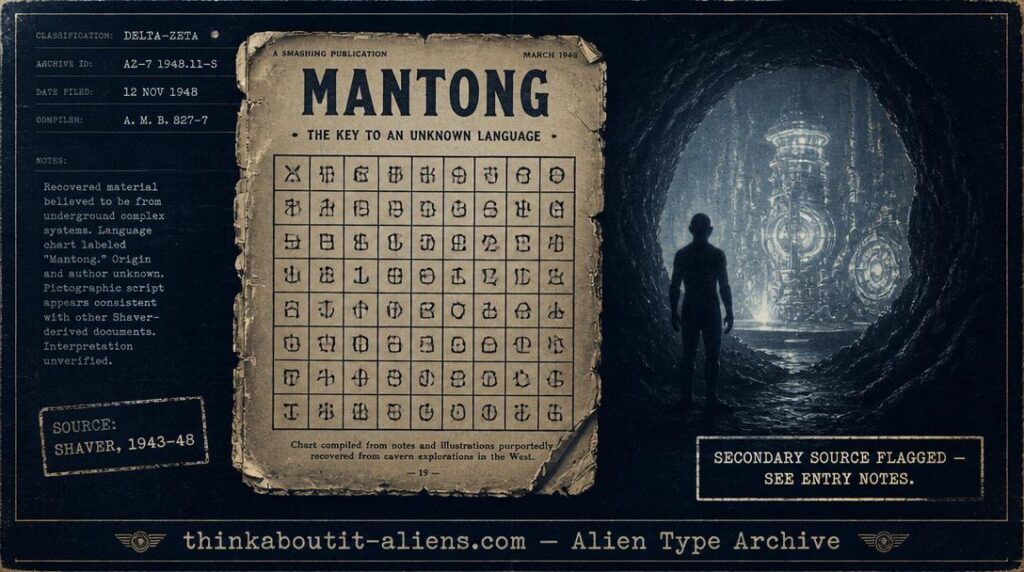
A dossier-style rendering evoking the 1940s Shaver Mystery origins of the Tero, paired with a stylized nod to Shaver's claimed "Mantong" alphabet.
THINK ABOUTIT’S ALIEN TYPE SUMMARY
TEROS
In December 1943, a Pennsylvania welder named Richard Shaver mailed a rambling letter to the editor of Amazing Stories describing an ancient alphabet embedded in the English language — and within it, an underground war between two factions of a degenerated, once-great civilization: the malevolent Dero and their sane, protective counterparts, the Tero. What followed became one of pulp fiction’s strangest chapters, a story presented as fact to hundreds of thousands of readers, and later borrowed, retooled, and given new names by at least one more recent and considerably darker source.
Name: Tero (plural often rendered “Teros“)
AKA: “The Agreeable People” is a reasonable plain-language gloss of “integrative,” consistent with Shaver’s own Mantong etymology. “Sunaynans” and “The Yearly Ones” come from a later, separate source — see the Source note below before using these terms interchangeably with “Tero.”
Location – Home System: Not extraterrestrial in Shaver’s own mythology. The Tero are described as descendants of an “Elder Race” — the Titans and Atlans — who came to ancient Earth (then called Lemuria, or Mother Mu) in deep antiquity and built vast underground cities.
Distance from Earth: Not applicable; the Tero are Earth-descended in the source mythology, not visitors from another star system
Attitude: Protective and benevolent toward surface humans, per Shaver’s stories, actively working to counter the harmful influence of the Dero
Motives: Defending surface humanity from Dero interference; preserving the technology and records left behind by the departed Elder Race
Physical Appearance: Not described in specific physical detail in Shaver’s original stories beyond being descended from the same Elder Race as the Dero and, by extension, surface humans
- Average Height: Undocumented
- Average Weight: Undocumented
- Body Temperature: Undocumented
- Pulse/Respiration: Undocumented
- Blood Pressure: Undocumented
- Life Expectancy: Undocumented with a specific figure; Shaver’s mythology describes the Elder Race as long-lived or “nigh-immortal,” a trait the Tero, as their descendants, are generally associated with
- Hair: Undocumented
- Skin: Undocumented
- Eyes: Undocumented
- Sex: Undocumented with specific detail
Other Physical Information: This entry previously included a claim linking Tero/human genetic mixing to Down syndrome (Trisomy 21). That claim has been removed. It is not part of Shaver’s original mythology, is not supported by any source reviewed for this correction, and is factually false and harmful as medical information regarding a real, well-understood chromosomal condition. It will not be restated here.
Special Traits and Abilities: Use of ancient “mech” (machinery) left behind by the Elder Race to counteract the harmful “detrimental” rays wielded by the Dero, per Shaver’s stories. A “genetic incompatibility” trait has been removed for the reasons stated above.
Communication Type: Described in Shaver’s stories as telepathic; capable of communicating with sympathetic surface humans
Origin: Descendants of the Titan-Atlan Elder Race, who Shaver’s stories describe as settling ancient Earth (Lemuria/Mother Mu) over 12,000 years ago, building vast underground cities to escape increasingly harmful solar radiation, and eventually departing for other worlds — leaving behind a remnant population that split into the sane, protective Tero and the degenerated, malevolent Dero based on differing exposure to “integrative” versus “detrimental” energies from the Elder Race’s abandoned machinery. This network’s own original “Alien Types” glossary, archived since the early 2000s, gives a related but distinct account: it describes the Tero as various human groups inhabiting re-established antediluvian cities beneath North America, some descended from early American colonists and others from older civilizations including Native American peoples who went underground centuries or millennia ago — and it explicitly states that the Dero “consist of draconian elements,” a departure from Shaver’s own 1940s meaning (in which the Dero are degenerated humans, not aliens) that nonetheless reflects this network’s own documented historical position, not a later invention.
Life Form Type: Descended from the same humanoid Elder Race lineage as the Dero and, per the mythology, modern surface humans
Subspecies: Undocumented as formal classifications. “Shuyukh,” “Halaabeans,” “Flugelrods,” and “Hulub” do not appear in Shaver’s original stories or in the secondary Shaver Mystery literature consulted for this correction, and have been marked Undocumented rather than presented as established lineages.
Most Common Species: Undocumented
Level of Species: Undocumented (no numbered or graded classification appears in Shaver’s stories)
Habits: Dwelling in underground cave cities to remain shielded from the sun, which Shaver’s mythology treats as a source of corrupting “detrimental” energy; maintaining and operating ancient Elder Race machinery; opposing Dero activity where possible
Transportation Type: Undocumented with specific detail; Shaver’s stories describe extensive underground cave and roadway networks built by the Elder Race, used by both Tero and Dero
Witnesses Reports: Richard Shaver (originator of the accounts, published from 1943 onward); Ray Palmer (editor of Amazing Stories, who rewrote, expanded, and promoted Shaver’s letters as the “Shaver Mystery” beginning in 1944)
Special Features/Characteristics: The Mantong alphabet, which Shaver claimed underlies all human language, assigns the letter “T” the meaning “integrative” and “D” the meaning “detrimental” — the direct etymological source of the names Tero and Dero
Summary/Description: The benevolent counterpart to the Dero in Richard Shaver’s 1940s “Shaver Mystery” pulp fiction — degenerated but sane descendants of an ancient, technologically advanced Elder Race who remained underground after most of their kind departed Earth, using inherited machinery to protect surface humanity from their corrupted Dero kin.
Source: Richard S. Shaver, stories published in Amazing Stories beginning 1944, edited and promoted by Ray Palmer (the “Shaver Mystery”); this network’s own original “Alien Types” glossary, archived since the early 2000s (© Think About It Enterprises, 1997–2006), which independently describes the Tero as North American cavern-dwellers and already links the Dero to “draconian elements.” A separate, later source layer exists: material published by Dwight York’s Nuwaubian movement (including a 1996 Nuwaubian calendar) borrowed the Tero/Dero terminology directly from Shaver’s work and added its own additional mythology, including the “Sunaynan” name. This third source requires explicit context: Dwight York was convicted in 2004 of child sexual abuse and related federal charges and sentenced to 135 years in prison, and the Southern Poverty Law Center has documented the Nuwaubian movement as promoting racist and antisemitic conspiracy content. Nuwaubian-sourced material is noted here for completeness, not presented as a neutral folklore source on par with Shaver’s original pulp fiction or this network’s own glossary.
Related Cases: The Dero (the malevolent counterpart entity in the same mythology); the broader Shaver Mystery phenomenon and its influence on later hollow-earth and underground-alien folklore
DETAILED REPORT
The Shaver Mystery is a genuinely significant, well-documented episode in American pulp fiction history, not an obscure or invented tradition. In December 1943, Richard Shaver, a steelworker in Pennsylvania, sent Amazing Stories editor Ray Palmer a letter describing an ancient alphabet, “Mantong,” which he claimed was the root of all human language and proof of a lost civilization. Palmer published it in January 1944, then went on to rewrite and expand Shaver’s subsequent submissions into a series of stories presented, controversially, as at least partly factual. The gambit reportedly boosted the magazine’s circulation toward a quarter of a million copies by 1946, while drawing sharp criticism from science fiction fandom for the factual framing.
In this mythology, an ancient, highly advanced “Elder Race” — the Titans and Atlans — settled Earth, then known as Lemuria or Mother Mu, over 12,000 years ago, building vast cave cities and machinery to shield themselves from the sun, which Shaver’s cosmology treats as a source of increasingly “detrimental” corrupting energy. When conditions worsened, most of the Elder Race departed for other worlds, but some remained. Prolonged exposure to the abandoned machinery’s energies split this remnant population: those exposed to “integrative” energy stayed sane and protective, becoming the Tero; those exposed to “detrimental” energy degenerated into the malicious, insane Dero, who use captured ancient technology to inflict accidents, disease, and misfortune on the surface world. Modern surface humans, in this mythology, are also descended from the same Elder Race lineage.
Between Shaver’s original 1940s work and the later Nuwaubian layer sits a third, genuinely older source: this network’s own original “Alien Types” glossary, in circulation since the early 2000s. Its “Teros” entry describes them not as a specific Elder Race lineage but more broadly as human groups occupying re-established antediluvian cities beneath North America, some descended from early American colonists and others from older civilizations, including Native American peoples who are said to have gone underground centuries or millennia ago. That same entry states plainly that the Dero “consist of draconian elements” — meaning the conflation of Shaver’s Dero with the unrelated reptilian-Draconian tradition, which this correction initially treated as a likely later addition, actually traces to this network’s own documented history rather than to any recent rewrite. It is still a departure from Shaver’s own 1940s meaning, in which the Dero are degenerated humans rather than aliens, but it is this archive’s own departure, made decades ago, and is credited here accordingly.
This entry previously sourced its material to “the 1996 Nuwaubian Calendar” and “Extraterrestrial Amongst Us” without noting where that material actually comes from. Research for this correction traced the Tero/Dero terminology directly to Shaver’s original 1940s work — a fact independently confirmed by secondary religious-studies sources, which describe the Nuwaubian movement, led by Dwight York, as having “borrowed” the dero/detrimental-robot concept directly from Shaver. York’s movement then layered its own additional names and mythology on top, including “Sunaynan.” Because York was later convicted of serious crimes against children and his movement has been documented by watchdog organizations as promoting hate-group content, this entry treats Nuwaubian-sourced material as a distinct, flagged layer rather than blending it silently into Shaver’s original, considerably less fraught pulp-fiction tradition, or into this network’s own separate historical glossary.
One specific claim from the previous version of this page — that Tero-human genetic mixing produces Down syndrome — has been removed entirely rather than corrected or hedged. It does not appear in Shaver’s original stories. It is also simply false: Down syndrome is a well-understood chromosomal condition (Trisomy 21) with a known biological cause unrelated to any claim of this kind, and repeating this framing risks real harm to people who have the condition and their families. This entry will not restate it.
RESEARCHER’S NOTES
Three Sources, One Borrowed Vocabulary — and Why They Can’t Be Treated the Same
- Source Chain Assessment: This entry actually has a real, well-documented origin — the 1943–1948 Shaver Mystery, one of the most consequential episodes in pulp science fiction history. This network’s own original glossary, in circulation since the early 2000s, offers a second, related but distinct account. A third, later source (Nuwaubian material) borrowed Shaver’s core terminology and added new names and claims. These are three separate sources and should never have been cited as if they were one.
- Origin Story Correction: The previous version placed the Tero’s origin on a planet called “Jomon” in the Arcturus system, roughly 36.7 light-years away. This does not appear anywhere in Shaver’s mythology or in this network’s own glossary, both of which place the Tero as Earth-descended, not visitors from another star system. This has been corrected.
- This Network’s Own “Dero = Draconian” History: The link between the Dero and “draconian elements” was initially flagged in this correction as a likely later fabrication, since it contradicts Shaver’s own 1940s meaning. Locating this network’s own original glossary showed that this specific conflation actually predates any recent rewrite — it is this archive’s own documented position from the early 2000s. It has been kept, but now correctly attributed to that source rather than presented as either pure Shaver canon or unexplained invention.
- Harmful Medical Misinformation Removed: A claim connecting Tero-human genetic mixing to Down syndrome has been removed outright, not merely marked Undocumented. This is a factually false and potentially hurtful claim about a real, well-understood medical condition, and this archive does not restate that kind of claim regardless of its source.
- Source Reliability — Nuwaubian Material: Where Nuwaubian-sourced terminology (“Sunaynan,” “The Yearly Ones”) is referenced at all in this entry, it is explicitly flagged rather than presented as equivalent to Shaver’s original pulp fiction. Dwight York was convicted in 2004 on child sexual abuse and related charges and sentenced to 135 years in prison; the Southern Poverty Law Center documents the movement he led as promoting hate-group content. This context is provided per this archive’s standing policy on Nuwaubian-sourced material.
- Fabricated Biometric and Classification Panel: Precise height, weight, body temperature, a “Level XIV” rating, and named subspecies (“Shuyukh,” “Halaabeans,” “Flugelrods,” “Hulub”) do not appear in Shaver’s stories or in the secondary literature on the Shaver Mystery, and have been marked Undocumented.
What remains, once the layers are properly separated, is a genuinely interesting piece of American pulp history: a steelworker’s claimed “racial memories,” an editor willing to publish them as fact, and a mythology of underground war between sanity and madness that a magazine rode to its highest circulation in years; this network’s own decades-old gloss on that mythology, relocating the Tero to North American antediluvian cities and quietly recasting the Dero as “draconian elements”; and, later still, a very different and much darker source that borrowed Shaver’s vocabulary without borrowing its comparatively modest original claims.
“The letter T stands for Integration.”
— Richard Shaver, describing the Mantong alphabet.
About the Author