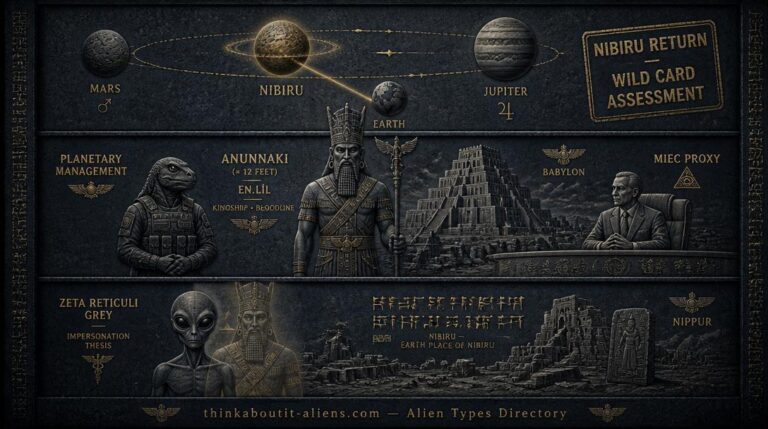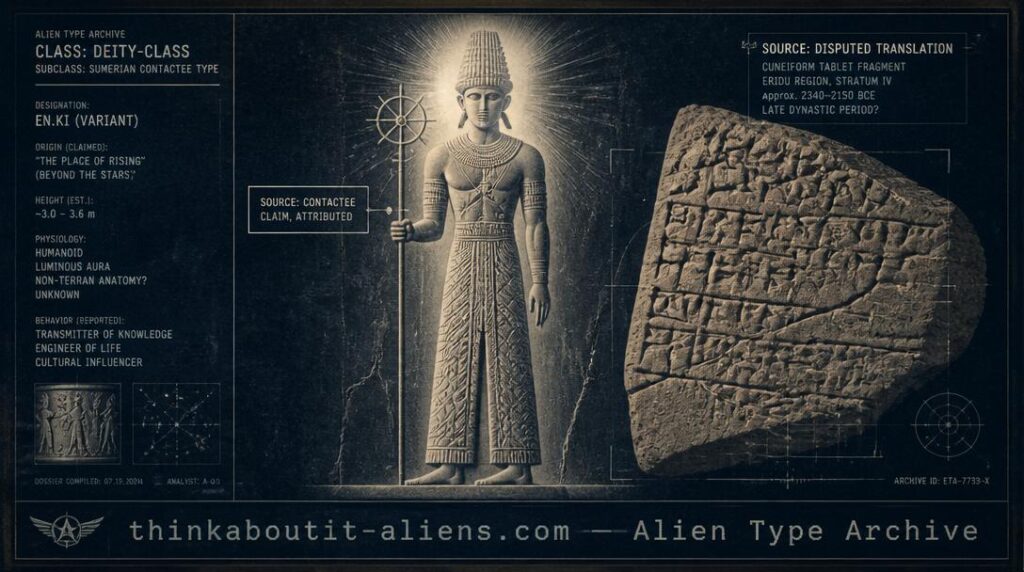
A dossier-style rendering of an Anunnaki figure evoking Sumerian relief art, paired with a cuneiform tablet reflecting the disputed translation at the center of this entry's sourcing.
THINK ABOUTIT’S ALIEN TYPE SUMMARY
THE ANUNNAKI
Few names in this archive carry as much genuine, traceable source material as the Anunnaki — disputed cuneiform translations from the late Zecharia Sitchin, a specific origin narrative relayed by contactee Alex Collier and compiled by exopolitics researcher Michael Salla, testimony from retired NATO officer Robert Dean, and a parallel African tradition described by Zulu sangoma Credo Mutwa. Each of these is a real, findable source. None of them agree with each other in detail, and this entry works best when that disagreement is shown rather than smoothed away.
Name: The Anunnaki
AKA: Nibiruans (per Alex Collier’s material). “The Anakim” and “The Elohim” are related but distinct traditions — ancient giant-human and Phoenician/Canaanite-deity lore, respectively — each with its own separate entry in this archive’s history, and should not be treated as simple synonyms for the Anunnaki. “Mantindane” is a term used by Zulu sangoma Credo Mutwa, but Mutwa’s own account describes the Mantindane as servants of the ruling reptilian Chitauri (comparable to the “Greys” in Western ufology), not as the ruling “god” figures themselves — this ambiguity exists in Mutwa’s own reported material and is preserved here rather than resolved into false certainty.
Location – Home System: Nibiru, per Zecharia Sitchin’s interpretation of Sumerian cuneiform texts — a purported planet with a highly elongated orbit that periodically enters the inner solar system
Distance from Earth: Variable, consistent with a nomadic or highly elliptical orbit as described in Sitchin’s interpretation
Attitude: Described across the Collier/Salla material as authoritative and strategic, positioned as a regulatory or management layer over human affairs rather than direct rulers
Motives: Per the Collier/Salla material, long-term oversight of a “human experiment,” with periodic returns to assess how Earth’s resources and humanity have been managed by other extraterrestrial groups in the interim
Physical Appearance: Described across sources as giant humanoids, “shining” or radiant in appearance; specific measurements below are unverified
- Average Height: Sources describe them generally as giants, without a single agreed figure; specific ranges (e.g., “7 to 12 feet”) are not consistently supported across the sources reviewed and should be treated as approximate at best
- Average Weight: Undocumented
- Body Temperature: Undocumented
- Pulse/Respiration: Undocumented
- Blood Pressure: Undocumented
- Life Expectancy: Described in Sitchin’s interpretation as very long-lived, tied to a claimed ~3,600-year Nibiru orbital cycle; precise figures are Sitchin’s own extrapolation, not an independently verified biological fact
- Hair: Depicted as dark and elaborately styled in Sumerian reliefs, per the art-historical record Sitchin draws on; this is a depiction in ancient artwork, not a documented biological trait
- Skin: Undocumented with a specific tone; “radiant” or “shining” appearance is a recurring description across sources
- Eyes: Undocumented with specific detail
- Sex: Male and female, within a described patriarchal hierarchy per the source material
Other Physical Information: A double row of teeth and an extra lumbar vertebra are not documented in the sources reviewed for this correction and have been removed
Special Traits and Abilities: Per Dr. Malachi Z. York’s material, described as having closed off their “heart chakra” and requiring external emotional energy to sustain themselves — see the Source note below regarding this material’s origin and context. Specific mechanisms such as “neural implant telepathy” or “Monatomic Gold” DNA repair are not documented elsewhere and have been marked Undocumented.
Communication Type: Telepathy is described across the contactee material; Sitchin’s interpretation connects Sumerian/Akkadian language to the broader Semitic language family, a claim that sits within mainstream historical linguistics regarding Semitic languages generally, independent of any extraterrestrial claim
Origin: Per Alex Collier’s account, as compiled by Michael Salla: the Anunnaki originated as the offspring of a marriage between Orion Group matriarchal royalty and Sirius B royalty, undertaken to end a conflict between the two groups; their name, “Nibiru,” was told to Collier by an Andromedan contact named Moraney as meaning “divided amongst two” in “the Orion tongue.” This is a specific, attributed contactee claim, not an independently verified etymology.
Life Form Type: Humanoid (giant), per the composite description across sources
Subspecies: Undocumented as formal classifications. Enlil and Enki are genuine named figures in Sitchin’s interpretation of Sumerian mythology (frequently described as rival sons of Anu), but “Enlilite Warriors” and “Enkiite Geneticists” as organized subspecies categories do not appear in Sitchin’s own material and have been marked Undocumented.
Most Common Species: Undocumented; a “Nibiruan Royal Guard” designation does not appear in the sources reviewed
Level of Species: Undocumented (no numbered or graded classification appears in any source reviewed)
Habits: Per the Collier/Salla material, influencing long-term human evolution through elite human institutions and systems rather than direct, overt contact
Transportation Type: Nibiru itself is described in Sitchin’s interpretation as a planetary body rather than a craft; no specific scout-vessel description is documented in the sources reviewed
Witnesses Reports: Alex Collier (contactee claims, compiled by Michael Salla); Zecharia Sitchin (author and translator, whose readings of Sumerian cuneiform are disputed by professional Assyriologists — see Researcher’s Notes); Sergeant Robert Dean (retired NATO staff member who has publicly described awareness of extraterrestrial matters during his military service); Credo Mutwa (Zulu sangoma, describing a related but distinct African tradition); Dr. Malachi Z. York (see Source note below regarding this material’s context)
Special Features/Characteristics: Per York’s material, described as unable to generate internal “light” or empathy and reliant on external emotional energy from humans; per Sitchin’s interpretation, associated with the Sumerian concept of “melammu,” a radiant divine aura attributed to gods and kings in Mesopotamian texts
Summary/Description: A race of giant humanoids described across several distinct traditions — Sitchin’s interpretation of Sumerian cuneiform, Alex Collier’s contactee narrative of an Orion-Sirius B royal union, and a related African tradition described by Credo Mutwa — as long-term overseers of human development, associated with ancient Mesopotamian mythology and ancient astronaut theory generally.
Source: Zecharia Sitchin’s published interpretations of Sumerian cuneiform texts (translations disputed by professional Assyriologists); Alex Collier’s contact claims as compiled by Michael Salla, PhD; Sergeant Robert Dean’s public statements; Credo Mutwa’s recorded oral tradition. A separate source layer is present in this entry: material attributed to Dr. Malachi Z. York, including an extended, apparently unedited first-person passage. This requires explicit context: York was convicted in 2004 of child sexual abuse and related federal charges and sentenced to 135 years in prison, and the Southern Poverty Law Center has documented the Nuwaubian movement he led as promoting racist and antisemitic conspiracy content. This material is retained for completeness because it was present in the page’s editorial history, but it is not presented as equivalent in reliability to the other sources listed here.
Related Cases: The February 20, 1954 Eisenhower-administration meeting claim, referenced in the Collier/Salla material as an unsuccessful negotiation over nuclear weapons technology; the separate Anakim and Elohim entries in this archive; Credo Mutwa’s Chitauri tradition
DETAILED REPORT
This entry rests on a genuinely wide spread of named, findable sources, which is unusual in this archive and worth taking seriously rather than flattening into one voice. The best-known is Zecharia Sitchin, whose series of books beginning in the 1970s interpreted Sumerian cuneiform tablets as describing a race of extraterrestrial beings, the Anunnaki, from a planet called Nibiru. It is important to note that Sitchin was not a trained Assyriologist, and his specific translations and interpretations of Sumerian and Akkadian texts have been widely and specifically rejected by professional scholars in the field, who consider his readings inconsistent with the actual grammar and content of the source texts. This does not mean Sitchin’s work isn’t worth documenting as a major and influential body of writing — it has shaped enormous amounts of subsequent ufology — but it should not be presented as an accepted scholarly translation.
A separate and more recent source is contactee Alex Collier, whose claimed decades of contact with beings from Andromeda produced a specific origin story for the Anunnaki: a diplomatic marriage between Orion Group and Sirius B royalty, intended to end a conflict between the two groups, with the resulting lineage named “Nibiru” — reportedly told to Collier by an Andromedan contact named Moraney to mean “divided amongst two.” This account was compiled and republished by exopolitics researcher Michael Salla, and the passage in this entry matches Salla’s compilation closely. It is a specific, attributed contactee claim, not a translation of any ancient text, and should be read as such.
A third, independent tradition comes from Credo Mutwa, a Zulu sangoma whose accounts of a reptilian ruling race called the Chitauri — described as having arrived from the sky, established themselves as gods, and organized human labor, notably around gold mining — bear a striking resemblance to Sitchin’s Anunnaki narrative despite no known historical contact between Mesopotamian and Southern African oral traditions. Mutwa’s own reported material distinguishes between the Chitauri (the ruling reptilian figures) and the Mantindane (servant-class beings comparable to the Greys of Western ufology) — a distinction this entry preserves rather than collapsing “Mantindane” into a simple synonym for the Anunnaki.
RESEARCHER’S NOTES
Four Traditions, One Name — And Why the Disagreement Between Them Is the Point
- Source Chain Assessment: This entry is unusually well-sourced by this archive’s standards, drawing on named authors and contactees whose claims can be checked against their own published material. The correction here is less about inventing content and more about restoring proper attribution to claims that had been presented as uniform “database” fact.
- Sitchin’s Scholarly Reception: Zecharia Sitchin’s cuneiform interpretations, foundational to the modern “Anunnaki from Nibiru” narrative, are not accepted by professional Assyriologists, who reject his translations on linguistic grounds. This entry notes that dispute rather than presenting Sitchin’s readings as settled scholarship.
- Fabricated Biometric and Classification Panel: Precise height, weight, body temperature, blood pressure, a double row of teeth, an extra lumbar vertebra, a “Level XVIII” rating, and named subspecies (“Enlilite Warriors,” “Enkiite Geneticists”) do not appear in Sitchin’s, Collier’s, or Mutwa’s material and have been marked Undocumented or removed.
- Nuwaubian-Sourced Material Flagged: A significant portion of this entry’s “Special Features” material, including an extended first-person passage, traces to material attributed to Dr. Malachi Z. York. Per this archive’s standing policy, that context — York’s 2004 conviction for child sexual abuse and the Southern Poverty Law Center’s documentation of his movement as a hate group — is provided explicitly rather than left as plain, unqualified attribution.
- Mantindane/Anunnaki Distinction Preserved: The previous version of this page’s own source material included an honest admission of uncertainty — that Credo Mutwa “didn’t distinguish between the Annunaki and the Zetas” when discussing the Mantindane. That hedge has been preserved here rather than resolved into a confident equivalence the source itself does not support.
What makes the Anunnaki entry genuinely worth documenting carefully is not a single settled account but the collision of several: a controversial independent translator, a contactee whose claims were compiled by a PhD exopolitics researcher, a respected African oral tradition, and a considerably more troubled fourth source that happened to use overlapping vocabulary. Keeping those four voices distinct, and naming where each one is weakest, is the point of this correction.
“They formed a new ‘tribe’ which has continued to flourish for at least hundreds of thousands of years.”
— Alex Collier, as compiled by Michael E. Salla, PhD.
About the Author