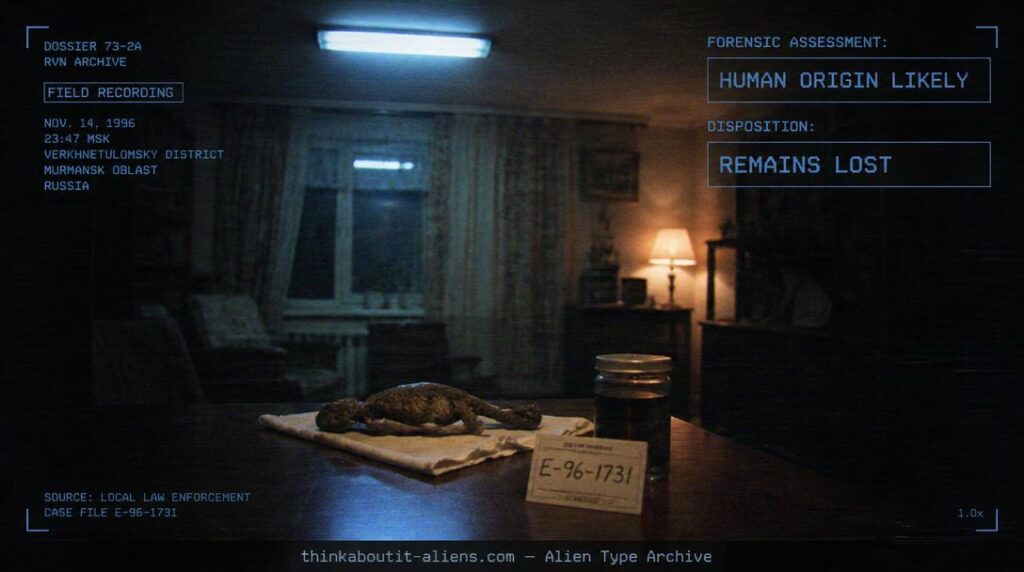
The remains found by Tamara Prosvirina in Kyshtym, Russia, in 1996 — later assessed by forensic and genetic experts as most likely human in origin.
THINK ABOUTIT’S ALIEN TYPE SUMMARY – Aleshenka
Correction Notice: This entry has been checked against the documented investigation history. The claim that genetic testing found “20 unknown markers” is a reversal of the actual finding — the Vavilov Institute reported no evidence of extraterrestrial origin. A forensic pathologist’s direct examination and conclusion, previously omitted, has been restored. Unsupported flourishes have been removed and are archived at the bottom.
In the summer of 1996, an elderly woman named Tamara Prosvirina was seen walking the streets of Kyshtym, Russia, cradling something wrapped in a blanket and calling it her baby. What she’d found — a small, large-eyed, hairless body about the size of a forearm — would become one of Russian ufology’s most famous images. It would also, within months, cost Prosvirina her freedom and possibly her life, and the body itself would vanish before anyone could settle what it actually was.
Name: Aleshenka
AKA: The Kyshtym Dwarf
Location – Home System: N/A. This is a single found-specimen case, not a species with a claimed origin system; some retellings speculate extraterrestrial origin, but no source names a planet or star.
Distance from Earth: N/A
Attitude: N/A — no interactive behavior is documented beyond the caretaking relationship Prosvirina described
Motives: N/A
Physical Appearance: Witness accounts conflict. Prosvirina’s friend Tamara Naumova described a hairless, brown body with large protruding eyes. Two other named acquaintances, Vyacheslav Nagovsky and Nina Glazyrina, separately described the being as hairy with blue eyes — the opposite of the hairless/dark-eyed version that circulates most widely. Those two witnesses’ broader reliability has been publicly questioned by local reporting. A doctor who examined the body directly described it as consistent with a 20–25 week human fetus.
- Average Height: Approximately 20–25 centimeters
- Average Weight: Undocumented
- Body Temperature: Undocumented
- Pulse/Respiration: Undocumented as a measurement; witnesses described faint, shallow breathing while the being was reportedly alive
- Blood Pressure: Undocumented
- Life Expectancy: N/A
- Hair: Disputed — described as hairless by some witnesses, hairy by others
- Skin: Described as greyish-brown, with dark spots on the head per some accounts
- Eyes: Disputed — described as large and dark by some witnesses, blue by others
- Sex: Later genetic analysis identified the remains as a premature female human fetus
Other Physical Information: Some witnesses described an absence of ears, umbilical cord, and visible genitalia. The examining doctor’s assessment of a 20–25 week premature fetus would be consistent with underdeveloped features at that gestational stage.
Special Traits and Abilities: None independently documented; claims of unusual behavior come solely from Prosvirina, who was diagnosed with schizophrenia around the same period
Communication Type: N/A
Origin: Found in a pile of sand/woods near a well outside Kaolinovy, near Kyshtym, Chelyabinsk Oblast, Russia
Life Form Type: The leading forensic assessment identifies the remains as human. Extraterrestrial origin is an unconfirmed popular theory, not a documented conclusion.
Subspecies: N/A
Most Common Species: N/A
Level of Species: N/A
Habits: N/A
Transportation Type: N/A
Witnesses Reports: Tamara Vasilyevna Prosvirina, a 74-year-old Kyshtym resident, reportedly found the being during a summer 1996 storm and cared for it at home, calling it her baby, “Alyoshenka” (a diminutive of Alexey — the name of her actual, adult, incarcerated son). Neighbors, alarmed by her behavior, contacted authorities; Prosvirina was subsequently hospitalized and diagnosed with schizophrenia. The being’s remains — cause and exact time of death undocumented — were later found by police among her belongings. Prosvirina died afterward in a car accident.
Special Features/Characteristics: A forensic pathologist, Irina Yermolaeva, examined the remains and concluded they represented a genuine mummified body — not a fabricated hoax object — most likely a miscarried or aborted human fetus, with deformities potentially linked to fallout from the 1957 Kyshtym/Mayak nuclear disaster, a real and severe nuclear accident that occurred near the same region. Separately, the Vavilov Institute of General Genetics analyzed cloth the body had been wrapped in and reported no evidence supporting extraterrestrial origin.
Summary/Description: A small mummified body found by a mentally ill woman in rural Russia in 1996, since lost. The leading documented conclusions — from a forensic pathologist and a genetics institute — both point toward a human, likely fetal, origin rather than an extraterrestrial one. The remains’ subsequent disappearance has fueled ongoing speculation but is not itself evidence of anything beyond poor evidence-handling.
Source: Contemporary Russian press coverage; forensic assessment by pathologist Irina Yermolaeva; Vavilov Institute of General Genetics; Andrey Loshak’s documentary “The Kyshtym Dwarf”
Related Cases: The “Atacama Humanoid” (Chile) is frequently compared to this case. It’s worth noting that the Atacama specimen was itself the subject of a 2018 peer-reviewed genetic study that identified it as a human fetus with a combination of genetic mutations, not an extraterrestrial or unknown organism — a resolution that undercuts, rather than supports, treating the two cases as evidence of a shared alien “class.”
DETAILED REPORT
The Aleshenka case is unusual among the entries audited on this site in that it isn’t primarily a citation problem — it’s a case where a real, documented forensic conclusion was quietly reversed. The Vavilov Institute’s actual finding, per contemporary reporting, was that genetic analysis of the wrapping cloth showed no evidence the remains were extraterrestrial. The previous version of this page described the same analysis as having found “20 genetic markers found that do not exist in any known terrestrial organism” — the opposite conclusion, unattributed to any actual source.
Equally significant is what was left out: forensic pathologist Irina Yermolaeva directly examined the remains and assessed them as a genuine, non-hoaxed mummified body, most likely a miscarried or aborted human fetus. She connected the deformities to a real, severe local event — the 1957 Kyshtym disaster, a major nuclear accident at the nearby Mayak facility, one of the most serious nuclear accidents in history prior to Chernobyl. That’s a documented, named, and testable explanation, and omitting it in favor of an “unknown genetic markers” framing tilts the page toward the alien-origin theory without basis.
Witness testimony about the being’s appearance also conflicts more than the previous version let on. Descriptions range from hairless with dark eyes to hairy with blue eyes — a level of disagreement that itself deserves to be part of the record, not smoothed into a single confident description.
RESEARCHER’S NOTES
A Reversed Finding — Aleshenka and the Case of the Missing Forensic Conclusion
- Source Correction: The Vavilov Institute’s documented finding was the absence of extraterrestrial genetic evidence, not the presence of “20 unknown markers.” This is a direct reversal of a real, citable result, not an embellishment of a thin source.
- Omitted Forensic Testimony: Pathologist Irina Yermolaeva’s direct examination and conclusion — genuine mummified tissue, likely a fetus, deformities plausibly tied to real regional nuclear fallout — is a named, documented assessment that belongs in this record regardless of which theory a reader ultimately favors.
- Witness Reliability: Local reporting on this case specifically flags the reliability of two of the witnesses describing an alternate (hairy, blue-eyed) appearance. That caveat is itself part of the documented record and shouldn’t be dropped in favor of a cleaner narrative.
- Comparative Case Correction: The Atacama Humanoid comparison, as previously framed, implied both cases support an extraterrestrial “reconnaissance probe” class. The Atacama case was resolved by genetic sequencing in 2018 as a human fetus with mutations — a fact that argues against, not for, that framing.
- Evidentiary Weight: With the physical remains lost, no further direct testing is possible. The existing forensic and genetic assessments — both pointing toward human origin — represent the most substantive evidence actually gathered before the body disappeared.
What actually happened to Tamara Prosvirina and the small body she called her baby remains genuinely sad regardless of what it was — a woman in psychiatric crisis, a fragile life that didn’t last, and a set of remains that vanished before science could finish its work. The documented forensic and genetic conclusions point toward a human origin, most likely tied to a real regional tragedy. That’s a less dramatic story than the one that’s circulated, but it’s the one the actual record supports.
Journalist Andrey Loshak, who documented the case, summarized local sentiment as: Aleshenka “made a mistake landing in Kyshtym.”
(Andrey Loshak, “The Kyshtym Dwarf”)
REMOVED CLAIMS (Archived for Reference)
These details appeared in an earlier version of this page and either reverse a documented finding or have no traceable source. Archived here rather than deleted.
- “Over 20 genetic markers found that do not exist in any known terrestrial organism”: reverses the Vavilov Institute’s actual reported finding of no extraterrestrial evidence
- “Genetic Mosaicism… a hallmark of hybrid programs”: no source; not a term used in the actual institute findings
- Omission of pathologist Irina Yermolaeva’s direct examination and human-fetus conclusion — restored above
- Theorized link to an October 1996 Korenevo meteorite landing — no source found connecting these two events
- “Level of Species: Type II (theorized)” — no source
- Framing of the Atacama Humanoid comparison as supporting a shared “reconnaissance probe” class — the Atacama case’s own 2018 genetic resolution (human fetus with mutations) argues against this framing
- Source attribution to “Russian Kosmopoisk research group and local militsiya archives” — not confirmed as the actual investigating body in the sources reviewed; local police (militsiya) involvement is documented, Kosmopoisk’s specific role is not
About the Author