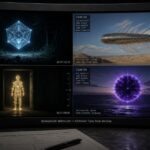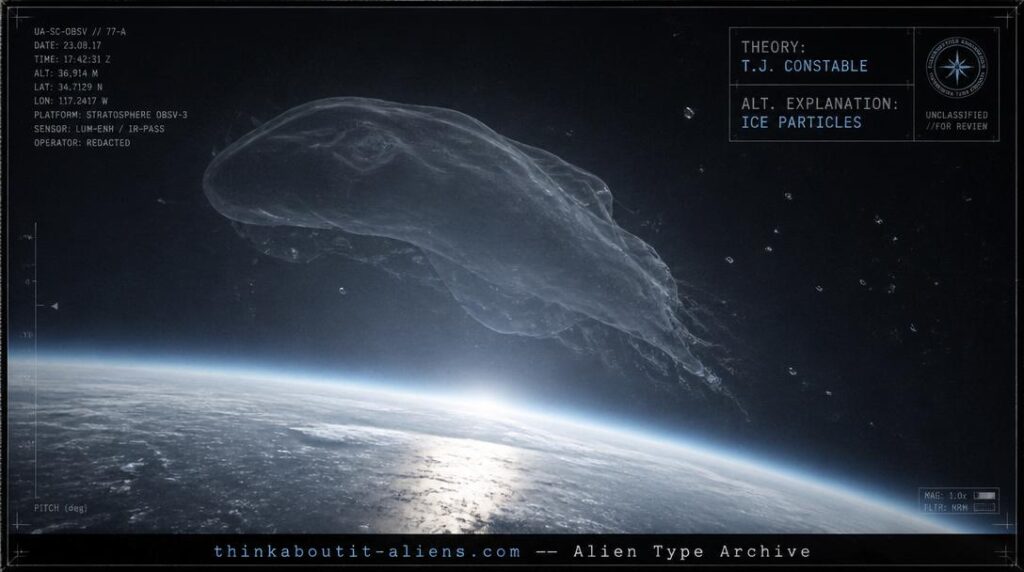
Living organism or ice crystals from a water dump? Both explanations are shown here, as the record actually supports.
THINK ABOUTIT’S ALIEN TYPE SUMMARY – Amoeba Like Creatures
Trevor James Constable spent decades arguing that some UFO sightings were actually living organisms — vast, gelatinous “Critters” drifting through Earth’s upper atmosphere, invisible to the eye but occasionally catchable on infrared film. It’s a real, documented fringe theory from a real researcher. Whether the evidence for it holds up, once the mainstream explanations are actually included, is a separate question.
Name: Amoeba Like Creatures
AKA: Blobs, Atmospheric Beasts, Sky Creatures, Space Blobs, “Critters” (Constable’s term)
Location – Home System: Claimed to inhabit Earth’s upper atmosphere/low orbit; not an extraterrestrial origin claim
Attitude: Described in the theory as non-intentional, following electromagnetic currents rather than directed movement
Motives: Not applicable under the theory; framed as instinctual biological behavior rather than purposeful activity
Physical Appearance: Per Constable’s theory, translucent, gelatinous, and enormous — ranging from meters to kilometers across. No physical sample has ever been recovered or examined in a lab; the theory rests on visual and photographic interpretation.
- Average Height: Claimed to range from roughly 5 meters to several kilometers; not independently measured
- Average Weight: Undocumented; claimed to be near-weightless under the theory
- Body Temperature: Undocumented
- Pulse/Respiration: Undocumented
- Blood Pressure: Not applicable under the theory
- Life Expectancy: Undocumented
- Hair: Not applicable under the theory
- Skin: Described in the theory as gelatinous and translucent
- Eyes: Not applicable under the theory; no sensory organs have been identified
Other Physical Information: None documented beyond the theory’s general description
Special Traits and Abilities: Claimed invisibility to the naked eye while remaining detectable on certain radar or infrared frequencies, per Constable’s theory; not independently confirmed
Communication Type: Undocumented
Origin: Claimed to originate and live within Earth’s own upper atmosphere, not an extraterrestrial world
Life Form Type: Categorized in the theory as an amoeboid or “bio-plasma” life form; not a recognized biological classification
Subspecies: Undocumented
Most Common Species: Undocumented
Level of Species: Not applicable; no technological or civilizational classification is claimed
Habits: Claimed to congregate near electromagnetic activity such as auroras or lightning storms, per the theory
Transportation Type: Not applicable; claimed to drift passively via solar wind and magnetic fields rather than self-propel
Witnesses Reports: Trevor James Constable, a real, named researcher, used infrared photography in the 1950s to document what he called “Critters,” publishing his theory that some UFO sightings represent living atmospheric organisms. Separately, during NASA’s STS-75 mission in February 1996, cameras captured footage of luminous objects near a broken satellite tether. Astronaut Franklin Chang-Diaz, who was present, described the objects at the time as debris — most likely ice particles from a water dump conducted hours earlier, illuminated by sunlight and distorted by the camera’s image-intensifier optics into apparent disc shapes. This remains the mission’s official and most substantiated explanation, though some UFO researchers dispute it based on the objects’ apparent size and movement.
Special Features/Characteristics: The theory associates these entities with “Star Jelly” (Pwdre Ser), a real, centuries-documented gelatinous substance occasionally found on the ground. Mainstream scientific analysis has generally identified recovered samples as mundane biological material — slime molds, cyanobacteria (Nostoc), or amphibian reproductive tissue — and at least one well-documented 2012 case in Dorset, England, turned out to be sodium polyacrylate, an industrial superabsorbent polymer. No credible, sourced laboratory finding of “unidentified bacteria” or unusual toxicity in Star Jelly samples was located.
Summary/Description: A fringe biological-UFO theory, most associated with researcher Trevor James Constable, proposing that some atmospheric phenomena are living organisms rather than craft. Its two most-cited pieces of supporting evidence — the STS-75 footage and Star Jelly deposits — both have well-documented, more mundane mainstream explanations that should be weighed alongside the theory itself.
Source: Trevor James Constable’s published research and photography; NASA STS-75 mission footage and crew statements; historical and scientific literature on Pwdre Ser/Star Jelly
Related Cases: None currently on file
DETAILED REPORT
Trevor James Constable was a real person with a real, decades-long body of published work arguing for living atmospheric organisms — that much is genuinely documented. What the previous version of this page left out was that both of its supporting pieces of evidence have well-established, named, mainstream counter-explanations that were never mentioned.
For STS-75, the astronaut actually present at the time attributed the objects to ordinary debris — ice particles from a water dump conducted hours before the footage, a known and common source of “fireflies” reported by shuttle crews since the Mercury program, further distorted by the camera’s own optical artifacts. That’s not a dismissal invented after the fact; it’s the contemporaneous account. For Star Jelly, centuries of recorded samples have generally turned out to be ordinary biological material, and in at least one well-documented case, an industrial polymer entirely unrelated to biology. Presenting only the “unidentified bacteria” and “toxicity” framing, with no counter-evidence, misrepresented how thin that particular claim actually is.
RESEARCHER’S NOTES
Two Omitted Explanations — Amoeba Creatures and the Missing Mainstream Account
- Source Chain Assessment: Constable is a real, named, published researcher, which distinguishes this entry from anonymous-compilation entries elsewhere on this site. That doesn’t make his theory correct — it makes it a genuine, attributable claim worth weighing against the evidence.
- Omitted Counter-Evidence: Both STS-75 and Star Jelly have real, sourced, mainstream explanations that were absent from the previous draft. Omitting the strongest counter-evidence for a theory’s central examples is its own form of distortion, separate from inventing new claims.
- Unsupported Addition: The claimed correlation between these entities’ appearances and localized illness outbreaks has no named study, dataset, or source behind it and has been removed rather than presented as established.
- Evidentiary Weight: No physical sample of an “Amoeba Like Creature” has ever been recovered and examined. The theory rests entirely on photographic and visual interpretation, which should be weighed accordingly.
Constable’s theory is a genuine, decades-old piece of ufology, and it deserves to be represented accurately — which means representing the mainstream explanations for its best-known evidence just as clearly as the theory itself. Ice particles and a water dump explain STS-75 at least as well as living organisms do; slime mold and frog spawn explain most Star Jelly. The theory can still be presented, but not as though those explanations don’t exist.
Aboard STS-75, astronaut Chang-Diaz described the objects as “a little bit of debris that kind of flies with us.”
(Franklin Chang-Diaz, STS-75 mission)
REMOVED CLAIMS (Archived for Reference)
These details appeared in an earlier version of this page without their documented mainstream counter-explanations, or with no source at all. Archived here rather than deleted.
- Illness-outbreak correlation: no named study or source found connecting sightings of these entities to localized illness
- “Unidentified bacteria” and “high levels of toxicity” in Star Jelly lab analysis: no credible sourced finding located; mainstream analyses generally identify mundane biological material or, in some cases, industrial polymer
- STS-75 footage presented without NASA/crew explanation: restored above — ice particles from a water dump, camera artifacts, per astronaut Chang-Diaz’s contemporaneous account
- 1939 US Navy weather balloon pilot sighting: could not be independently verified against a named source; presented previously as settled fact
- Exact biometric-style claims presented as established (specific antifreeze protein mechanism, precise temperature tolerance) — no source; reframed as claims of the theory rather than documented fact
About the Author