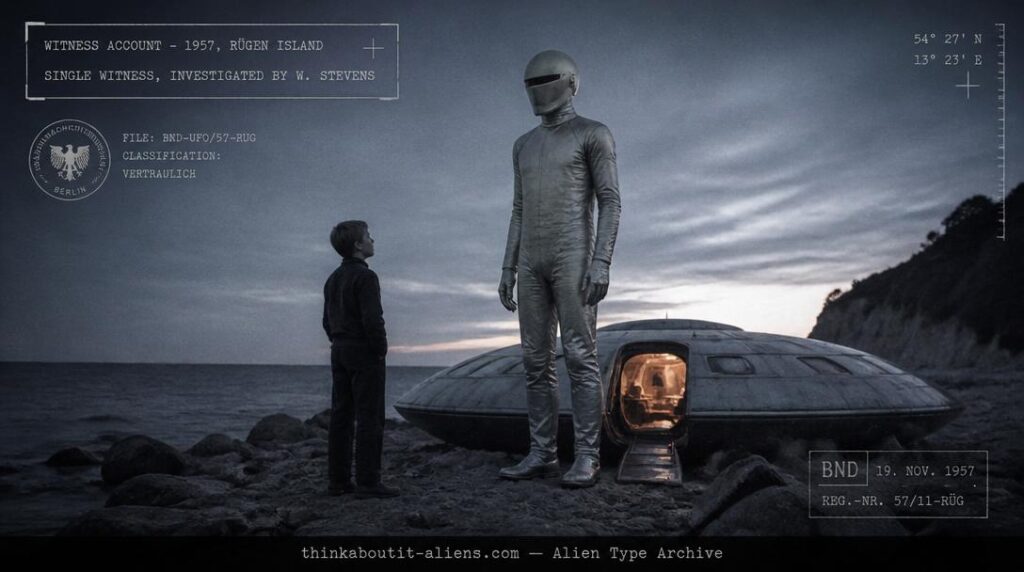
Martin Wiesengrün's reported 1957 encounter near Rügen Island, Baltic coast — the primary source for the Arian alien type.
THINK ABOUTIT’S ALIEN TYPE SUMMARY – Arian
In the summer of 1957, on the Baltic island of Rügen, a 15-year-old boy known only by the pseudonym Martin Wiesengrün was invited aboard a craft for what he described as three days of planned education. He was told the beings aboard had lived on Earth once, in what’s now Greenland, and had watched an asteroid end the age of dinosaurs 65 million years ago. It’s one of the more detailed European contactee cases on record, and one where the source itself is refreshingly upfront about what it doesn’t know for certain.
Name: Arian
AKA: People of Raula (their sun’s name, per the source)
Location – Home System: A planet called Arian, said to be the fourth planet orbiting Aldebaran (Alpha Tauri), which the natives reportedly call Raula. The source notes an unconfirmed possibility that Aldebaran has a brown dwarf companion, which would make it a binary system.
Distance from Earth: The source itself gives differing estimates — older figures place it around 60 light-years, roughly matching a separate 59-light-year figure from Wiesengrün himself; this entry does not pick a single number the source doesn’t commit to
Attitude: Described as benevolent and educational in the source, consistent with the case’s overall non-threatening, instructional tone
Motives: Per the source, an interest in preserving and sharing Earth’s ancient history with selected individuals; no broader stated agenda beyond the described educational purpose
Physical Appearance: Described in the source as very tall (2–3 meters), with hair in shades of brown, red, or occasionally blue-tinted among elders. When Wiesengrün met them, they wore helmets and silver-toned jumpsuits, per his account.
- Average Height: 2–3 meters, per the source
- Average Weight: Undocumented
- Body Temperature: Undocumented
- Pulse/Respiration: Undocumented
- Blood Pressure: Undocumented
- Life Expectancy: Described in the source only as very long-lived; no specific figure is given
- Hair: Brown or red most commonly; a bluish tint reported among elders, per the source
- Skin: Undocumented in detail beyond general humanoid description
- Eyes: Undocumented in detail
- Sex: Undocumented
Other Physical Information: Wiesengrün reported meeting several different beings aboard the craft, not all of whom were said to be from Arian
Special Traits and Abilities: Long lifespans and telepathic ability are described in the source in general terms, without specific figures or named mechanisms
Communication Type: Described in the source as capable of both telepathy and spoken communication in multiple Earth languages
Origin: Planet Arian, fourth planet of the Aldebaran (Raula) system; orbital period given in the source as approximately 20.2 Earth years
Life Form Type: Humanoid
Subspecies: None noted; described in the source as a single, unified planetary population
Most Common Species: Undocumented as a formal designation
Level of Species: Undocumented; no civilizational rating appears in the source
Habits: Undocumented beyond the events of the Wiesengrün encounter itself
Transportation Type: A craft aboard which Wiesengrün spent three days; the source does not give a detailed technical description of its propulsion or design
Witnesses Reports: The primary source is a contactee known by the pseudonym Martin Wiesengrün, who reported being invited aboard a craft in the summer of 1957 near Glowe, on the Baltic island of Rügen (then in East Germany), at age 15. He described three days aboard, during which he was told the beings had once lived on Earth in what is now Greenland, had witnessed the asteroid impact roughly 65 million years ago associated with the extinction of the dinosaurs, and separately referenced Atlantis. The case was investigated by UFO researcher Wendelle Stevens. A separate, more vaguely described claim of other 1957 Baltic-area contactees reporting “luminous giants” could not be verified against a specific named source and should be treated as unconfirmed.
Special Features/Characteristics: The claimed Greenland presence and witnessing of the end-Cretaceous asteroid impact are among the case’s most striking and specific claims, tying an individual contact account to a real geological event dated to roughly 66 million years ago
Summary/Description: A tall, long-lived humanoid people from a planet orbiting Aldebaran, per a single detailed 1957 contact case investigated by Wendelle Stevens. The account describes an ancient claimed connection to Earth, including a pre-human Greenland presence and witnessing the asteroid impact that ended the Cretaceous period.
Source: Martin Wiesengrün (pseudonym) and Wendelle Stevens, UFO Contact From Planet Arian of Aldebaran (1957 case), via galactic.no
Related Cases: Aldebarans (this network’s separate entry, addressing the distinct Vril/Nazi mythology sometimes wrongly associated with Aldebaran)
DETAILED REPORT
The Arian case stands out for its restraint in a genre that often reaches for maximal drama. Wiesengrün’s account, as preserved in the source, is specific about a few things (the 1957 date, the Rügen Island location, his age, the three-day duration) and notably vague about others — the source itself gives two different distance estimates rather than picking one to sound more authoritative, and it doesn’t assign a numeric lifespan or civilizational rating to the Arians. That kind of built-in uncertainty is worth preserving rather than smoothing over.
The previous version added a precise life expectancy of 4,742 years and a “Type II” classification, neither of which appears in the actual case material. It also introduced an unattributed “living technology” claim in its expanded narrative sections that goes beyond what the source documents about the craft itself.
RESEARCHER’S NOTES
An Honest Uncertainty — Arian and the Two Distance Estimates
- Source Chain Assessment: This traces to a named investigator (Wendelle Stevens) and a specific, dated, located case — a stronger position than many entries on this site, though it remains a single pseudonymous witness.
- Preserved Uncertainty: The source’s own two differing distance figures (roughly 59 and 60 light-years) are more honest than the single confident “65.1 light-years” the previous draft presented, and that honesty has been restored.
- Fabrication Scope: The specific 4,742-year lifespan, exact biometrics, and Kardashev-style classification have no basis in the case material and were added independently of it.
- Evidentiary Weight: A single pseudonymous witness, decades removed from the event, investigated by one researcher. Notable and detailed, but not independently corroborated.
What makes the Wiesengrün case worth preserving isn’t a precise lifespan or a civilizational tier — it’s a fifteen-year-old’s account of three days of planned education, and a source honest enough to give two different distance estimates rather than pretend to more certainty than it has. That’s a better foundation than the invented specificity that had replaced it.
The Arians reportedly told Wiesengrün they had lived on Earth “in what is now Greenland” before the asteroid impact.
(Martin Wiesengrün / Wendelle Stevens case account)
REMOVED CLAIMS (Archived for Reference)
These details appeared in an earlier version of this page and have no basis in the source. Archived here rather than deleted.
- Precise distance of “65.1 light-years” — the source gives two different, less precise estimates (roughly 59–60 light-years) rather than a single confident figure
- Life expectancy of “4,742 earth years” — no source; the material describes only general long-livedness
- Full biometric panel (weight, body temperature, pulse, blood pressure) — no source
- “Type II” Kardashev classification and “Type-A” life form designation — no source
- “Frequency Immersion” resonance chambers and named “Astro-navigation” ability — no source
- “Living technology” responding to crew bio-rhythms — not described in the core case material
- Unattributed “other 1957 Baltic contactees” claim — could not be verified against a specific named source; presented here as unconfirmed rather than established
About the Author