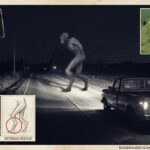
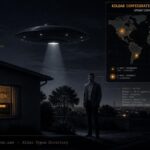
A visual reconstruction of the Elegant Humanoid case, one of the oldest documented named-witness humanoid encounters in American newspaper archives.
THINK ABOUTIT’S ALIEN TYPE SUMMARY
Elegant Humanoid
On November 25, 1896 — fifty-one years before Roswell — Colonel H.G. Shaw told a Stockton newspaper that his horse had frozen in fright near a canal outside Lodi, California, and that three seven-foot, fur-covered beings had tried, and failed, to carry him off to a waiting airship.
Name: Elegant Humanoid
AKA: The Lodi Elegant Man, The Furry Humanoids. “Pseudohomo concinnus” does not appear in Shaw’s original account and is not a recognized scientific classification — an invented binomial, consistent with similar invented binomials found elsewhere in this archive.
Location – Home System: Not stated by Shaw beyond his own speculation (see Origin, below).
Distance from Earth: Not applicable — no distance is claimed beyond Shaw’s own speculative Mars theory.
Attitude: Per Shaw’s account, the beings physically attempted to force Shaw toward their craft, giving up only once it was clear they lacked the strength to move him — closer to an attempted abduction than passive observation, though no harm was reported.
Motives: Not stated in the source beyond the apparent attempt to take Shaw aboard their craft.
Physical Appearance: Three slender beings roughly 7 feet tall, bald-headed but covered in light, downy fuzz over the body, spindly arms, small delicate hands, and feet reported as unusually long and monkey-like.
- Average Height: Approximately 7 feet (2.1 m), consistently reported.
- Average Weight: Not documented in any source; later commentary speculates the beings were light, since three failed to lift one grown man, but no figure was ever recorded.
- Body Temperature: Not documented in any source.
- Pulse/Respiration: Not documented in any source.
- Blood Pressure: Not documented in any source.
- Life Expectancy: Unknown; not addressed.
- Hair: Bald-headed, with a light downy fuzz over the rest of the body.
- Skin: Not specifically described beneath the fuzz.
- Eyes: Large, making the mouth and ears appear smaller by comparison.
- Sex: Not addressed in any source.
Other Physical Information: Fingers without visible nails; unusually long, monkey-like feet.
Special Traits and Abilities: Unusual lightness of movement, described as leaping or floating rather than walking normally; entered their craft by rising and floating rather than using a conventional entrance.
Communication Type: A chant-like or “warbling” sound made to one another; no English words reported, no telepathy described.
Origin: Not established beyond Shaw’s own quoted theory: “I have a theory, which of course, is only a theory, that those we beheld were inhabitants of Mars, who have been sent to the earth for the purpose of securing one of its inhabitants.”
Life Form Type: Humanoid, fur-covered, per sourced descriptions.
Subspecies: Not documented in any source.
Most Common Species: Not documented in any source.
Level of Species: Not documented in any source.
Habits: Per the single documented encounter, examining Shaw’s carriage and attempting to bring him aboard their craft.
Transportation Type: A metallic, cigar-shaped craft, roughly 25 feet in diameter and 150 feet in length, featureless apart from a rudder and pointed ends, hovering silently near a canal bridge. The beings carried egg-shaped lamps that lit without visible flame, and used a bag with a hose or nozzle applied to the mouth.
Witnesses Reports: Colonel H.G. Shaw and Camille Spooner, near Lodi, California, November 25, 1896, first published in the Stockton Evening Mail. This sits within the 1896–97 “mystery airship” wave, an era in which contemporary editors are known to have printed hoaxes alongside genuine accounts. No physical evidence or independent corroborating witnesses beyond Shaw and Spooner have surfaced.
Special Features/Characteristics: The craft and lamps glowed without visible flame or combustion; the beings used a mouth-applied breathing apparatus, consistent with a possible need for different atmospheric conditions than humans.
Summary/Description: Three fur-covered, seven-foot beings encountered near Lodi, California in 1896, in one of the best-documented “Pre-Roswell” newspaper accounts, attempted an apparent abduction before departing in a metallic airship.
Source: Stockton Evening Mail, November 25, 1896, as reported by Colonel H.G. Shaw and Camille Spooner.
Related Cases: Part of the broader 1896–97 “mystery airship” newspaper wave, alongside numerous similar and sometimes fabricated reports across California and the Midwest.
DETAILED REPORT
Of the entries in this archive drawing on 19th-century sourcing, the Elegant Humanoid case is unusually well anchored: a dated, named-witness newspaper account, with physical and behavioral detail specific enough to check against independent secondary summaries of the same article. Several of those details — the mouth-applied breathing apparatus (not the nose, as the prior draft stated), Shaw’s own Mars speculation quoted directly, and the craft’s approximate dimensions — were either corrected or restored in this revision because they diverged from or were missing from the source as verified.
The invented Latin binomial “Pseudohomo concinnus” follows a pattern seen elsewhere in this archive (compare Cyclops’s “Macrohomo unuoculus”): a scientific-sounding label with no connection to any taxonomic authority, layered onto an otherwise genuine historical account to lend it unearned authority.
Context matters here: 1896–97 was a documented wave of “mystery airship” newspaper stories across the United States, and press editors of the era are independently documented as having fabricated some of these accounts outright. Shaw’s account should be read within that context — genuinely published, dated, and named, but not immune to the hoax-prone climate surrounding it.
RESEARCHER’S NOTES
The Lodi Encounter — California 1896 and the Mystery Airship Context
- Source Chain Assessment: A single, dated, named-witness newspaper account (Shaw, Stockton Evening Mail) anchors this entry — stronger sourcing than most of this archive’s 19th-century cases, though still a single source with no independent corroboration.
- Classification Correction: The breathing apparatus was corrected from nose to mouth; Shaw’s Mars theory was restored as a direct quotation rather than the vaguer “multidimensional outpost” framing in the prior draft; “Pseudohomo concinnus” was flagged as an invented, non-scientific binomial.
- Pattern Context: This case is part of the documented 1896–97 “mystery airship” newspaper wave, a period independently known for both genuine witness reports and outright newspaper hoaxes — a context that should inform, but not automatically discredit, this specific account.
- Physical Evidence: No physical evidence of any kind survives; the case rests entirely on the original newspaper text and Shaw and Spooner’s testimony as reported in it.
- Geographic/Historical Context: Predates the Roswell incident by 51 years and the term “flying saucer” by decades, making it one of the oldest documented humanoid-encounter cases in American newspaper archives.
The honest record: a genuinely old, genuinely published, named-witness account with specific, internally consistent physical detail — sitting inside a historical period independently documented for both real reports and newspaper hoaxes, with no way from this remove to sort definitively which this one is.
“I have a theory, which of course, is only a theory, that those we beheld were inhabitants of Mars, who have been sent to the earth for the purpose of securing one of its inhabitants.”
— Colonel H.G. Shaw, Stockton Evening Mail, November 25, 1896.
About the Author