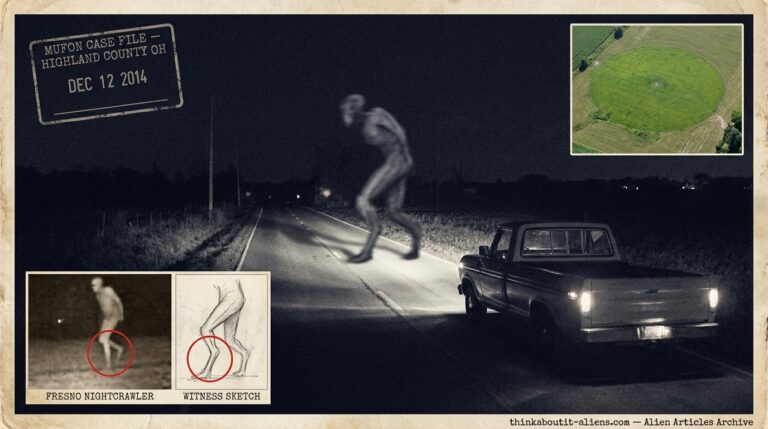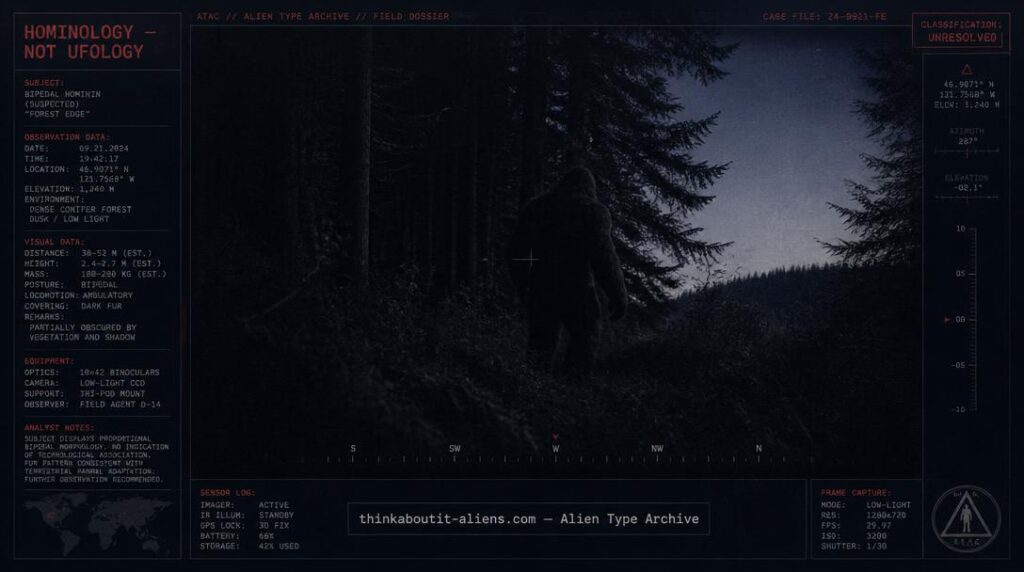
A visual reconstruction of the Homins, correctly framed within the field of hominology rather than ufology.
THINK ABOUTIT’S ALIEN TYPE SUMMARY
Homins
“Homin” isn’t an alien-database term at all — it was coined in the 1970s by Russian researcher Dmitri Bayanov specifically to argue that Bigfoot, Yeti, and their regional counterparts are an as-yet-undiscovered biological hominid, not a paranormal, extraterrestrial, or interdimensional phenomenon.
Name: Homins
AKA: Bigfoot, Sasquatch, Yeti, Yowie, Hibagon, Almas — all real regional names within cryptozoological literature.
Location – Home System: Not applicable — “homin” is a cryptozoological classification for an alleged undiscovered Earth primate, not a species with a claimed extraterrestrial home system. “Possible origin in the Lyra constellation” is not part of the hominology field this term comes from.
Distance from Earth: Not applicable — the entire premise of hominology research is that these are terrestrial, biological animals.
Attitude: Generally described in cryptozoological reports as reclusive and avoidant of humans.
Motives: Not applicable in the framework this term comes from — hominology treats these as wild animals avoiding human contact, not entities with a stated mission.
Physical Appearance: Consistent with typical cryptozoological witness descriptions: a large, bipedal, fur-covered humanoid figure.
- Average Height: Commonly reported in the 7–10 foot range across witness accounts, though estimates vary widely and no specimen has been physically recovered to confirm any figure.
- Average Weight: Commonly estimated in a similar range in secondary cryptozoological sources, though this remains an estimate with no confirmed specimen.
- Body Temperature: Not documented — no confirmed specimen exists to measure.
- Pulse/Respiration: Not documented.
- Blood Pressure: Not documented.
- Life Expectancy: Not documented.
- Hair: Consistently reported across witness accounts as thick body fur, color varying by region (reddish-brown, black, or, for Yeti reports specifically, white to grey).
- Skin: Consistent with typical witness descriptions of dark, leathery visible skin on the face, palms, and soles.
- Eyes: “Eye-shine” in low light is a commonly reported detail in witness accounts.
- Sex: Both male and female individuals have been reported across witness accounts.
Other Physical Information: A pronounced mid-tarsal foot break has been proposed by some footprint researchers (notably Jeff Meldrum) as a distinguishing anatomical feature in purported footprint casts — a real claim within cryptozoological literature, though disputed and unconfirmed by any recovered specimen.
Special Traits and Abilities: Not part of the hominology framework, which treats these as ordinary (if undiscovered) biological animals.
Communication Type: Wood-knocking and high-pitched vocalizations are genuinely and commonly reported in the field research literature.
Origin: Within hominology, treated as a proposed undiscovered terrestrial primate lineage.
Life Form Type: Per the term’s actual coiner (Bayanov), “non-sapiens hominid” — a proposed biological primate, not an interdimensional entity.
Subspecies: Sasquatch, Yeti, Almas, Yowie, Skunk Ape — all real regional names within cryptozoological literature for what researchers in this field propose may be related or separate undiscovered primate populations.
Most Common Species: Sasquatch (North American reports) is the most extensively documented regional case within cryptozoological literature.
Level of Species: Not applicable; no such classification exists within hominology.
Habits: Reported as nocturnal/crepuscular and reclusive.
Transportation Type: Not applicable — no mode of “transportation” beyond ordinary movement is proposed within hominology.
Witnesses Reports: A genuinely large body of witness reports exists across cultures and decades, including the well-known 1967 Patterson-Gimlin film. Researcher David Paulides has separately written about unexplained disappearances in North American national parks (the “Missing 411” body of work), sometimes discussed alongside Sasquatch reports by other researchers, though Paulides himself does not present these as confirmed to be connected.
Special Features/Characteristics: A strong, musky odor is one of the most consistently reported details across witness accounts and is a genuine, recurring element of the field literature.
Summary/Description: “Homin” is a term coined by Russian researcher Dmitri Bayanov to describe Bigfoot, Sasquatch, Yeti, and related regional reports collectively as a proposed undiscovered biological primate lineage — not, as this entry previously claimed, an interdimensional or extraterrestrial phenomenon.
Source: Dmitri Bayanov and the hominology research tradition; the 1967 Patterson-Gimlin film; regional witness reports compiled across decades of cryptozoological literature.
Related Cases: Hairy Dwarfs, another cryptid-adjacent entry in this archive with its own separate sourcing.
DETAILED REPORT
The Homins entry required a category-level correction, not just a fact-level one. “Homin” is a real term, but it comes from hominology — a fringe branch of cryptozoology/primatology whose entire premise is that Bigfoot-type creatures are an undiscovered biological primate, explicitly not paranormal, extraterrestrial, or interdimensional. Attaching “vibrational frequency,” “Lyra constellation origin,” and “dimensional phasing” to this term doesn’t just add unsupported detail — it contradicts the founding premise of the research tradition the term is borrowed from.
Genuine cryptozoological detail (musky odor, wood-knocking, eye-shine, the Patterson-Gimlin film, Meldrum’s mid-tarsal-break footprint claim) was kept, since these are real elements of the actual field literature, distinct from the fabricated alien framing layered on top.
RESEARCHER’S NOTES
Hominology, Not Ufology — A Term Borrowed and Inverted
- Source Chain Assessment: “Homin” traces to a real, named researcher (Bayanov) and a real (if fringe) field of cryptozoological study, entirely separate from any UFO or alien-contact tradition.
- Classification Correction: The entire interdimensional/extraterrestrial framing was removed as directly contradicting the term’s actual founding premise; genuine cryptozoological detail was preserved.
- Pattern Context: This is a distinct failure mode from most entries in this archive — not embellishment on a thin ufology source, but wholesale misapplication of a term from an unrelated research field.
- Evidentiary Weight: No confirmed specimen has ever been recovered; the Patterson-Gimlin film remains disputed within mainstream science; Paulides’ “Missing 411” connection to Sasquatch reports is speculative and not endorsed by Paulides himself as confirmed.
- Geographic/Historical Context: Regional reports span multiple continents and cultures (North America, Himalayas, Australia, Central Asia, Japan), reflecting a genuinely global body of witness testimony regardless of the underlying explanation.
The honest record: “homin” is a real term from a real (if fringe) field of primatology-adjacent cryptozoology, describing a proposed undiscovered biological animal — not an alien, and not an interdimensional being. That distinction is the correction.
Dmitri Bayanov’s own coined term, “non-sapiens hominid,” is the single most load-bearing piece of terminology in this entry, defining the entire field this species classification comes from.
About the Author