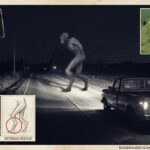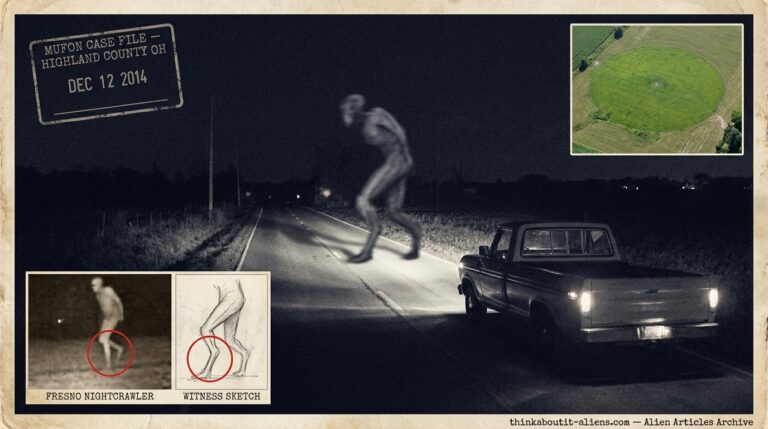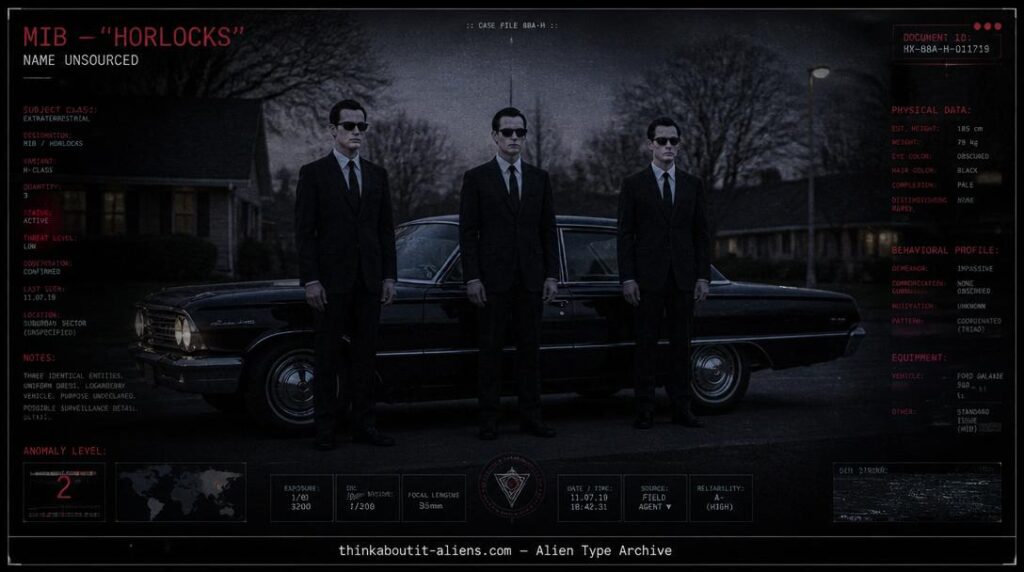
A visual reconstruction of the Men in Black, based on Albert K. Bender's foundational 1953 account
THINK ABOUTIT’S ALIEN TYPE SUMMARY
Horlocks (Men In Black)
In 1953, UFO researcher Albert K. Bender abruptly shut down his organization and its newsletter, later claiming three men in dark suits had silenced him — a story that, by his own account, grew stranger still, involving a planet called Kazik and a secret base beneath Antarctica.
Name: Men In Black (MIB). “Horlocks” does not appear in any primary source located — Bender’s own book is titled Flying Saucers and the Three Men, and no MIB researcher (Bender, Gray Barker, John Keel) uses this name. It is flagged as an unsourced, apparently invented designation.
AKA: MIBs.
Location – Home System: Per Bender’s own account, the beings he encountered claimed to be from a planet called Kazik, with a secret base beneath Antarctica. A separate claim, tracing to Branton-associated material (a single, largely uncorroborated compiler flagged elsewhere in this archive), places a different MIB “center” at Sirius with a claimed subterranean “Atlantean” counterpart beneath the Eastern U.S. seaboard — presented in that source as speculation, and not to be confused with Bender’s own, separate account.
Distance from Earth: Sirius is a real star roughly 8.6 light-years away — accurate as an astronomical fact, but only relevant if the separate, unverified Branton-associated Sirius claim is accepted, which is not the same as Bender’s own Kazik/Antarctica account.
Attitude: Cold, intimidating, and authoritative, consistent across witness accounts including Bender’s own.
Motives: Per the broader MIB folklore tradition, silencing and intimidating UFO witnesses and researchers, consistent with Bender’s own account of being ordered to stop his investigations.
Physical Appearance: Consistently described across witness accounts (including Keel’s) as pale, expressionless men in dark suits.
- Average Height: Not given specific figures in any primary source.
- Average Weight: Not reported in any primary source.
- Body Temperature: Witnesses across the folklore tradition commonly describe MIB as cold to the touch — a genuine recurring detail, though no specific numeric figure is documented anywhere.
- Pulse/Respiration: Not reported in any primary source.
- Blood Pressure: Not reported in any primary source.
- Life Expectancy: Not reported in any primary source.
- Hair: Hairlessness or ill-fitting wigs are a genuine, recurring detail across witness accounts in the broader folklore tradition.
- Skin: Pale, waxy, or plastic-like — a genuine, recurring detail across the folklore tradition.
- Eyes: Often hidden by sunglasses, or described as bulging or expressionless when seen.
- Sex: Almost exclusively reported as male across the folklore tradition.
Other Physical Information: Expressionless faces, monotone speech, and awkward or stiff movement are consistently reported across the folklore tradition, including Bender’s own account.
Special Traits and Abilities: Intimidation and persuasion tactics — phone calls, surprise visits, and confiscation of evidence — are consistently documented across the folklore tradition.
Communication Type: Monotone verbal speech is consistently documented.
Origin: Genuinely unresolved and disputed across the entire MIB tradition — proposed as government agents, extraterrestrials, or something else entirely, with no consensus and no independent confirmation from any government source.
Life Form Type: Disputed across sources — some accounts describe apparently human agents, others (particularly Branton-associated material) speculate about bio-synthetic or “zombie”-type constructs, presented there as speculation.
Subspecies: Not established in any primary source. “Bio-synthetic constructs, Android Enforcers, and Draconian-controlled Humans” are speculative categories from Branton-associated material, not confirmed classifications.
Most Common Species: Not established in any primary source.
Level of Species: Not reported in any source.
Habits: Traveling in groups of three and driving vintage black vehicles are consistently documented across the folklore tradition, including Bender’s own account.
Transportation Type: Vintage black automobiles (commonly cited as Buicks or Lincolns) are a genuine, recurring detail across the folklore tradition. Claims that these vehicles “phase into mountains” trace to Branton-associated material specifically.
Witnesses Reports: Albert K. Bender is the foundational witness. In 1953, as head of the International Flying Saucer Bureau and its newsletter Space Review, Bender abruptly announced he could not publish information he had obtained and shut down the organization, later stating three men in dark suits had visited and warned him into silence. His full account, published as Flying Saucers and the Three Men (1962), describes further experiences involving a planet called Kazik and a secret base beneath Antarctica — an account even sympathetic reviewers have described as moving into “tinfoil hat territory,” and which Bender himself never fully clarified before his death in 2016. Gray Barker separately popularized and expanded on the Bender story. John Keel, in The Mothman Prophecies and elsewhere, documented his own independent encounters and interviews involving MIB-type figures, and concluded he did not believe they were human.
Special Features/Characteristics: Consistently reported: immaculate, unusually “new-looking” black suits and a notable lack of normal human affect, including, in some accounts, an absent blinking reflex.
Summary/Description: Enigmatic figures who intimidate and silence UFO witnesses, tracing to Albert K. Bender’s 1953 account and later independently reinforced by John Keel’s own documented encounters — with no source, including Bender’s or Keel’s own work, ever using the name “Horlocks.”
Source: Albert K. Bender, Flying Saucers and the Three Men (1962); John Keel, The Mothman Prophecies; Gray Barker’s popularizations of the Bender case. Additional Draconian/Sirius/Atlantean material traces to Branton-associated compilation and should be treated with the same caution applied to other Branton-sourced entries in this archive.
Related Cases: Eva Borgs and Hydra Reptilians, other Branton-associated entries in this archive requiring the same sourcing caution.
DETAILED REPORT
The headline finding for this entry is the name itself: “Horlocks” does not appear anywhere in the primary Men in Black literature. Bender’s actual book is titled Flying Saucers and the Three Men, and neither Bender, Barker, nor Keel ever use the term. Rather than quietly building the entry around an unsourced name, this correction flags it directly.
The underlying story is genuinely well-documented, if bizarre in its own telling: Bender really did shut down his UFO research bureau in 1953 after claiming three men in dark suits silenced him, and his fuller 1962 account really does involve a planet called “Kazik” and a claimed Antarctic base — his own claim, not an invention layered on afterward. The Draconian-control, Sirius, and “Atlantean complexes” material was separated out and attributed specifically to Branton-associated writing, distinct from Bender’s or Keel’s documented material.
RESEARCHER’S NOTES
Men in Black — An Unsourced Name on a Real 1953 Case
- Source Chain Assessment: Bender’s 1953 case and 1962 book are real and well-documented; Keel’s independent encounters add a second, separate documented source; Branton-associated material is a third, distinct, and less reliable layer.
- Classification Correction: “Horlocks” was flagged as an unsourced name not found in any primary MIB literature, rather than presented as established terminology.
- Pattern Context: This is a clear example of an entirely invented proper name being used as if it were established terminology — worth checking specifically for elsewhere in this archive.
- Evidentiary Weight: Bender’s own account is internally bizarre enough that even sympathetic reviewers flag it as extreme; Keel’s independent encounters add a second data point but no physical evidence exists from either.
- Geographic/Historical Context: The MIB phenomenon as documented spans from Bender’s 1953 case through Keel’s 1960s-70s investigations to the present day, one of the longest-running documented folklore traditions in American ufology.
The honest record: a real, bizarre, well-documented 1953 case and a real, independent second witness (Keel) — with an entry name (“Horlocks”) that, after a real search, does not appear to trace to either of them or to any other primary source.
Bender stated that three men wearing dark suits had ordered him to stop publishing flying saucer material, and that he complied because he had been “scared to death” of them
— his own words, as reported in secondary accounts of his case.
About the Author