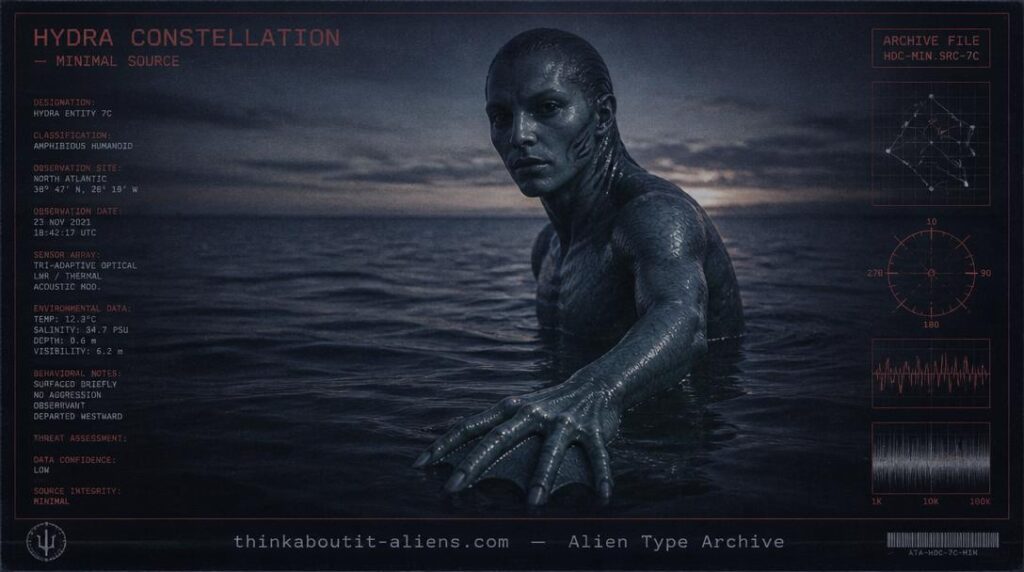
A visual reconstruction of the Hydra Reptilians, documented in only a minimal original source template.
THINK ABOUTIT’S ALIEN TYPE SUMMARY
Hydra Reptilians
The entire documented record for this entry amounts to a brief physical description — roughly human-sized, scaled, webbed, gilled — plus a nod to the Hydra, Python, and Typhon of Greek mythology. Everything more elaborate than that was added without a source.
Name: Hydra Reptilians
AKA: Not reported in any source. “Hydran Nagas” and “Beta Hydrae Aquatics” are not found in the source and are fabricated labels.
Location – Home System: Per the source, associated with the constellation Hydra (the Sea Serpent), specifically named star systems Beta Hydrae, Epsilon Hydrae, and N Hydrae.
Distance from Earth: Not given in the source. The “100 to 180 light-years” figure in a prior draft does not match the real astronomical distances of the named stars — Beta Hydrae is roughly 365 light-years away and Epsilon Hydrae roughly 135 light-years away — so even as an approximation, the figure is inaccurate to the stars it claims to describe.
Attitude: Not reported in the source.
Motives: Not reported in the source.
Physical Appearance: Per the source: humanoid sea-serpents, roughly 5 to 6 feet tall, with scaled skin, gills, and webbed fingers and/or toes.
- Average Height: Roughly 5 to 6 feet, per the source.
- Average Weight: Not reported in the source.
- Body Temperature: Not reported in the source.
- Pulse/Respiration: Not reported in the source.
- Blood Pressure: Not reported in the source.
- Life Expectancy: Not reported in the source.
- Hair: Not reported in the source.
- Skin: Scaled, per the source; specific coloring is not given.
- Eyes: Not reported in the source.
- Sex: Not reported in the source.
Other Physical Information: A species living in or near water, with scaly, webbed hands and feet, as well as gills, per the source.
Special Traits and Abilities: Not reported in the source; bioluminescence, infrasonic manipulation, and hydrostatic resistance are all fabricated.
Communication Type: Not reported in the source.
Origin: Not reported in the source beyond the constellation association noted above.
Life Form Type: “Aquatic reptilian,” per the source.
Subspecies: Not reported in the source; “Naga-Type” and “Bipedal-Type” are fabricated categories.
Most Common Species: Not reported in the source.
Level of Species: Not reported in the source.
Habits: Not reported in the source; “Pod-Clans,” geothermal outposts, and water-oxygenation monitoring are fabricated.
Transportation Type: Not reported in the source; “living” submersibles and water-propulsion craft are fabricated.
Witnesses Reports: None documented. “Fishermen in the Bermuda Triangle,” deep-sea divers, and military sonar technicians reporting USOs are generic, unattributed claims with no named case, date, or location, and are flagged as fabricated. “Historical naval records from the 17th-19th centuries,” cited as a source in a prior draft, are not identified by any specific record, ship, or date.
Special Features/Characteristics: Not reported in the source; a secondary heavy-metal-filtering circulatory system and triple-lidded eyes are fabricated.
Summary/Description: A minimally-documented humanoid sea-serpent species associated with the constellation Hydra, linked in the source only to general cross-cultural serpent-deity mythology, with almost no other detail available.
Source: A brief, largely blank entry template (mirrored on this site’s own earlier network) offering only a general physical sketch and a mythological reference — no named contactee, witness, or compiled reference book could be located beyond this.
Related Cases: Other extremely thin single-paragraph entries in this archive, e.g. Elffaf, Hav-Hannuae-Kondras.
DETAILED REPORT
The Hydra Reptilians entry, checked against this site’s own earlier network archive, confirms an almost entirely blank original template: humanoid sea-serpents, roughly 5 to 6 feet tall, scaled, webbed, gilled — plus a genuine and accurate reference to Greek serpent mythology (Hydra, Python, Typhon). Nearly every other field in the prior draft was fabricated on top of that thin base.
One specific inflation is worth noting: even the “100 to 180 light-years” distance figure, offered as loose scientific flavor, doesn’t match the real astronomical distances of the actual named stars (Beta Hydrae at roughly 365 light-years, Epsilon Hydrae at roughly 135). Pseudo-precision that doesn’t even match the real astronomy it’s borrowing from is a distinct and useful category of error to flag.
RESEARCHER’S NOTES
The Sea Serpent Entry — A Blank Template and a Wrong Distance
- Source Chain Assessment: The entire record traces to a single, largely blank compiled template, confirmed to match this site’s own earlier network archive — no additional or independent sourcing exists anywhere.
- Classification Correction: A serpentine-tailed body form, specific biometrics, and an invented subspecies system were all removed; the distance figure was flagged as inaccurate even relative to the real stars it references.
- Pattern Context: The mismatched real-astronomy distance figure is a specific, checkable category of fabrication — worth flagging distinctly from generic unsupported claims, since it demonstrates borrowed “precision” that doesn’t survive a basic fact-check.
- Evidentiary Weight: None; no named witness, case, date, or location is documented anywhere in the sourced material.
- Geographic/Historical Context: The cross-cultural serpent-deity connection (Greek, Babylonian, and broader ancient Near Eastern traditions) is real and independently documented mythology, distinct from and not evidence for the modern “alien” framing layered on top of it.
The honest record: a nearly blank original template, confirmed against this site’s own earlier archive, describing a scaled, webbed, roughly human-sized sea-serpent humanoid — with a real mythological connection worth keeping and almost everything else fabricated on top of it.
No verifiable direct quotation could be confirmed for this entry; the source’s own description — “a species that live in or near water” with “scaly webbed feet and hands, as well as gills”
— is presented above as reported fact rather than as an invented quotation.
About the Author