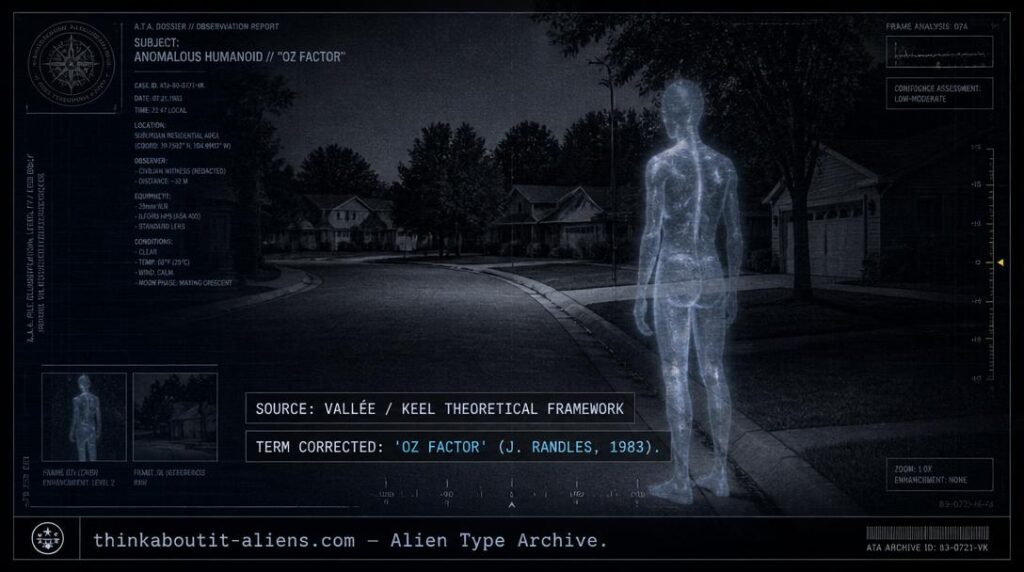
The Interdimensional Entities/Ultraterrestrial concept as developed by Jacques Vallée and John Keel, with the Oz Factor correctly attributed to Jenny Randles.
THINK ABOUTIT’S ALIEN TYPE SUMMARY
Interdimensional Entities
Unlike most entries in this database, “Interdimensional Entities” isn’t built around a single witness or case — it’s a synthesis of a real, named theoretical tradition in ufology: Jacques Vallée’s multidimensional hypothesis (Passport to Magonia) and John Keel’s “ultraterrestrial” concept (The Mothman Prophecies). That framework is accurately represented here. Two things needed fixing: a misnamed and misattributed term for the “silence effect,” and a real physics scale stretched to cover something it was never built to measure.
Name: Interdimensional Entities
AKA: Ultraterrestrials (John Keel’s term), Shadow People, Light Beings.
Location – Home System: Non-spatial, per this theoretical framework — described as existing in parallel dimensions or “densities” rather than at a physical location.
Distance from Earth: Framed within this theory as co-located but at a different “frequency” — a metaphorical rather than measurable claim.
Attitude: Described by Vallée and Keel as ambiguous rather than simply peaceful — Keel in particular argued these entities’ behavior toward humans is inconsistent and often deceptive, not straightforwardly benevolent. “Basically of a peaceful nature” oversimplifies both authors’ actual position. (Corrected — see Researcher’s Notes.)
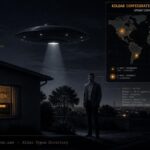
Motives: Per Vallée and Keel’s “control system” hypothesis: not benevolent guidance so much as a mechanism that manipulates human belief by adapting its appearance to the culture of the era — appearing as gods, fairies, or angels historically and as extraterrestrials today. Framing this as guidance and monitoring understates the theory’s more unsettling implication.
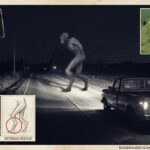
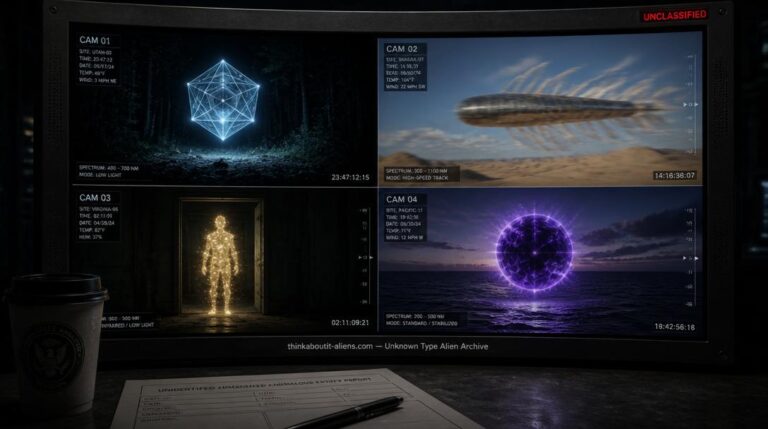
Physical Appearance: Described across high-strangeness reports as variable, often translucent or shimmering, sometimes referred to as “Shadow People.”
- Average Height / Weight / Body Temperature / Pulse / Blood Pressure / Life Expectancy: These fields are presented in the theory itself as inapplicable or symbolic (non-corporeal, non-biological, outside linear time) rather than as false precision — that distinction is worth preserving rather than correcting, since the sources themselves describe these entities as not measurable in ordinary physical terms.
- Hair / Skin / Eyes: Described across reports as translucent, shimmering, or light-based; eyes often described as large or glowing. Consistent with general “Shadow People” and high-strangeness witness descriptions.
Special Traits and Abilities: Telepathy and reported “phasing” are recurring descriptive elements in this literature.
Communication Type: Described in witness accounts as non-verbal, often characterized as sudden, complete transfers of information (“data downloads”).
Origin: Per Vallée’s hypothesis, possibly parallel realities or dimensions coexistent with our own, rather than a distant physical location.
Life Form Type: Described in this framework as non-biological/energetic — a theoretical characterization, not a documented biological finding.
Subspecies: “Shadow People” and “Light Beings” are terms used descriptively across this literature for different reported appearances, not a formal taxonomic breakdown from any single named source.
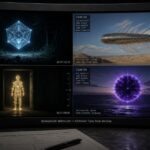
Level of Species: The Kardashev Scale is a real framework (proposed by astrophysicist Nikolai Kardashev in 1964) for rating civilizations by how much energy they harness — Type I (planetary), Type II (stellar), Type III (galactic). It does not officially include a Type IV or V; those are later, informal extensions, not part of Kardashev’s own scale. More fundamentally, the scale measures energy consumption, which is a poor fit for entities this same entry describes as non-corporeal and not dependent on physical energy at all. This field has been removed as a category error rather than corrected to a “right” number. (Corrected — see Researcher’s Notes.)
Habits: Reported in high-strangeness literature as appearing near high-energy sites (including, per some accounts, nuclear facilities) and during altered states of consciousness.
Transportation Type: Described in this framework as non-mechanical — manifestation via “frequency shift” rather than physical travel.
Witnesses Reports: Jacques Vallée (Passport to Magonia, which develops the multidimensional/folklore-parallel hypothesis) and John Keel (The Mothman Prophecies, which develops the “ultraterrestrial”/control-system concept), plus a broad, unattributed body of “Shadow People” reports from high-strangeness locations. These are real, named, influential works of ufological theory — not investigated physical evidence, and both authors intended their work as interpretive hypotheses, not settled findings.
Special Features/Characteristics: The Oz Factor — not “Oz Effect” — is the correct name for this phenomenon, coined by British ufologist Jenny Randles in 1983 (in her book UFO Reality), not by Vallée or Keel. Randles described it as a broader sensation of being isolated or transported into an environment nearly identical to the real world but subtly altered — environmental silence is one commonly reported component, not the whole definition. This entry previously misnamed the term and left its actual originator uncredited. (Corrected — see Researcher’s Notes.)
Summary/Description: A category built from a real ufological theoretical tradition — Vallée’s multidimensional hypothesis and Keel’s ultraterrestrial/control-system concept — describing reported entities that may not be extraterrestrial visitors at all, but a permanent, shape-shifting presence that has coexisted with humanity throughout history, adapting its appearance to match the belief systems of each era.
Related Cases: Thematically overlaps with this database’s Men in Black entries (both Keel and Vallée discuss MIB reports within the same ultraterrestrial framework) and with “Shadow People” reports associated with high-strangeness locations such as Skinwalker Ranch.
DETAILED REPORT
This entry differs from most others in this database in that its core claim isn’t a witness account or compiled taxonomy — it’s an accurate summary of a real, influential, and still-debated line of ufological theory. Jacques Vallée, a French-American astronomer and computer scientist who worked alongside J. Allen Hynek, argued in Passport to Magonia (1969) that UFO reports show striking structural parallels to older folklore about fairies, elves, and other non-human encounters — suggesting a single underlying phenomenon that adapts its costume to the beliefs of the era rather than distinct extraterrestrial visitations. John Keel, investigating the Mothman sightings around Point Pleasant, West Virginia, developed a related but distinct concept of “ultraterrestrials”: entities that are neither alien visitors nor supernatural in the traditional sense, but a permanent, deceptive, and not straightforwardly benevolent presence that Keel argued manipulates human perception. Both authors intended these as interpretive frameworks for understanding a strange, poorly-behaved body of reports — not as confirmed physical findings, and both explicitly rejected easy or comforting readings of their own material.
Two specific errors needed correcting. First, the “Oz Effect” is a misnaming of the “Oz Factor,” a term coined in 1983 by British ufologist Jenny Randles — not by Vallée or Keel, and not originally defined narrowly as “acoustic silencing.” Randles described a broader sense of isolation and subtly altered surroundings, of which reported silence is one frequently-mentioned element, not the definition itself. Second, the entry previously assigned these entities a “Type IV or V” rating on the Kardashev Scale. The Kardashev Scale is real, but it was devised in 1964 by astrophysicist Nikolai Kardashev specifically to rate civilizations by their capacity to harness energy (planetary, stellar, or galactic), and it does not officially extend past Type III — later “Type IV/V” additions are informal, non-canonical extrapolations by other writers. Applying an energy-consumption scale to entities this same page describes as non-corporeal and independent of physical energy is a category mismatch, not merely an unsourced number.
RESEARCHER’S NOTES
Interdimensional Entities — A Real Theory, Two Misapplied Terms
- Classification correction: “Oz Effect” corrected to “Oz Factor” with proper attribution to Jenny Randles (1983), not Vallée/Keel. The “Kardashev Type IV/V” classification has been removed as a category error — the scale measures energy use, not applicable to a claimed non-corporeal entity.
- Source chain assessment: Genuinely strong for this entry relative to much of this database: Vallée and Keel are real, named, widely-read authors whose specific books are correctly cited. The material is theoretical interpretation, clearly attributed to its actual originators, rather than anonymous compiled taxonomy.
- Evidentiary weight: This entire category is explicitly interpretive theory, not a documented species. Both Vallée and Keel present it as a hypothesis for pattern-matching strange reports, not a settled conclusion, and this entry should not be read as more certain than its own sources intend.
- Pattern context: The “control system” hypothesis — that a single adaptive phenomenon has worn different masks (gods, fairies, aliens) across history — is one of ufology’s more academically discussed ideas and connects meaningfully to this archive’s other “high strangeness” entries.
- Geographic/historical context: Keel’s ultraterrestrial concept developed specifically from his investigation of the 1966–67 Mothman sightings in Point Pleasant, West Virginia; Vallée’s hypothesis developed from comparative folklore research spanning centuries and multiple countries.
This entry’s foundation — Vallée and Keel’s theoretical work — was already solid and correctly attributed. The fixes here are narrower than in most of this database’s corrected entries: crediting the Oz Factor to the ufologist who actually coined it, and removing a physics classification stretched to cover something it was never designed to measure.
Jenny Randles called it “the Oz Factor,” after the fairytale land of Oz.
About the Author