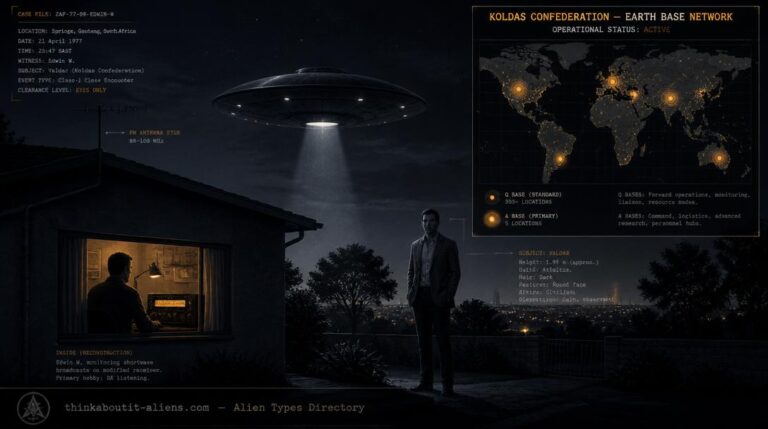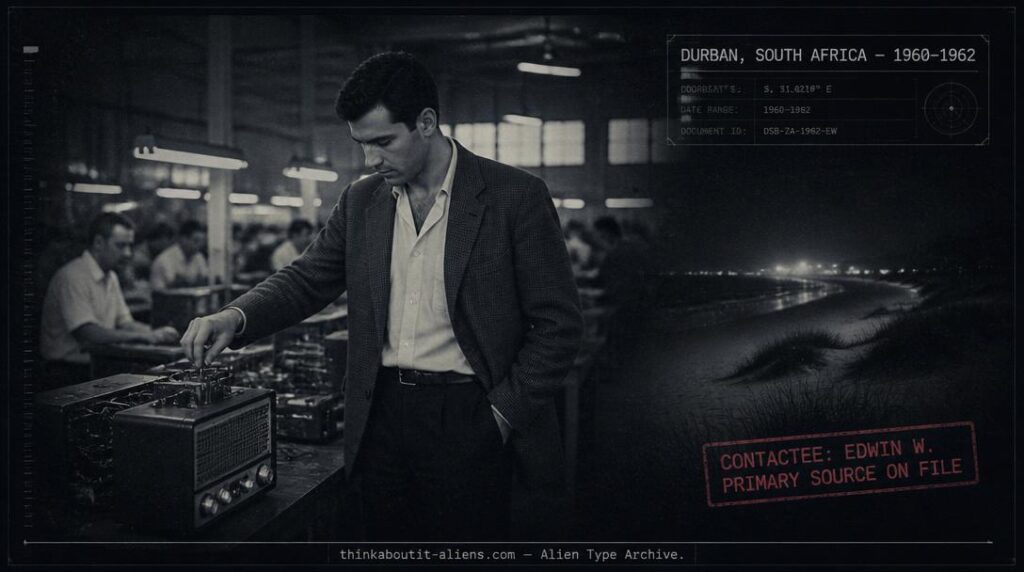
A dossier-style illustrative rendering of Valdar, using his Earth alias "George K.," as described in Edwin W.'s primary account of the Koldas contact case.
THINK ABOUTIT’S ALIEN TYPE SUMMARY
Koldas
In 1960, a Durban radio factory hired a new technician who introduced himself as George K. — tall, dark-haired, unremarkable, a good fisherman and a better colleague — and three months later he asked his new friend Edwin a question that would define the next twenty years of his life: what did he think about the possibility of life in outer space?
Name: Koldas — the name applies to both the planet and its inhabitants, the Koldasians.
AKA: Koldasians. Their home civilization is referred to in primary testimony as the “Confederation of Twelve Planets.”
Location – Home System: Planet Koldas. Primary testimony describes it as existing in another “dimension” — the published transcripts substitute the word “Universe” throughout, but the book’s own editorial footnote states this was a terminology compromise: early human listeners in the contact group could not accept “dimension” as the extraterrestrials’ own term and requested “Universe” be used instead.
Distance from Earth: Not applicable in conventional spatial terms. Described in sourcing as reached via “timeless tunnels” connecting dimensions rather than physical distance.
Attitude: Described in primary testimony as peaceful. Valdar is directly quoted stressing that “they come in peace,” and a Koldasian named Wy-Ora states that Koldas maintains no armaments for offensive purposes.
Motives: Per Valdar’s own account, members of the Confederation reportedly brought some of Earth’s population to this planet roughly 70,000 years ago — an origin claim made within the testimony itself, not independently corroborated. Ongoing contact is framed in the source as relationship-building and periodic assistance rather than any stated agenda.
Physical Appearance: No species-wide description exists. Two named individuals are directly described in primary testimony: Valdar, using the Earth alias “George K.” while embedded in Durban society, and Clyveen, his fiancée.
- Average Height: No species average is given. Valdar is individually described as tall, just under two meters. Clyveen is described only as “tall.”
- Average Weight: Not specified in sourcing.
- Body Temperature: Not specified in sourcing.
- Pulse/Respiration: Not specified in sourcing.
- Blood Pressure: Not specified in sourcing.
- Life Expectancy: Not specified in sourcing.
- Hair: Individually described only — Valdar: dark hair. Clyveen: fair hair. No species-wide pattern is stated.
- Skin: Individually described only — Clyveen: fair-skinned. Not specified for Valdar beyond “an ordinary guy” in appearance.
- Eyes: Individually described only — Clyveen: blue. Not specified for Valdar.
- Sex: Male and female, per the two individuals directly described.
Other Physical Information: Valdar is described as having a round, open face, well-built, and appearing approximately 30 years old — indistinguishable from an ordinary human colleague to the point that Edwin worked alongside him for months without suspicion.
Special Traits and Abilities: In one documented later session, Valdar reportedly demonstrated the ability to perceive through Edwin’s own eyes remotely during a transmission — a specific claim made within the source rather than a general species trait.
Communication Type: Evolved significantly over the course of contact: in-person conversation for approximately two years, followed by radio transmissions (reportedly numbering in the thousands over the following two decades) via a standard radio receiver modified by Valdar, later a direct voice channel using “Edwin’s physical senses to transmit and receive,” and eventually transmissions captured via a modified portable cassette recorder.
Origin: Planet Koldas, part of a “Confederation of Twelve Planets,” per Valdar’s own testimony.
Life Form Type: Human-passing in appearance, per direct eyewitness testimony. No biological distinction from humans is described anywhere in the primary source.
Subspecies: None documented.
Most Common Species: Not specified in sourcing.
Level of Species: No classification is offered in any source. Not applicable.
Habits: While embedded on Earth, Valdar worked as a radio technician and regularly went fishing with Edwin at Patterson’s Groyne, Durban. On Koldas, Valdar is described visiting a food research station where Clyveen’s parents lived during his rest periods.
Transportation Type: A spacecraft directly witnessed by Edwin on the beach near the Bluff, Durban, at Valdar’s Easter 1962 departure. Extensive further craft and technology detail exists within the primary source and may warrant a dedicated case write-up beyond this summary profile.
Witnesses Reports: Full documented case: Edwin W. (contactee), Durban, South Africa. Contact began in 1960 when Valdar, using the alias “George K.,” was hired at the same radio-manufacturing factory as Edwin and worked alongside him for approximately three months before disclosing his origin. In-person contact continued for roughly two years. Valdar departed via a witnessed spacecraft near the Bluff, Durban, at Easter 1962, promising continued contact. Contact resumed and continued for approximately two decades through the escalating methods described above. Investigated and documented by Carl van Vlierden, who spent nearly seven years arranging a meeting with Edwin, and by Cynthia Hind, with the full account published by Vlierden and Wendelle C. Stevens.
Special Features/Characteristics: Before departing, Valdar changed from Earth clothing into a tight-fitting, light-blue Koldasian uniform, described by Edwin as resembling a track suit with a front fastener.
Summary/Description: The Koldas, or Koldasians, are human-passing beings from a planet described as belonging to a “Confederation of Twelve Planets” in another dimension. The fullest documented case is that of Edwin W. of Durban, South Africa, who worked alongside a Koldasian named Valdar — using the alias “George K.” — for roughly two years beginning in 1960, before Valdar’s witnessed departure by spacecraft at Easter 1962. Contact continued for approximately two decades afterward through radio transmissions and, later, direct communication methods. No species-wide physical description exists; only individual eyewitness accounts of specific named Koldasians are documented.
Source: Carl van Vlierden & Wendelle C. Stevens, UFO Contact from Planet Koldas (full text on file); Exopaedia, “Koldas” (secondary compilation); cross-referenced via Jake Muller, A Guide to ETs/Star Nations and Beings, Vol. 1 (2023).
Related Cases: Very likely the same underlying case as the “Dals” claim documented elsewhere in Muller’s guide (contactee Edward F. White, Durban, South Africa) — shared location, shared roughly two-decade radio-contact arc, and the same two researchers, Vlierden and Stevens, credited on both.
DETAILED REPORT
The earlier correction to this page relied on Muller’s condensed summary of a secondary Exopaedia compilation, which offered little beyond a planet name, an undefined “antimatter universe” framing, and a bare-bones account of a South African contact case. With the primary source now on file — Carl van Vlierden and Wendelle C. Stevens’ UFO Contact from Planet Koldas — this entry can be rebuilt on considerably firmer ground.
The documented case begins in 1960, when a new radio technician introduced himself to contactee Edwin W. as “George K.” at a Durban factory. Edwin later described him plainly: tall, just under two meters, well-built, a round open face, dark hair, apparent age around 30 — indistinguishable from any ordinary colleague. The two became close over several months of shared work and fishing trips before “George” began steering conversation toward the possibility of life in outer space, eventually revealing himself as Valdar, a visitor from the planet Koldas. Physical contact continued for roughly two years, during which Valdar spoke at length about his home world, its “Confederation of Twelve Planets,” and a claim that Confederation members had brought some of Earth’s population to this planet approximately 70,000 years ago. Valdar departed by spacecraft, witnessed directly by Edwin, near the Bluff outside Durban at Easter 1962 — changing beforehand from Earth clothing into a tight-fitting, light-blue Koldasian uniform.
Contact resumed afterward and continued for close to two decades, evolving through several methods: a modified standard radio receiver Valdar had given Edwin before departing, a later direct voice channel that used “Edwin’s physical senses to transmit and receive,” and eventually a modified portable cassette recorder. The book’s own preface notes the case is unusual for having been “carefully investigated and documented by highly competent and well experienced long time UFO investigators” — specifically Carl van Vlierden, who spent nearly seven years working to arrange a personal meeting with Edwin, and Cynthia Hind, both cited as unable to refute the volume of evidence they examined.
One detail directly resolves a gap flagged in the earlier version of this page. Muller’s review noted that neither “antimatter” nor “universe” nor “parallel” was ever explained in the source he consulted. The primary book explains it directly, in its own editorial footnote: the extraterrestrials’ actual term was reportedly “dimension,” but early members of the contact group found that term difficult to accept and requested “Universe” be substituted throughout the transcripts. That substitution, not a literal astrophysical antimatter claim, is the likely origin of the “antimatter universe” language that has circulated in secondary compilations since.
This source also substantially firms up the connection to this archive’s flagged “Dals” material. The Dals case, as summarized in Muller’s guide, involves a South African contactee named Edward F. White, also from Durban, also maintaining roughly two decades of radio contact with beings from a planet called Koldas, documented by the same two researchers — Vlierden and Stevens. Between the shared location, shared timeline, shared planet name, and shared research team, this is very likely one case circulating under two different contactee-name attributions rather than two independent events.
It’s worth noting plainly that this source is not a short encounter report. It runs to a full-length narrative spanning years of transmissions, introduces multiple named Koldasians and other Confederation-affiliated beings, and eventually develops into an extended interplanetary conflict narrative involving other named worlds. That scope is closer to an ongoing contact diary than a single documented incident, which is worth bearing in mind when weighing how much independent verification exists for any single claim within it — the detail is real and sourced, but it comes from one continuous account rather than multiple independent witnesses.
RESEARCHER’S NOTES
Primary Source Located — Rebuilding Koldas From the Original Case File
- A Substantial Upgrade: This correction moves the entry from a thin, Exopaedia-derived summary to material drawn directly from the original case file, adding named individuals, physical descriptions, specific dates, and a documented investigation history.
- Physical Description Restored, Correctly Scoped: Real eyewitness physical descriptions exist for Valdar and Clyveen specifically. They are presented here as individual descriptions, not converted into invented species-wide biometric averages the way the earlier fabricated draft did.
- The “Antimatter Universe” Language, Explained: The primary source’s own editorial footnote clarifies that “Universe” was substituted for the extraterrestrials’ original term, “dimension,” at the request of early human listeners. This directly resolves the gap Muller’s thinner secondary source left unaddressed.
- The Dals Cross-Reference, Effectively Resolved: Shared location, shared contact-duration pattern, and shared research team (Vlierden and Stevens) make it very likely that the “Dals” claim elsewhere in this archive’s sourcing describes the same case under a different contactee-name attribution. Formal merging awaits a dedicated Dals entry.
- Scale and Genre, Worth Bearing in Mind: The source is an extensive, multi-year narrative involving numerous named Confederation-affiliated civilizations and an interplanetary conflict arc. It reads closer to an ongoing contact diary than a single-incident case report — real and sourced, but drawn from one continuous account rather than independently corroborated witnesses.
Corrected from a thin, undefined secondary summary to a properly sourced case file — named individuals, real dates, a documented investigation, and an honest accounting of just how large and unusual the underlying source material actually is.
“I would say he was just under two meters tall.” — Edwin W., describing Valdar, in Carl van Vlierden & Wendelle C. Stevens, UFO Contact from Planet Koldas
About the Author