A real, carved tradition — and a real, decades-long argument about what it actually proves.
THINK ABOUTIT’S ALIEN TYPE SUMMARY
Nommo
The Nommo sit at the crossing point of two very different kinds of source: a genuinely disputed, decades-old anthropological controversy over what the Dogon people of Mali actually knew and when they knew it, and a separate set of modern channeled and SSP-veteran claims that don’t agree with each other either. Robert Temple’s famous 1976 case for ancient Sirian contact has been challenged for just as long by anthropologists who found no independent trace of the astronomical tradition he described. Neither layer supports the invented biometric panel, named subspecies, or “Grade 4” classification this page previously carried.
Name: Nommo
AKA: Masters of the Water, the Monitors, the Teachers
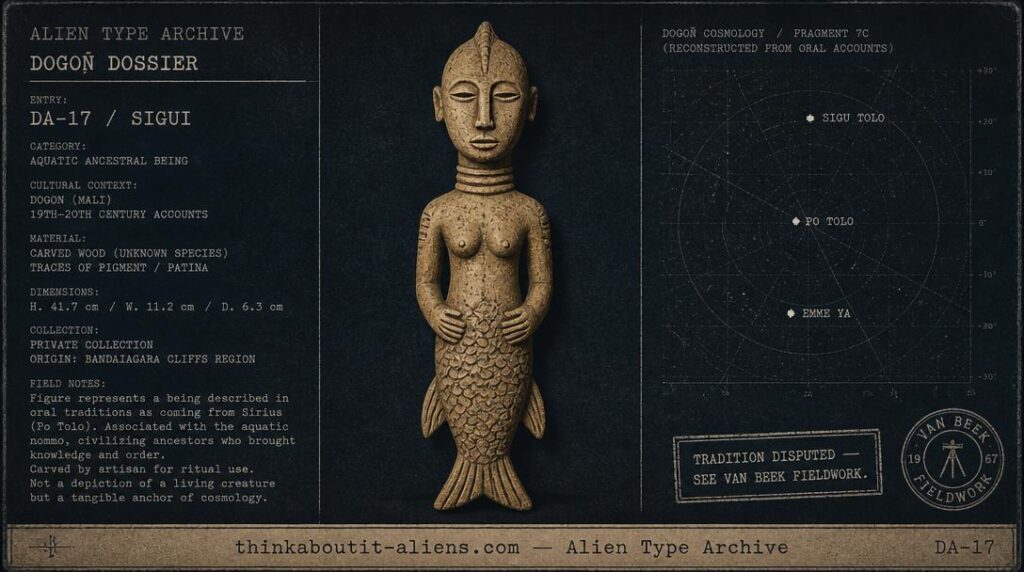
Location – Home System: Sources genuinely disagree. One account places their origin generally in the Sirius system. Another states their homeworld is a Sirius-system planet, described as mostly warm, aqua-blue water. A third, more detailed account names their original home as Nyan, a planet in the Thula (Sirius B) system, from which they were later driven by conflict and relocated to a terraformed world called Xylanthia, in the Emerya (Sirius C) system.
Distance from Earth: Approximately 8.6 light-years (the real, measured distance to the Sirius system)
Attitude: Described across sources as instructive and protective, credited with teaching early human civilizations and, in one account, currently serving as guardians maintaining Earth’s biosphere
Motives: Teaching early human civilizations writing, astronomy, and other foundational knowledge, per the long-standing Dogon-derived tradition; ongoing biosphere guardianship, per a separate channeled account
Physical Appearance: Consistently described, across both the traditional Dogon-derived material and this archive’s own sources, as amphibious beings resembling mermen and mermaids — human-like above the waist, fish-like below. Skin is described as mainly green, though capable of shifting through other colors, including “all the colors of the rainbow.” No source supports the specific biometric figures, amber eyes with nictitating membranes, visible gill slits, or webbed fingers previously listed on this page.
- Average Height: Undocumented
- Average Weight: Undocumented
- Body Temperature: Undocumented
- Pulse/Respiration: Undocumented
- Blood Pressure: Undocumented
- Life Expectancy: Undocumented
- Hair: Undocumented
- Skin: Mainly green, capable of shifting through other colors
- Eyes: Undocumented
- Sex: Described as hermaphroditic in some renderings of the traditional Dogon-derived material, and separately as androgynous in a more recent channeled account — the two terms are not necessarily equivalent and are presented here as they appear in each source
Other Physical Information: Folk-art depictions consistently show a humanoid upper torso with legs or arms and a fish-like lower torso and tail
Special Traits and Abilities: A highly advanced use of sound is attributed to them in one account; no specific ability beyond this is documented
Communication Type: Undocumented in detail
Origin: See Location above — accounts genuinely disagree on the specific planet and even star within the Sirius system
Life Form Type: Amphibian, described as half-man, half-fish
Subspecies: None documented in this archive’s sources. No source supports the “Surface Monitors” or “Deep-Water Guardians” castes previously listed here.
Most Common Species: Not applicable
Level of Species: Undocumented
Habits: Credited, per the long-standing Dogon-derived tradition, with teaching writing, astronomy, and other foundational knowledge to early human civilizations. One SSP-veteran source describes them simply as “3D real” and as “Amphibians with ships.”
Transportation Type: Described in the Dogon-derived tradition as arriving in an “ark,” said to have descended amid thunder and wind; no further technical detail is independently confirmed
Witnesses Reports: The primary account traces to the Dogon people of Mali, as recorded by French anthropologists Marcel Griaule and Germaine Dieterlen in the 1930s–40s and later popularized by Robert Temple’s The Sirius Mystery (1976). This tradition remains genuinely disputed: anthropologist Walter Van Beek, who conducted later fieldwork among the Dogon, found no general community tradition of an invisible companion star and concluded the detailed astronomical lore likely emerged from Griaule’s own dialogue with a single informant rather than reflecting widespread Dogon belief; astronomer Ian Ridpath and others have separately suggested the Dogon’s apparent knowledge of Sirius B may trace to contact with 19th- and 20th-century European astronomers. Separately, SSP veteran Penny Bradley confirms awareness of the Dogon Nommo tradition and describes the beings as “3D real.”
Special Features/Characteristics: In the Dogon tradition, Sirius B is called Po Tolo, described as extremely small yet the heaviest thing in existence — a description that does correspond to the real density of white dwarf stars, whatever the ultimate origin of the knowledge. A third star, called Emme Ya (identified with the hypothesized Sirius C), is also named in this tradition. The Dogon Sigui ceremony is tied to Sirius B’s orbital cycle, though sources differ on whether the ceremony’s cycle is 50 or 60 years, a discrepancy unresolved in the secondary literature.
Summary/Description: The Nommo are documented through a combination of a long-standing, heavily disputed anthropological tradition — the Dogon people’s reported knowledge of the Sirius system, popularized by Robert Temple and challenged by later fieldwork finding no independent trace of it — and a set of more recent, mutually inconsistent channeled and SSP-veteran accounts describing them as guardian or teacher figures tied to Sirius. These sources do not agree on the Nommo’s specific planet of origin, and the biometric, technological, and classificatory detail previously presented on this page has no basis in any of them.
Source: Exopaedia website (Nommo entry); Penny Bradley, personal communication; this site’s own prior “Nommo” material (source undocumented); El (Ileana) Ka, Messages from a Star Traveler website; Elena Danaan, A Gift from the Stars, 2020, p. 110 — all as presented and cross-referenced in Jake Muller, A Guide to ETs/Star Nations and Beings (M–Z), Vol. 2, 2024, pp. 89–90. Broader background: Marcel Griaule and Germaine Dieterlen, “Un système soudanais de Sirius” (1950); Robert K. G. Temple, The Sirius Mystery (1976); Walter E. A. Van Beek’s critical fieldwork response.
Related Cases: None documented.
DETAILED REPORT
The Nommo entry rests on two layers of material that this archive treats separately rather than blending into one settled account. The older and better-known layer is the Dogon Sirius tradition, first published by French anthropologists Marcel Griaule and Germaine Dieterlen in 1950 and popularized by Robert Temple’s 1976 book The Sirius Mystery. In this account, the Nommo are amphibious beings, half-man and half-fish, who arrived on Earth in a mythic “ark” amid thunder and wind, and taught the Dogon detailed knowledge of the Sirius star system — including Sirius B (called Po Tolo, “smallest seed and star,” described as extraordinarily dense) and a third, then-unconfirmed star, Emme Ya, later associated with the hypothesized Sirius C. The Dogon Sigui ceremony is tied to this cosmology, though published sources disagree on whether its cycle runs 50 or 60 years. This tradition is also linked, by Temple and others, to similar amphibious “teacher” figures in other ancient cultures, notably the Babylonian Oannes, described by the Hellenistic writer Berossos as a part-man, part-fish being who emerged from the Persian Gulf to teach civilization to the Sumerians.
This tradition is also one of the most contested in twentieth-century anthropology. Griaule and Dieterlen themselves did not claim to explain how the Dogon could have known Sirius B’s properties before its telescopic discovery in 1862. Later fieldwork by anthropologist Walter Van Beek found no general Dogon tradition of an invisible companion star at all, and concluded that the detailed cosmology Griaule recorded likely emerged from his own close dialogue with a single, unusually elaborate informant rather than reflecting community-wide belief. Astronomer Ian Ridpath and others have proposed that whatever accurate astronomical knowledge does appear in the record may trace to contact with 19th- and 20th-century European astronomical expeditions to the region. This archive presents the tradition as genuinely disputed rather than as settled fact.
Separately, this archive’s own more recent sources describe the Nommo in ways that do not fully agree with each other or with the older Dogon material. SSP veteran Penny Bradley, speaking generally in support of the Dogon account, describes the Nommo as “3D real” and as “Amphibians with ships.” A second source describes the Nommo’s homeworld only as a warm, aqua-blue-water planet somewhere in the Sirius system, and casts them as guardians of a group of “Etheric Sirians” — souls who took up residence in dolphin, whale, and mermaid or merman bodies after their original home, Sirius B, “imploded.” A third, more detailed account instead places their original homeworld at Nyan, in the Thula (Sirius B) system, and describes them being driven out by conflict with an “Orion Alliance” before resettling on a terraformed aquatic world called Xylanthia, in the Emerya (Sirius C) system — a planet said to experience no night at all, owing to light from three stars. This last account also describes renewed Nommo contact with early Terran civilizations (Sumer, Babylon, Akkad, Egypt, and the Dogon) around five thousand years ago, ended by the intervention of a reptilian empire.
None of these accounts is reconciled with the others, and none supports the detailed biometric panel, named subspecies, or “Grade 4” species classification previously presented on this page.
RESEARCHER’S NOTES
The Nommo — Sirius, a Contested Anthropology, and Three Unreconciled Modern Accounts
- Classification Correction: This entry previously presented a full biometric panel (height, weight, blood pressure, amber eyes with nictitating membranes, visible gill slits, a dual-chambered heart), named subspecies (“Surface Monitors,” “Deep-Water Guardians”), and a “Grade 4” classification. None of this appears in any source reviewed — neither the Dogon-derived material nor this archive’s own SSP-veteran and channeled sources describe any of it. All fabricated detail has been removed.
- Source Chain Assessment: This entry draws on two genuinely different kinds of source: a decades-old, well-documented anthropological controversy (Griaule, Temple, Van Beek, Ridpath) concerning what the Dogon actually believed and when, and a handful of more recent, mutually inconsistent channeled and SSP-veteran claims. Neither layer should be presented as confirming the other, and the anthropological controversy in particular should not be flattened into a confirmed “ancient astronaut” fact — the scholarly record on this point is genuinely contested.
- Pattern Context / Comparative Cases: This is the first entry in this correction pass to rest substantially on a real, decades-long academic controversy rather than purely contactee or SSP-veteran testimony. Presenting Temple’s ancient-astronaut interpretation as settled science (as the previous version of this page did, stating “modern science confirms” the Dogon’s claims) misrepresents a position that mainstream anthropology and astronomy have specifically and repeatedly challenged.
- Physical Evidence / Evidentiary Weight: No independent corroboration exists for either the ancient Dogon-Sirius contact claim or the modern channeled accounts of the Nommo’s current activity. Van Beek’s fieldwork specifically failed to replicate Griaule’s findings among the wider Dogon community, which meaningfully weakens the claim of a continuous, ancient, community-held tradition.
- Geographic and Historical Context: The parallel drawn between the Nommo and the Babylonian Oannes figure is a genuine and long-noted comparative mythological observation, first advanced by Temple himself and repeated widely since; it should be understood as a comparative mythology argument, not as independent proof of either figure’s historical reality.
The honest record on the Nommo is a layered one: a famous, still-disputed anthropological claim about the Dogon’s astronomical knowledge, sitting alongside a handful of more recent channeled and SSP-veteran accounts that describe the Nommo’s origin and current activity in ways that do not agree with each other. None of it supports the tidy biometric species profile this page once presented as settled fact.
SSP veteran Penny Bradley describes the Nommo simply as “3D real.”
About the Author