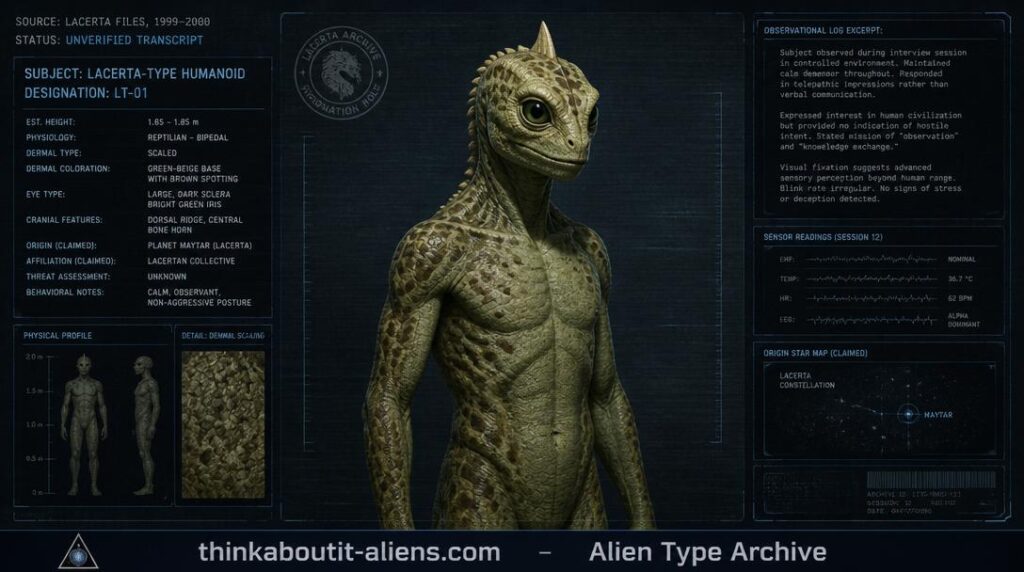
The Serpentine Reptilians, or Saurians — as described directly by "Lacerta" in the 1999–2000 interview transcripts.
THINK ABOUTIT’S ALIEN TYPE SUMMARY
SERPENTINE REPTILIANS
In the Think About It Alien Database, the Serpentine Reptilians draw primarily on the Lacerta Files, a widely circulated 1999–2000 transcript in which a Swedish man known only as Ole K. describes two interviews with a self-identified reptilian being named Lacerta. This entry preserves what that primary source actually says — including her explicit statement that her species is native to Earth, not extraterrestrial — and treats the separate, older tradition of the Naga in Hindu, Buddhist, and Jain mythology as a distinct, genuinely revered religious tradition rather than confirmed evidence of the same beings.
Name: Serpentine Reptilians
AKA: Saurians (self-designation, per the Lacerta Files); Nagas (a distinct Hindu/Buddhist/Jain religious tradition, discussed separately below); Amphisbaena (a two-headed serpent of Greek and Roman legend, not a reptilian-humanoid tradition — an earlier draft’s “Amphiptes” was a misspelling of this term and is not otherwise connected to this entry).
Location – Home System: Earth, per the Lacerta Files specifically. Lacerta states directly: “We did not come from the stars. This planet was ours long before humans existed. We evolved here.” An Alpha Draconis (Thuban) extraterrestrial origin is not part of the Lacerta Files and belongs to a separate, unrelated reptilian-conspiracy tradition.
Distance from Earth: Not applicable per the Lacerta Files, which describe an Earth-native species. Thuban (Alpha Draconis) is a real star roughly 303 light years away, but this figure has no documented connection to Lacerta’s account.
Attitude: Described by Lacerta as generally non-hostile toward humans but maintaining cautious distance, given what she characterizes as humanity’s aggressive tendencies. She does not describe her species as viewing humans as prey, resources, or temporary tenants.
Motives: Per Lacerta, coexistence and self-preservation through concealment, alongside covert contact with select human governments and scientists; she does not describe a goal of reclaiming the surface or managing humanity as a resource.
Physical Appearance: Per Lacerta’s own description: a bipedal, humanoid form with green-beige scaled skin marked by irregular brown spots, a pronounced dorsal ridge, and a small bone horn on the head in place of hair.
- Average Height: Lacerta describes her own species as roughly 1.6 to 1.8 meters (about 5’3″–5’11”); some secondary retellings of the interview cite a taller 6–7 foot range. The primary transcript’s own figure is the shorter one.
- Average Weight: Undocumented as a specific figure in the primary source.
- Body Temperature: Described as cold-blooded (ectothermic), per Lacerta.
- Pulse/Respiration: Undocumented as a specific figure.
- Blood Pressure: Undocumented.
- Life Expectancy: Described by Lacerta as far exceeding a human lifespan; no specific figure is given in the primary source.
- Hair: None; a small bone horn occupies a comparable position on the head, per Lacerta.
- Skin: Green-beige, with irregular brown spot patterns (denser and more extensive in females), per Lacerta’s own description.
- Eyes: Larger than human eyes, with large black pupils surrounded by a small bright-green iris (dark-green in males); slit pupils capable of widening to a full oval; a protective nictitating membrane, per Lacerta.
- Sex: Binary. Lacerta explicitly describes her species as having small breasts and external genitalia comparable in function to a human’s, and elsewhere describes nursing young — not oviparous (egg-laying) reproduction, contrary to an earlier draft of this page.
Other Physical Information: A non-prehensile tail and three primary claw-tipped fingers are described in some secondary summaries of the interview; these details vary somewhat between retellings of the transcript.
Special Traits and Abilities: Telepathy and a claimed limited ability to manipulate matter, per Lacerta. A venomous bite and a hypnotic “glance” are not documented in the primary source and were not located independently.
Communication Type: Verbal (in the recorded interviews) and telepathic, per Lacerta.
Origin: Earth-native, evolved from a dinosaur lineage, per Lacerta’s explicit statement. Not extraterrestrial in the primary source.
Life Form Type: Saurian humanoid, per Lacerta’s own term for her species.
Subspecies: Undocumented in the Lacerta Files. A “Royal Naga” (winged/crested) designation belongs to the separate Hindu/Buddhist/Jain Naga tradition, not to Lacerta’s account, and should not be presented as a subspecies of the same entity.
Most Common Species: Undocumented as a formal designation.
Level of Species: Undocumented; no numbered ranking system appears in the Lacerta Files or in Naga mythology.
Habits: A matriarchal, consensus-governed society organized in subterranean cities, per Lacerta — not the militaristic or caste-based hierarchy described in an earlier draft of this page.
Transportation Type: Lacerta describes advanced craft with cloaking capability, connected in the interview to broader UFO phenomena and, per her account, to the Roswell incident; no specific “shuttle” or “mother ship” terminology appears in the primary source.
Witnesses Reports: Ole K. and E.F. (pseudonymous), Sweden, December 1999 and April 2000 — the Lacerta Files. Naga traditions are documented separately across Hindu, Buddhist, and Jain religious texts spanning many centuries, independent of the Lacerta interviews.
Special Features/Characteristics: A forked tongue used for chemical/scent detection (a vomeronasal, or Jacobson’s organ) is described in some secondary summaries of the Lacerta material; this detail was not independently verified against the primary transcript excerpts reviewed for this entry.
Summary/Description: The Serpentine Reptilians of this entry trace primarily to the Lacerta Files, a widely circulated but unverified 1999–2000 transcript describing interviews with a self-identified Earth-native reptilian being. Lacerta describes her species as green-beige-skinned, roughly human-sized, cold-blooded, telepathic, and organized into matriarchal subterranean societies — explicitly denying an extraterrestrial origin. The Naga of Hindu, Buddhist, and Jain mythology are a separate, far older, and independently significant religious tradition; equating them with Lacerta’s account or with a hostile “ancient owner of Earth” narrative is a modern ufological reinterpretation, not an established historical fact, and this page does not present it as one.
Source: The Lacerta Files (interviews conducted by “Ole K.” with “Lacerta,” Sweden, December 1999 and April 2000; widely translated and republished, notably by Chris Pfeiler); Hindu, Buddhist, and Jain textual and cultural traditions concerning the Naga, treated here as a distinct subject.
Related Cases: The broader “reptilian humanoid” tradition in ufology, including the separate Alpha Draconis/”Draconian” reptilian-elite narrative popularized by other authors — a tradition with documented ties to antisemitic conspiracy structures in some of its variants, and one this entry does not adopt or endorse.
DETAILED REPORT
The Lacerta Files are a specific, well-documented (if unverified and widely disputed) piece of ufology history: a transcript, originally in German, attributed to a Swedish man using the initials “Ole K.,” describing two interviews conducted in December 1999 and April 2000 with a being who identified herself as “Lacerta.” The transcript — translated into English by Chris Pfeiler and republished across dozens of independent sites in the decades since — describes Lacerta’s species as an Earth-native, dinosaur-descended people living in subterranean cities, explicitly denying any extraterrestrial origin (“We did not come from the stars… We evolved here”). Skeptics have long noted the absence of physical evidence, recordings, or corroborating witnesses, and some researchers have suggested the text reads more like a work of speculative fiction than a genuine transcript; it is presented here as documented lore, not verified fact.
Several details in an earlier draft of this page directly contradicted the primary source. Lacerta describes her species as reproducing in a broadly mammalian manner — small breasts, functional external genitalia comparable to a human’s, and nursing of young — not as oviparous (egg-laying), as the earlier draft stated. She also explicitly denies an extraterrestrial origin, which contradicts the earlier draft’s claim of an Alpha Draconis (Thuban) home system; that association belongs to a separate and unrelated reptilian-conspiracy tradition, most associated with other authors, which in some of its variants carries a documented history of antisemitic conspiracy structure (the “reptilian bloodline elite” trope). This entry does not adopt that framework. Lacerta’s own described height (roughly 5’3″–5’11”) was also inflated in the earlier draft to 6’5″–8’0″, and her documented skin coloring (green-beige with brown spotting) was altered to a more dramatic “emerald green to dull copper or obsidian” range not found in the source.
The Naga of Hindu, Buddhist, and Jain mythology are a separate matter entirely, and deserve to be treated on their own terms rather than folded into ufology as retroactive evidence. Nagas are serpent deities and semi-divine beings with a long, rich, and still-living religious history — protectors of the Buddha’s teachings, guardians of sacred waters and treasure, ancestral figures for several royal lineages across South and Southeast Asia, and objects of ongoing devotional practice such as Naga Panchami. Treating this tradition as literal historical evidence for a hostile subterranean reptilian species is a modern reinterpretation specific to ancient-astronaut-influenced ufology, not a claim made within the traditions themselves, and this entry does not present it as settled fact.
The entire 2026 material — satellite gravimetry detecting “Geo-Crystalline Cities,” non-interference treaties between governments and Serpentine hubs, “glitch” videos of failing biological cloaks, and a present-day campaign to “reclaim the surface” — does not appear in the Lacerta Files, in Naga religious tradition, or in any other source located for this entry.
RESEARCHER’S NOTES
Two Traditions, One Page — Separating Lacerta’s Saurians From the Naga and the Draconian Trope
- The Lacerta Files are real, if unverified, ufology history: a specific, dated, widely republished 1999–2000 transcript exists and can be checked directly — this entry now reflects what it actually says rather than an inflated retelling.
- Lacerta explicitly denies the extraterrestrial origin the earlier draft asserted: “We evolved here,” not on a planet orbiting Alpha Draconis — this is one of the most direct, checkable contradictions found across this correction pass.
- The reproduction method was simply wrong: Lacerta describes mammalian-like reproduction with nursing young, not egg-laying; this is not an interpretive judgment call, it is a factual reversal of the source.
- The Naga deserve to be treated as a real religious tradition, not ufology evidence: conflating a living, revered Hindu/Buddhist/Jain tradition with a hostile alien-invader narrative reduces a serious belief system to genre furniture, and this entry keeps the two explicitly separate.
- The Alpha Draconis “reptilian elite” tradition carries real documented harm elsewhere in its variants: some versions of this trope have a well-documented history of antisemitic conspiracy structure; this entry notes that association for context but does not adopt or elaborate that framework.
The honest state of this entry is that it rests on real, if unverifiable, source material — the Lacerta Files — which this page now represents accurately rather than embellished. The Naga tradition is preserved as what it actually is: an ancient and still-practiced religious tradition, not evidence for Lacerta’s account or for any hostile subterranean species claiming ownership of the surface world.
“We did not come from the stars. This planet was ours long before humans existed. We evolved here.”
— attributed to “Lacerta,” The Lacerta Files, Interview I (1999)
About the Author