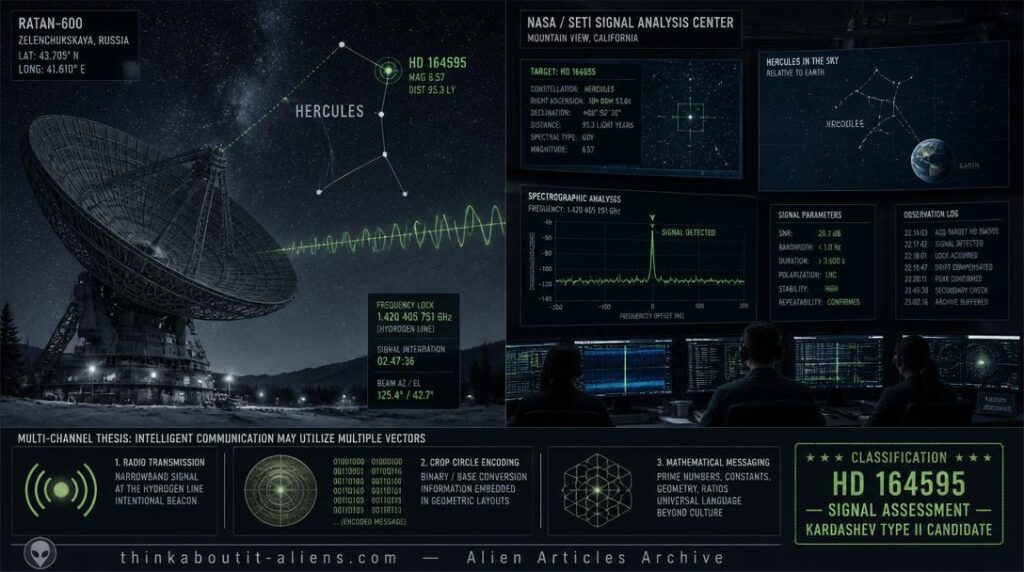
The HD 164595 signal event — Russia's RATAN-600 telescope detects a non-random radio spike from constellation Hercules while NASA and SETI monitor the spectrographic readout.
In late August 2016, an anomalous radio signal spike from the sun-like star HD 164595 — located in the constellation Hercules, approximately 95 light-years from Earth — sent ripples through both the mainstream astronomy community and the UFO research world. The signal was first detected by the RATAN-600 radio telescope in Russia, one of the largest radio telescopes on the planet, and was subsequently shared with NASA and the SETI Institute for analysis. What made the signal notable was not merely its strength but its characteristics: a non-random, concentrated burst from a star remarkably similar to our own sun, orbited by at least one confirmed planet — precisely the type of stellar system where the Drake equation predicts intelligent life is most likely to emerge. While mainstream astronomers cautioned that the signal could be terrestrial interference or a natural phenomenon, other researchers — including the team at Secureteam10 — argued that the signal’s profile was consistent with an artificial transmission from a civilization capable of harnessing stellar-scale energy output, placing the hypothetical source at Type II on the Kardashev scale.
This article situates the HD 164595 signal within a broader pattern of potential extraterrestrial communication attempts, connecting the radio spike to the appearance of binary code embedded in crop circle formations — a phenomenon that, while widely dismissed as hoaxing, has produced mathematically coherent binary sequences that researchers have interpreted as encoded messages. The author, C. Anthony, proposes that these represent three distinct communication mediums being deployed simultaneously: radio transmissions targeting scientific instrumentation, binary geometric patterns targeting ground-level observers, and the overarching pattern of coordinated outreach suggesting that extraterrestrial intelligence is not waiting to be found but is actively attempting to establish contact through multiple channels. Whether the HD 164595 signal proves to be artificial or natural, its detection — and the speed with which it was suppressed from mainstream coverage — represents a significant data point in the ongoing debate over whether the “Great Silence” is truly silence, or simply a signal we haven’t yet agreed to hear.
NASA and Russia Received Three Detailed Messages from Alien Planet: HD 164595
In an attempt, to reach Earth, an alien species sent out three detailed messages. NASA and Russia were the first to get them and the findings are beginning to baffle scientists.
NASA AND RUSSIA GET ALIEN MESSAGE FROM STAR
When astronomers first felt the spike in radio signals from a distant star, they were all too excited. The sources of this signal came from the sun-like star called HD 164595.
Not exactly a catchy name but that’s not the point here. This star is from constellation Hercules nearly 95 light years away.
However, other astronomers think NASA and Russia just received an alien message. It’s not the first time either.
NASA AND RUSSIA GET STRONG ALIEN MESSAGE THIS WEEK
UFO researchers Secureteam10 just reported that Russia and NASA detected a very strong mystery signal from space. Thanks to SETI, the search for alien life is heating up in a big way. SETI regularly monitors space for radio transmissions from potentially civilized societies.
On 8/29/2016, they found a strong signal that they think is artificial in nature. Furthermore, it’s coming from a sun-like star very much like our own.
This only increases the chance of finding intelligent life like here on Earth. If this was a stand-alone event, that’s one thing. However, it’s a part of a larger trend.
NASA AND RUSSIA FIND ALIEN BINARY CODE
We’ve all seen crop circles and for the most part, dismiss them as a childish hoax. However, there are far more to these creations than we give them credit for. There are a few different cases where researchers found a binary code in these crop circles.
According to them, this is a message from ET’s. What they are warning us about is uncertain but estimates range from invasion warning to a simple hello.
It looks like aliens are trying just as hard as we are to communicate. It’s only a matter of time before we establish contact.
By C Anthony
Executive Summary:
The HD 164595 Signal — A Radio Spike from Hercules, Kardashev Type II, and the Multi-Channel Contact Hypothesis
On August 29, 2016, a strong non-random radio signal was detected from the star HD 164595 in the constellation Hercules by Russia’s RATAN-600 telescope. The star is a near-solar analog approximately 95 light-years from Earth with at least one confirmed planetary companion, making it a high-priority SETI target. The signal’s power profile suggested either a highly focused narrow-beam transmission directed at our solar system or an omnidirectional broadcast of a magnitude that would require the energy output of an entire star — placing the hypothetical sender at Type II on the Kardashev scale of civilizational advancement. NASA and the SETI Institute were notified and began independent monitoring. Mainstream scientific consensus quickly gravitated toward terrestrial interference or natural astrophysical phenomena as the most likely explanation, and no repeat signal was detected in follow-up observations.
The article extends the HD 164595 event into a broader “multi-channel contact” thesis proposed by author C. Anthony: the argument that extraterrestrial intelligence is attempting to communicate with Earth through at least three simultaneous mediums — radio transmissions targeting SETI instrumentation, binary code embedded in crop circle formations targeting ground-level observation, and geometric patterns encoding mathematical messages. While this synthesis is speculative and the Secureteam10 source cited in the article carries acknowledged credibility limitations within the UFO research community, the underlying radio detection at RATAN-600 is a documented astronomical event that generated legitimate scientific attention. The article captures a significant moment in SETI history and raises the question of whether the institutional framework for evaluating potential alien signals is adequate to the task — or whether signals that don’t conform to expected parameters are systematically dismissed before they can be properly analyzed.
“When astronomers first felt the spike in radio signals from a distant star, they were all too excited. The source of this signal came from the sun-like star called HD 164595… from constellation Hercules, nearly 95 light years away.”
— C. Anthony (August 2016)
About the Author